Two hundred years ago today, Mozart’s Requiem was sung for Haydn (who had died on the last day of May) in Vienna’s Schottenkirche.
One Fine Insight from 1973
June 10, 2009

A memorable part of Leonard Bernstein’s Norton Lectures at Harvard, in which he gave a masterly elucidation of Mozart’s 40th Symphony, came when he recomposed the first movement as Mozart would have done had he been merely a master of musical materials and not a genius. Everything was perfectly thought-out, symmetrical — but without that spark of life that genius lends.
Ever since that revelation, I have now and then been struck by the same principle being displayed by a great variety of the best composers (whether or not to Mozart’s degree is another question) . To take an example that revealed itself to me a few days ago: Puccini’s “Un bel dì” from Madama Butterfly. It would be difficult to come up with a composer more distant from Mozart in many ways. But in the aspect of creativity that Bernstein was dealing with, they are blood-brothers. Here is a take-home assignment: look at or listen to “Un bel dì” and rethink it as perfectly well-behaved, very regular, tune. My efforts produced a perfectly charming tune for a popular song — which simply revealed why people are so enchanted with the much less predictable tune that Puccini came up with.
To take one example that occurs right off the bat: the mediocre composer (maybe me) might have ended the first phrase, “Un bel dì, vedremo” with “-mo” held for three beats and followed it by a perfectly balanced consequent phrase. But the conflicted Butterfly gets to sing something far more interesting. Just as she utters her “-mo,” the orchestra continues the melody immediately, to be joined by the unhappy geisha two beats later. There are so many intricate things going on here that reward close examination. But for now, I just want to register my delight at this general way of thinking, which I was led to years go by Bernstein’s infectious and intelligent love for Mozart’s great edifice in G Minor.
The song is “Unstoppable” by Santigold.
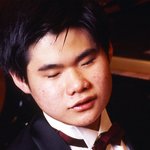 As noted here before (and by Anne Midgette elsewhere), the Thirteenth Van Cliburn International Competition has taken a fresh approach to its presentation of contemporary works. In the event, many of the competitors have told interviewers that they chose a work from the four possibilities based on what they thought they could learn in time. And who can blame them? John Musto‘s difficult “Improvisation and Fugue” thus was played by only one of the semi-finalists, Nobuyuki Tsujii. But that twenty-year-old not only took a gold medal but won the large cash award for the best performance of a contemporary piece for his crystalline interpretation of the Musto work. That he learned it in a short time and played it with confidence is a great tribute to him, and his winning shows the good judgment of the jury. He had been a clear audience favorite throughout.
The young Japanese pianist did not choose the Musto as his only challenging work by any means. He played hours of major works (including, among many other things, the Hammerklavier Sonata, a Schumann quintet, and concertos by Chopin and Rachmaninoff). He has been blind from birth.
The new work, which was commissioned by the Stecher and Horowitz Foundation for their own Fourth New York International Piano Competition held last summer, where it enjoyed some brilliant performances, can be heard in Nobuyuki Tsujii’s prize-winning version on Cliburn TV (at Semifinal Archive for May 31), and played by the winner of the Stecher and Horowtiz competition, Allen Yueh, here. You will want to compare the two quite distinct interpretations.
UPDATE: Nobu’s performance is now also on YouTube.
Who Blogs?
June 6, 2009
 I’m a fan of Richard Florida, not just for his ideas but for the ideas of other people that he leads me to. In his brief discussion of the blogger’s personality, he cites an article on creativity that I wish I had read decades ago. Why? Because it explains myself to me in terms that I have never before understood as well as its researcher does. I have a feeling that at least some others who visit here may have a similar experience.
Years ago when I was required to take the Myers-Briggs test, the professionals who gave me my interpretive interview were emphatic that my results were psychologically impossible. On every single trait that the test proposes to illuminate, I scored almost exactly (and in two instances exactly) in the middle. I was told that this was impossible.
Parents and educators might do well to read the Psychology Today article linked above when they find they have one of those puzzling, hard-to-classify kids on their hands.
Sweating the Small Stuff
June 5, 2009
 I found it rather endearing when Nicholas Kristof apologized yesterday on Facebook for a grammatical error in his column for Wednesday’s New York Times. My question, though, was: Shouldn’t it be the editors apologizing rather than the madly globe-trotting and cause-championing prolific writer?
So, while Kristof is removing the mote from his eye, I want to complain about the mote (admittedly not quite a beam) in a Times caption-writer’s eye. For some time now, I have been startled to see in that influential paper captions for photos of classical musicians that employ such locutions as “Krystian Zimerman on the piano.” The use of on there I take to be acceptable and idiomatic pop or jazz slang. The hitherto-customary “Krystian Zimerman at the piano” or, perhaps better, “Krystian Zimerman playing the piano” seems to me to represent usage worth maintaining — if only because portraying a much more artistically-healthy relationship between interpreter and instrument.
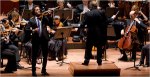
Today’s edition includes a review of Tim Fain (whom I knew as Timothy but notice that his own Web site now calls him Tim — which I think is fine, a fact that I hope indicates that I’m not just being a prig about classical-music conventions) and the Riverside Symphony. The photo has this caption: “George Rothman leading the Riverside Symphony, with Tim Fain on violin, on Wednesday, in their last program of the season.” Please.
(If you think I’m being just silly about this, feel free to say so, giving me your reason why. I’m willing — even eager — to be talked out of these irritating situations.)
Who Knew?
June 4, 2009
 Office choirs? The Guardian writes about them as though they are an everyday thing. Is this a trend I’ve been missing?
Bermel, Alarms, and the Red Fish
June 3, 2009
From time to time I have posted here press releases that were sent to me and which I considered to be of general interest. Here’s one of my own that I wanted to share with you:
(Le) Poisson Rouge
presents
Alarm Will Sound
playing
Music of Derek Bermel
Sunday, June 14, 2009
7:30 p.m. and 10 p.m.
Doors open at 6:30 p.m.
(Le) Poisson Rouge
158 Bleecker Street
New York, NY 10012
212-505-FISH
This unique evening begins a week-long recording project:
a full-length Derek Bermel album by Alarm Will Sound,
to be released this fall.
Alarm Will Sound is a 20-member band committed to innovative performances and recordings of today’s music. They have established a reputation for performing demanding music with energetic virtuosity.
The performances have been described as “equal parts exuberance, nonchalance, and virtuosity” by the Financial Times and as “a triumph of ensemble playing” by the San Francisco Chronicle. The New York Times says Alarm Will Sound is “the future of classical music.”
The versatility of Alarm Will Sound allows it to take on music from a wide variety of styles. Its repertoire ranges from European to American works, from the arch-modernist to the pop-influenced. The group fosters close relationships with contemporary composers besides Derek Bermel, premiering pieces by Steve Reich, David Lang, Anthony Gatto, Cenk Ergun, Aaron Jay Kernis, Michael Gordon, Augusta Read Thomas, Stefan Freund, and Wolfgang Rihm. Alarm Will Sound may be heard on three CDs so far.
The most recent release, Acoustica, features arrangements of music by Aphex Twin. This unique project taps the diverse talents within the group, from the many composers who made arrangements of the original electronica tracks, to the experimental approaches developed by the performers. Transforming music written for computerized equipment into live performance is precisely the kind of original, genre-bending challenge Alarm Will Sound actively pursues.
Members of the ensemble began playing together while studying at the Eastman School of Music, and with diverse experience in composition, improvisation, jazz and popular styles, early music, and world musics, they bring intelligence and a sense of adventure to all their performances.
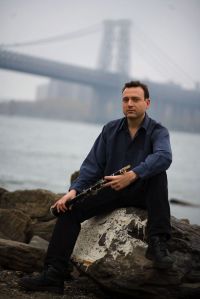
Derek Bermel is described by the Toronto Star as an “eclectic with wide open ears” and by the Pittsburgh Post-Gazette as “one of America’s finest young composers.” Both as composer and clarinetist, Derek Bermel has been widely hailed for his creativity, theatricality, and virtuosity. His works draw from a rich variety of musical genres, including classical, jazz, pop, rock, blues, folk, and gospel. Hands-on experience with music of cultures around the world has become part of the fabric and force of his compositional language.
Currently serving as 2006-09 Music Alive Composer-in-Residence with the American Composers Orchestra at Carnegie Hall, Bermel has received commissions from the Pittsburgh, National, and Saint Louis Symphonies, Los Angeles Philharmonic, the Chamber Music Society of Lincoln Center, WNYC Radio, eighth blackbird, the Guarneri String Quartet, Music from China, De Ereprijs (Netherlands), Jazz Xchange (U.K.), Figura (Denmark), violinist Midori, electric guitarist Wiek Hijmans, cellist Fred Sherry, and pianists Christopher Taylor and Andy Russo, among others. His many awards include the Alpert Award in the Arts, the Rome Prize, Guggenheim and Fulbright Fellowships, the Trailblazer Award from the American Music Center, the Academy Award from the American Academy of Arts and Letters, the Lili Boulanger Award, commissions from the Koussevitzky and Fromm Foundations, Meet the Composer, and residencies at Yaddo, Tanglewood, Aspen, Banff, Bellagio, Copland House, Sacatar, and Civitella Ranieri.
Last season Bermel performed as soloist alongside Wynton Marsalis in his Migration Series, a work commissioned by the Lincoln Center Jazz Orchestra and ACO. He also appeared as clarinet soloist with the Los Angeles Philharmonic in conductor/composer John Adams’ Gnarly Buttons, and as soloist in his own concerto Voices at the Beijing Modern Music Festival. The Philharmonia Orchestra also produced an all-Bermel concert as part of its Music of Today series at Queen Elizabeth Hall in London. Highlights during this season included the Pittsburgh Symphony’s premiere of The Good Life for chorus and orchestra, and a return to Carnegie Hall for two premieres: a Koussevitzky Commission for ACO conducted by Dennis Russell Davies, and as soloist in the world premiere of Fang Man’s clarinet concerto.
Beginning in Fall 2009, Bermel will serve as composer-in-residence with the Los Angeles Chamber Orchestra and as artist-in-residence at the Institute for Advanced Study in Princeton. Voices, a recently released disc of his orchestral music on the BMOPsound label, received a rave from the New York Times and was hailed as “magnificent” by the San Francisco Chronicle.
Bermel holds B.A. and D.M.A. degrees from Yale University and the University of Michigan. His main composition teachers were William Albright, Louis Andriessen, William Bolcom, Henri Dutilleux, André Hajdu, and Michael Tenzer, and he studied clarinet with Ben Armato and Keith Wilson. He also studied ethnomusicology and orchestration in Jerusalem with André Hajdu, later traveling to Bulgaria to study Thracian folk style with Nikola Iliev, to Brazil to learn caxixi with Julio Góes, and to Ghana to study Lobi xylophone with Ngmen Baaru. His music is published by Peermusic Classical (North/South America & Asia) and Faber Music (Europe & Australia).
(Le) Poisson Rouge invites you to immerse yourself in a nightlife of true substance and vitality. Bring open mind and drinking shoes.
On the Web:
(Le) Poisson Rouge: http://lepoissonrouge.com/events/view/147
Alarm Will Sound: http://www.alarmwillsound.com
Derek Bermel: http://derekbermel.com
 RogerEvansOnline.com