Heresy?
September 26, 2011
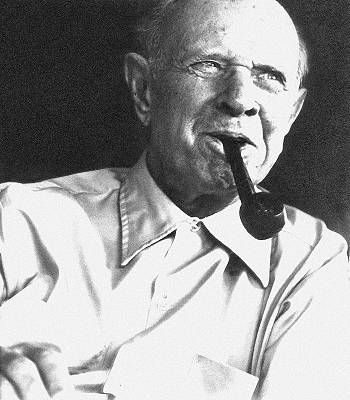
Why is this man smiling?
The cellist of eighth blackbird writes:
… we’re living in a time where Pablo Casals, still considered the best cellist who ever lived ever by many, would have struggled to get into an undergraduate conservatory …
Do you agree? Why or why not?
Grey Skies Smilin’ at Me
September 25, 2011
“Don’t you like a rather foggy day in a wood in autumn? You’ll find we shall be perfectly warm sitting in the car.”
Jane said she’d never heard of anyone liking fogs before but she didn’t mind trying. All three got in.
“That’s why Camilla and I got married, ” said Denniston as they drove off. “We both like Weather. Not this or that kind of weather, but just Weather. It’s a useful taste if one lives in England.”
“How ever did you learn to do that, Mr. Denniston?” said Jane. “I don’t think I should ever learn to like rain and snow.”
“It’s the other way around,” said Denniston. “Everyone begins as a child by liking Weather. You learn the art of disliking it as you grow up. Noticed it on a snowy day? The grown-ups are all going about with long faces, but look at the children – and the dogs? They know what snow’s made for.”
“I’m sure I hated wet days as a child,” said Jane.
“That’s because the grown-ups kept you in,” said Camilla. “Any child loves rain if allowed to go out and paddle about in it.”
— C.S. Lewis, That Hideous Strength, Chapter 5 “Elasticity” (1946)
Lewis wrote somewhere else that a person who lives in England had better learn not to speak of the sky as merely grey but to distinguish between shades of grey. He thought the infinite varieties of English weather worth noticing and describing in detail and with subtlety. British composers seem not to have needed that advice, since we’re now told that they are twice as likely to have written music with meteorological themes than their foreign counterparts.
On Your Mark!
September 25, 2011
Iain Burnside discusses the Wigmore Hall International Song Competition, and the problem of music competitions in general.
Sensation in Musicology
September 24, 2011

Alex Ross retails the “top ten titles” for papers at this fall’s Annual Meeting of the American Musicological Society:
Francesco Dalla Vecchia, “Sopranos Gone Wild: Flashing in Seventeenth-Century Venetian Opera”
Craig Monson, “‘How Do You Solve a Problem Like Maria?’ — ‘They Would Claw Each Other’s Flesh If They Could’: Conflicting Conformities in Convent Music”
David Kasunic, “Beethoven in the Background: Music and Fine Dining in Nineteenth-Century France”
Amanda Eubanks Winkler, “High School Musicals: Understanding Seventeenth-Century English Pedagogical Masques”
Rachel Cowgill, “Filling the Void: Theosophy, Modernity, and the Rituals of Armistice Day in the Reception of John Foulds’s A World Requiem”
Jessica Wood, “An Old World Instrument for Cold War Diplomacy: The Touring Harpsichord in 1950s Asia”
Elaine Kelly, “Late Beethoven and Late Socialism in the German Democratic Republic”
John Howland, “Nobrow Pop in the New Millennium?: Nico Muhly and Post-2000 Chamber Pop”
Paula Higgins, “Josquin and the Dormouse: Aesthetic Excess, Masculinity, and Homoeroticism in the Reception of Planxit autem David”
Joseph Auner, “Weighing, Measuring, Embalming Tonality”
It happens that this year is the first time I’ve ever had a paper proposal turned down for the Annual Meeting. Clearly I have not kept up with the times in terms of sexy, provocative titles! (Compare the list above with the title in the illustrated 1986 Journal.)
UPDATE: My notifying the AMS List of Alex Ross’s Top Ten List brought on correspondence that caused him to make an addendum to the Ten.
A Public Service
September 22, 2011

Your humble servant, author of Music & Power, is hardly inclined to dispute the mixing of music and politics. Quite aside from the exact details of the London disruptions of the Israel Philharmonic concerts, and the firings from the London Philharmonic Orchestra, the principles that Tom Service lays out here are of great importance.
Traduttore = Traditore
September 21, 2011

First a few quotes, the first concerning how much trust we should put in certain kinds of news reports:
A report of the latest speech by the Iranian president … could … be attributed to a named journalist’s adaptation of a Reuter’s English-language wire originating in Kuwait based on a report in Arabic from Al Jazeera which had provided the information from listening to a radio broadcast in Farsi from Teheran.
The second pertains to a past disaster:
Bellos attributes the outbreak of the Franco-Prussian War of 1870 to the false cousinage of the German word Adjutant, which referred to a high official, and the French adjudant, which meant only ‘sergeant-major’. When Bismarck announced that the French ambassador had been dismissed by a message from the Kaiser delivered by his Adjutant vom Dienst, Napoleon III took great (and calamitous) offence at his representative being seen off by what he assumed to be an NCO.
And here’s one last passage, dealing with one of translation’s greatest landmarks:
Not until the Pentateuch was translated into Greek, in the third century BC, by seventy-two bilingual Jews, did it reach a wide audience. Bellos says that they did their miraculously harmonious work in Paphos on Cyprus. Unless Bellos has new information, tradition has it that the scholars were sequestered on the lighthouse island of Pharos, a suitable spot for those whose work was destined to be a light to the Gentiles.
If those subjects appeal to you, you’ll eat up this review, and very possibly the book it treats.
What is Music Notation For?
September 20, 2011
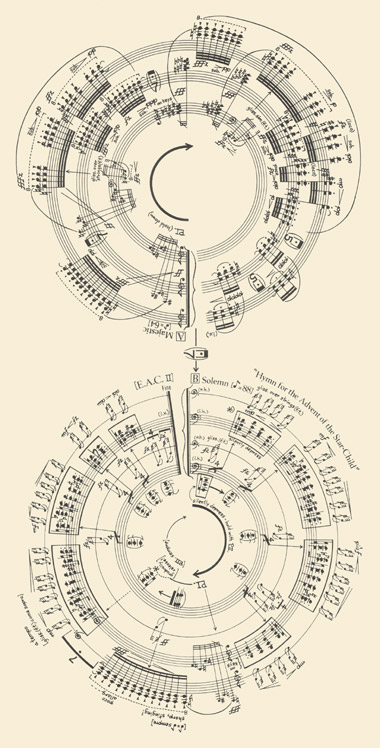
Dennis DeSantis is intransigent. He has had it with elaborate scores that add nothing to the aural result but complicate the musician’s task. In a clear and easy-to read article, he declares:
Notation should be considered a set of instructions for performers. And nothing else.
Couldn’t He Have Thought of Something More Original?
September 16, 2011
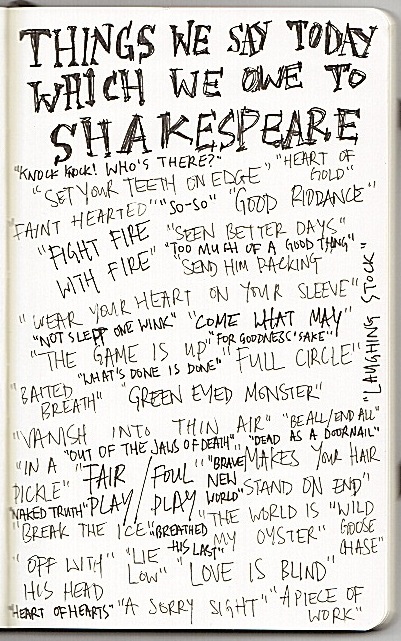
Oh, wait. According to Random House, they were orginal when he said them. But you knew that.
 RogerEvansOnline.com