Two Kinds of Writing (and Reading?)
January 28, 2008
 The day after this Web site began, Publishers Weekly came up with an article on the difference between writing online and writing a book.
Thinking About Bach at the Keyboard
January 28, 2008
 The Italian Concerto and the “Goldberg” Aria with Variations were meant to show two different approaches to music for the keyboard. Though Bach published little in his lifetime, he did see to it that both these works were issued in his summa on keyboard technique, the four-volume Clavier-Übung (Keyboard Study). Here is the layout of the volumes:
I. Six Partitas (suites of dances), 1731
II. Italian Concerto and French Overture, 1735
III. Organ compositions: chorale-preludes, two-voice pieces, and the “St. Anne” Prelude and Fugue, 1739
IV. “Goldberg” Variations, 1741–2
The Italian Concerto is the ultimate product of one of Bach’s long-term projects: to transplant to German music the concerto style as the Italians had developed it. A major result was his many concertos that set soloists in relief against orchestra; but even more inventive were Bach’s efforts, between 1708 and 1717, to devise concertos that a keyboard player could perform without an orchestra. The seven organ examples included three that were transcribed from the composer who represented the avant-garde of concerto-making, Antonio Vivaldi. They used the smaller organ division nearer the hearers (the Rückpositiv) for the concertino solo parts, and the larger, higher-up division (Oberwerk) for the full-orchestra ripieno; thus could one player perform a whole concerto.
During the same period, Bach was experimenting with sixteen “concertos” for clavier alone, six of which were also arranged from concertos by Antonio Vivaldi. In these he went yet a step further: he removed the concerto’s usual element of spatial contrast and trusted the player to provide even that illusion by skillful use of purely keyboard resources. The naturalization of Italian orchestral techniques to the German keyboard could go no further — except by producing his own completely new “Italian” concerto. And by 1734 Bach was so fluent in the modern Italian style that he could confidently call an original work, in an engraved and published book, an Italian Concerto, when it was neither from Italy nor with orchestra. Metaphor and illusion in music can go no further.
Tomorrow: the “Goldberg” Variations
Mozart’s Birthday
January 27, 2008
Eye Hath Not Seen, Ear Hath Not Heard
January 26, 2008
 Newly-concocted links between music and visual arts can be tricky. Of course, when they really work they pay great dividends. I wish I could have seen/heard one such manifestation last week: The endlessly inventive young composer Huang Ruo had a premiere at the North Carolina School of the Arts, in which both the music and the “performance” of painting took place in real time. Perpetrated by the merely opportunistic, such a device could just amount to a gimmick, but in responsible hands — as in this case — it seems a promising idea.
Winter Dreams
January 25, 2008
 The Philadelphia Orchestra’s bringing Tchaikovsky’s first symphony to New York amounts to innovative programming, since concert-goers are so accustomed to the more emotionally complex later symphonies. I’m taking it as an excuse to revisit that fresh work myself.
TCHAIKOVSKY: SYMPHONY NO. 1
However much Tchaikovsky extended and refined his musical vision through the years, he never ceased to refer affectionately to the “sweet sin of my youth” that was his First Symphony. Just before he set about composing it, he had spent a good deal of time at the piano with symphonies of Mendelssohn. They showed the young Tchaikovsky that an intensely personal Romantic vision could be reconciled with symphonic procedures. Mendelssohn’s “Italian” and “Scottish” Symphonies in a sense gave permission for the emotional outpourings of the symphony Tchaikovsky called “Winter Dreams.”
But those outpourings were a little too spontaneous — and far too copious — for Tchaikovsky’s friendly but outspoken critics. The descriptive atmosphere of the music fortunately survived the extensive revisions that followed, calling forth much admiration from Russian audiences. The work then went unheard, except as an occasional curiosity, until the latter half of the 20th century; but both it and the Second Symphony highlight facets of the composer’s musical personality that appear in a very different light in the later symphonies.
Read the rest of this entry »
Not So Fast
January 24, 2008
 Sunday’s New York Times devoted much of the front page of the Arts & Leisure section, plus an entire inner page, to a theme that has been on my mind all week. The piece in question told the compelling story of two ambitious opera-creators who worked for seventeen years to achieve a first production, losing masses of cash in the process. There were many insinuations and outright claims that opera is a moribund, unprofitable medium for all concerned. My first thought was pretty much “Poppycock,” and so were my eighteenth and nineteenth.
Not only are opera companies proliferating in this country in a manner that is unprecedented, but the welcome accorded new operas was drastically underplayed by Sunday’s writer. I know personally several composers who are prospering conspicuously in that métier. And a writer with a respected musical-theater history, who has just finished his fourth libretto for well-placed opera projects, tells me that he sees no reason to rely on the uncertainties on Broadway and Off when he can dwell in operaland, where, to his visible gratification, operas get commissioned, produced, and paid for reliably.
I can give an example, not randomly or remotely, but as a close-up witness to the work of a particular friend. He had his first opera produced in 2004 with great success. That opus has already had a second new production (both done by name directors with casts of rising young stars who have continued to rise high), and this second production will soon result in the release of a commercial recording of the work. This same new opera composer then had a conspicuous success with his second opera, in November (subsequent productions of which are in the offing), will see the premiere of a third, a one-acter, in New York in March, and has the commissions for more operas backing up. Depite the fact that he is active as a performer and composes in other forms, he already makes a good living as a composer of operas that, furthermore, employ plenty of other people who get paid.
So, while the thrills and chills in the tale of intemperate behavior, betrayal, and thwarted ambition in Sunday’s Times are undoubtedly true and representative of certain trajectories, they’re not the whole story. Every art, every medium, and every function within that medium have their pitfalls. But there is success to be found, satisfaction to be had, and not inconsiderable money to be made in creating opera still. And from what I know of some of these folks, it’s only going to get better.
If Musical Erudition Were All
January 23, 2008
 A formidable social commentator has long since assured us that “Ignorance is like a delicate fruit; touch it, and the bloom is gone.” In reading two biographies of Noël Coward and his diaries, I had been struck by his frequent witty barbs aimed at classical music, its composers and performers. Such evident hostility, which sometimes also revealed a remarkable ignorance, was interesting to me only because it proceeded from someone who had absolute mastery of one corner of an art that he otherwise seemed largely to despise. But poses adopted for effect are not unknown among the epigrammatic.
Now comes the currently-celebrated collection of his letters, and I think I understand his position a little better. For the first time, I learn that this much-carressed son of a doting stage mother had auditioned for the choir of the Chapel Royal and been rejected. There were unmistakable signs that the failure rankled permanently. Even in old age, he was to contradict energetically any impression that his voice had been the problem by asserting that his “performance had been too dramatic.” But the truth is that his musical education had been too spotty. Singing in his local parish choir and taking the available singing and dancing lessons did not give him the skills (crack sight-singing among them) that the Chapel Royal would have been looking for. With the whole kingdom as a talent pool, it must not have been difficult to find a supply of boys with far more musical cultivation than little Noël had been afforded. It is tempting to see it as our good luck that Coward’s very individual genius was not to be spoiled by membership in such a disciplined crew — until we recall that no less an original than Sir Arthur Sullivan was proud till his dying day of his musical upbringing as a “Child of the Chapel Royal.”
Coward’s father was an occasional seller of pianos who was not able to provide lavishly for his family, and Coward used to boast that his entire education had come from the stage, his activities as a child star constituting a full-time job that left no time for conventional schooling. To go, and that pretty swiftly, from lower-middle-class provincial life to being the confidant of royalty (something else that, ironically, might have been less likely had he served the Crown as a chorister) effectively mirrors his musical education. He jumped from living among some of the kinds of socially backward characters that the men of Monty Python have immortalized to ruling among the elite of international theater and hereditary aristocracy, without ever knowing, as an equal, much of what lay in between — scholars or scientists, say. For one who “dearly loves a lord,” it is a great thing to be guest of the titled, but a far greater to be their host, as Coward frequently was. Similarly, he could go from being unfit for membership in a good choir to being the unequaled master of his own musical specialty without stopping at the rigors and delights that ordinarily mark such a journey.
When we learn from the mother — a fact, so far as I know, never acknowledged by Coward — that his paternal grandfather had been the accomplished organist of the Crystal Palace without of course achieving anything like the celebrity and wealth of a Noël Coward, we may learn a good motive for his understandably valuing his own less conventional musical route to fame and fortune. It is, after all, his letters and not those of his hard-working grandfather that are now collected in a best-seller.
As late as 1949, Coward was still dealing with the Chapel Royal setback. In a letter to a journalist he protested that, however much his singing as a boy may have been undervalued by those snooty professional musicians, it “on one occasion moved the ex-Queen of Portugal to tears.”
Take that, Arthur Sullivan!
Happy Birthday to Her
January 22, 2008
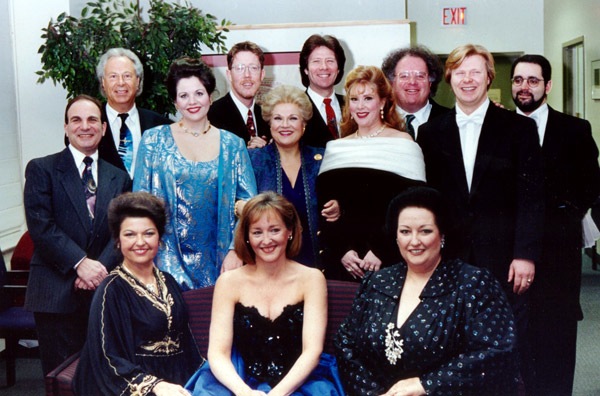
 Today in Carnegie Hall begin the always-much-anticipated celebrations of Marilyn Horne‘s birthday. These annual events have been a highlight ever since her downright historic sixtieth birthday concert in 1994. Carnegie Hall (of which she has long been a valuable board member) begins this year’s extensive and varied program this evening with one of Marilyn Horne’s patented master classes, in which she seems to incarnate several centuries of knowledge and experience. While she’s changing the singing of young performers before our eyes, we glimpse insights into the musical choices that have governed her own career. The festivities, continuing through the rest of the week, exemplify the year-round aims of The Marilyn Horne Foundation, a hard-working goal-oriented project worthy of its stupendous namesake.
Here’s my take on her important 1999 birthday celebration, from Opera News: horne.pdf
 RogerEvansOnline.com