Musica Sacra 2.0
April 9, 2008
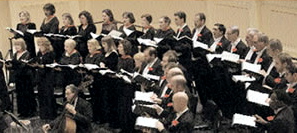 Passing the torch is not always a simple matter (as the sponsors of the Beijing Olympics can testify), but the sad loss of Richard Westenberg at least leaves behind a worthy successor in Kent Tritle.
Last night in Carnegie Hall, Tritle conducted his first concert as music director of Musica Sacra, and it was, most appropriately, Bach’s B-Minor Mass, sung in memory of Westenberg.
How different are things now than when Westenberg began developing the ensemble in the 1960s! By the ’70s, his concerts had become the great hope of New Yorkers who wished for some local choral manifestation of international early-music advances. It lends some perspective to recall how, 40 years ago, the senior music critic of the Times publicly expressed indignation when Thomas Dunn committed the outrage of performing the B-Minor Mass with a chorus of only 16 and an orchestra of 24 (when nowadays we sometimes hear it with only one singer or player on a part). No doubt carrying out Westenberg’s original goals, in this changed marketplace of options, will not be a matter of simply preserving in amber all of his practices. He would have been the first to protest against that. But matching his successes is a worthwhile goal, no matter how altered the environment.
Kent Tritle has become the leading force in a complete range of choral concert music in the city, through his superb concert work at St. Ignatius Loyola’s on Park Avenue and with secular choruses that include the Oratorio Society of New York. A healthy Musica Sacra will bode well for the whole commonwealth of music. And surely no one is better equipped to see to that health than Kent Tritle.
Russian Roulette
April 5, 2008
 It has been a good week for the Russians in New York. The night after Hvorostovsky’s big recital in Carnegie Hall (after which a friend said it is becoming essential to learn Russian if we’re to overhear the good gossip at the best music events), I finally made it to The Gambler at the Met last night. Going with a colleague who had already seen this very production in St. Petersburg was an advantage, since I haven’t known this opera at first hand. It’s another musical world from War and Peace, which is in a different galaxy again from Betrothal in a Monastery. Speaking as someone who first became convinced of Prokofiev’s operatic genius by seeing the sparkle of A Love for Three Oranges at the English National Opera and then at the Minnesota Opera, I was unprepared for the authentically Dostoyevskian Styx that he gave himself to in The Gambler.
There are two other performances left, including next Saturday’s broadcast. If you want a thoroughly well-performed drama (characterized by the committed and skilled presidial skills of the estimable Gergiev) with a first-rate mostly Russian cast, I recommend this highly.
Banquetto Musicale
March 30, 2008
 You may have noticed that we live in a time of publicity. But many worthwhile events succeed while remaining independent of the massive media-saturation.
Read the rest of this entry »
Television Too
March 24, 2008
 And it’s not just digital music downloads. The current Atlantic has a stimulating article on how the experience of the music industry may inform the coming revolution in the television/online axis. Given the enormous boost that the online rush has given to niche markets, its coming hybridization with TV presents major opportunities for classical music.
Who will be ready to take advantage of this? Whatever happens to the global economy, providers of compelling media content will continue to prosper, for the highly legitimate reason that even hard times — especially hard times — require it. (See the Hollywood film industry during the Great Depression for an extreme precedent.)
So it’s possible to be worried and optimistic at the same time.
Price-Point Counterpoint
March 22, 2008
 Most of the talk about the enormous impact of digital downloads of music is understandably about the kinds of music that have the gargantuan, immediate, short-term impact — that is, that elite, tiny percentage of mega-selling popular musics that dominate the airwaves and the iPods of the known world.
There is much to be said about the special requirements of and opportunities for the usually longer 99-cent “songs,” as they are called in the iTunes world, that consist of a movement of a Bruckner symphony or hunk of a Glass opera. But I’m struck by the new power demonstrated by a paragraph in today’s New York Times — a kind of power I haven’t seen much discussion of. A review of a piano recital tells us that
Improbably, on the day of its release, March 11, his “Art of Fugue” recording went to the top of the classical music charts of both Billboard and iTunes. It was featured on the iTunes home page, along with Snoop Dogg and U2. What better proof that the availability of classical music on the Internet is attracting curious new listeners?
What is said of “curious new listeners” is undoubtedly true. But I’m a listener who already owns several recordings of Die Kunst der Fuge, and I’m fascinated by the effect that those several sentences, as I was reading them online before it was daylight outside, had on me. The effect has implications for my musical life, for the music industry (if the accurate but to-some-off-putting word may be pardoned here), and for a truly global economy.
Read the rest of this entry »
Facial Profiling
March 19, 2008
 The other day we heard of a new experiment in recreating Bach’s face. Now comes something possibly even more exciting: a newly rediscovered portrait of Mozart, which seems to have been painted from life when he was twenty-seven.
It’s About Time
March 18, 2008
 Once I was part of a small theater party that included one of the world’s most famous singers. The play was Romeo and Juliet in a remarkable production. It struck me forcibly that the director’s creativity revealed itself most vividly in manipulation of small-scale time. Everything — every word, every action — happened at the most telling moment, and not always the most obvious one.
At intermission I mentioned this to my companions, making the commonplace observation that these devices couldn’t be employed in opera, since the exact plotting of when things happen is the most basic given of the composer’s contribution to opera. It is imperious, non-negotiable.
The eminent singer recounted a particularly clear illustration of this. She was starring in a German production of an opera based on an important play. For a substantial period, the director rehearsed the singers as though they were non-singing actors. No music. Just word and action. It was, the diva told me, a memorably thrilling experience, and they all felt that this would result in the dramatic coup of their careers.
Then they added the music. “It all went right down the drain. All that work had produced results that we couldn’t use.” The reason, of course, was the temporal element. A gesture that had been searingly telling in passing could not be sustained over the long seconds, or even minutes, that the music accompanying/amplifying it would take. And there was nothing that could be done about the time the music required. Everything else had to accommodate it.
I’ve never seen a production of Victor Hugo’s Hernani, but last night at the Met I saw Verdi’s opera based on it. It was a thrilling evening that had nothing at all in common with realistic drama. In all the exciting efforts to bring the insights of legitimate theater to the operatic stage that occupy us these days, I hope we don’t forget the limits of what that can accomplish. We could ruin what is best about the special dramatic world that the opera Ernani inhabits by importing from another medium devices that are foreign to the uncompromising temporal character of early Verdi, in which a single emotion can occupy a good chunk of time, and will do so rewardingly only if we give in to the unrealism of it.
But I’m not really worried. Opera, like any other performing art is success-driven, not to say success-dependent. If something doesn’t work, we’ll be forced back to what does. Opera has its own version of the “free market,” and it won’t brook contradiction or defiance for long. So bring on the experiments, I say! Opera is clearly around for the long haul, and time is on our side.
 RogerEvansOnline.com