I STILL Hear America Singing
March 23, 2009
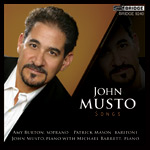 Bridge Records is just about to release Songs of John Musto. Here are the liner notes that I wrote for the disc:
Has there ever before been a place or time that offered such glorious opportunity as American song now enjoys? The widest possible field seems to be open to it. Not only do its practitioners feel free to use classical tonality in its many guises, but all of post-tonality and post-post-tonality are at their disposal as well.
Since at least Debussy and Vaughan Williams, our more cultivated composers feel free even to try medieval modes anytime they desire such variegated colors and more muted harmonic functionality; and every Western and non-Western culture now offers itself as a quarry ready to be mined — with universals like the pentatonic scale on the one hand and the specialized colors of local idioms on the other. While all this certainly represents a rich gift to our composers, it also calls for an unprecedented discretion, demanding taste judgements that even a stylistic eclectic like Bach — whose music could speak Italian, French, or North German as his muse dictated — might have found challenging.
Read the rest of this entry »
Quiet Zone
March 10, 2009

The contents of this space are usually so preoccupied with music that silence may get short shrift. This fact has been brought home to me by being placed in the midst of a few days’ quiet in what, for a touch of mystery, I will call an undisclosed tropical location.
I wonder how many others are in my situation. Without giving it much thought, I have spent a whole year continuously in urban environments — my usual place of residence being the über-urban island of Manhattan. After just a few days in this Eden where the loudest sound is made by the waves of a calm gulf, one feels as though a RESET button has been pushed. And how.
Getting back, already, to our habitual topic, I have to say that music sounds different somehow. Thanks to the miracles of iPod, the Naxos site, and other such modern dispensations of a gracious heaven, I can invoke practically any music I think of whenever I want it. And that’s a superb state to be in.
But I’m more surprised to be reminded what a different occupation reading becomes in an environment like this. It seems to have a completely different function from that of reading on a subway or reading while waiting for (or dreading) the phone’s ring. While that may not seem a particularly surprising reflection, who reflects on such things in the midst of all the din we so easily become accustomed to?
A most peculiar phenomenon I’m experiencing (and I hope this reveals no pathology) is that I keep seeing inanimate objects (a beach umbrella, a potted plant on a pedestal, a lamp-post) out of the corner of my eye and then looking to see what person it is. So accustomed to being surrounded by an infinity of human beings, my brain seems habituated to assuming that shapes are human until being demonstrated to be otherwise. This is curious. And it even happens over and over with the same objects.
Perhaps most thrilling of all is rediscovering the wonder that is sleep. Accustomed as I am to regarding sleep as an inconvenience that reduces the amount of enjoyment or work that one can get done, or as something to feel guilty for not getting enough of, it is a profound joy to be reminded that the aforementioned sound of the waves breaking has a completely different effect on the sleeping organism than rattling trucks, accelerating buses, or screaming fire engines produce. To wake from a sleep that is not merely reparative but that seems in retrospect to have been almost consciously enjoyable is a sensation to be treasured.
Ah! the delicious silence!
Now I have a Mahler symphony I want to hear with my restored ears.
Sleeping Beauty
March 2, 2009

Over the years, I’ve had many a reason for gratitude to the Metropolitan Opera. Tonight, thanks to the premiere of the new production of La Sonnambula, I can add the discovery within me of hitherto unrealized stores of willing suspension of disbelief. I had heard many complaints beforehand (mostly from people who were at the dress rehearsal, but also from two Met ushers who independently told me that the production was a mess), so at least I had the advantage of being forewarned. The recasting of the plot made no sustained sense whatever (which is strange, since the whole reason for ignoring the libretto’s plain sense was the supposed unbelievability of the opera’s simple little story).
But I had a great time on account of the music and the two leading performers. I’m also unashamed to admit that there were entertaining distractions for me in the wildly incoherent direction — like when, in a moment of chaos, the prompter was dragged out of her box to join the cast onstage.
I’ve already hymned Dessay and Flórez sufficiently here and here. And, about this time last year, I posted pieces on how the development of Chopin’s melodic style makes complete sense only in light of Bellini’s operas. These are, as it happens, among the most-visited postings on this site. (Somebody must have linked to them somewhere.) They can be see here and here. I bring them up now because it struck me tonight that, whereas in the past a pianist might safely look to bel canto singers for a guide to the cantabile that every pianist worth his salt pursues, nowadays the reverse might be requisite. Namely, we probably have more Chopin pianists who understand the long melodies and arc-shaped phrases of the idiom than we have singers who have mastered them.
What I like about the two principals tonight, however, is that — while some cavil at the timbre or size of their voices — they sing with a musicality that I’m convinced Bellini and Chopin would have recognized.

Peace/War, Old/New, Barcelona/New York
February 22, 2009
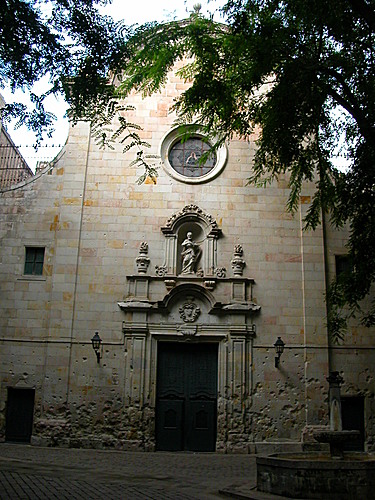
I first heard the now-famous Hespèrion XXI more than twenty years ago in a not very large church in an evocative little square near the cathedral in Barcelona. They were not world-famous then, and I kept wondering during that concert how they would go over in New York. The wild applause at a 9 o’clock concert in Alice Tully Hall tonight, on the first evening of the Hall’s formal opening festivities, certainly answered that question.
But, as I sat in the sparkling new concert room, I couldn’t help meditating on abounding ironies. The church where I first heard them, dedicated to Sant Felip Neri (whose first oratory, in Rome, gave us the term oratorio for the new kind of sacred stories in music performed there), is on the edge of the old Jewish quarter (the Call), and tonight Hespèrion was performing a whole concert of Jewish music of the Sephardic Diaspora. (And it was only two weeks and two blocks away that I heard The New York Festival of Song serving up their own feast of Diaspora repertory.)
Read the rest of this entry »
Alice Tully Hall 2.0
February 17, 2009

Alice Tully Hall, the last of the original Lincoln Center venues to open, was so inseparably — and justly — associated with the woman for whom it was named that it used to seem unimaginable that there would ever be a day when she did not preside from her box there. This was not a case of a magnate giving money on the condition that the hall be named for the donor — an unedifying epidemic of which New York seems to see no end of in recent years. (It’s largely a new practice; even Carnegie Hall was known simply as the Music Hall until after its builder’s death.) Instead, a woman who had tirelessly supported chamber music for many decades held out for a certain kind of chamber-music hall in the new complex that the tirelessly-building Rockefellers (after first demolishing on a vast scale) were pushing through on the site of another famous, if fictional, West Side Story. It opened forty years ago and served us for many events for which it was suited and many for which is was not so well-appointed.
This evening I heard the first pre-opening tryout of various kinds of music with a full crowd inside the radically rebuilt hall. All I can say is that we’re in for a real treat for years to come at the corner of Broadway and 65th. What Miss Tully would have thought of her much-revised home for chamber music many will no doubt try to imagine. What I felt was genuine delight in an attractive and acoustically glowing room.
UPDATE: The New York Times, New York, and The New Yorker.
Gramophone Banquet
February 13, 2009
 Many readers will be very pleased to learn that the invaluable Gramophone magazine has now archived all its numbers from 1923 to the present issue. Just as fortunately, they offer the articles not only as digitalization of the original graphical page but also in searchable text.
This is a feast many of us will delight in. The problem, as I see it, is that classical-music lovers now confront a consumer of hours that may actually rival YouTube.
Hmm
February 8, 2009
 It’s surely striking that Lincoln, Darwin, and Mendelssohn were born within a few days of each other.
Let’s Hear it for Those Old Piano Teachers
January 28, 2009
 “When I was a boy, the bestselling books were often the books that were on your piano teacher’s shelf. I mean, Steinbeck, Hemingway, some Faulkner. Faulkner actually had, considering how hard he is to read and how drastic the experiments are, quite a middle-class readership. But certainly someone like Steinbeck was a bestseller as well as a Nobel Prize-winning author of high intent. You don’t feel that now. I don’t feel that we have the merger of serious and pop — it’s gone, dissolving. Tastes have coarsened. People read less, they’re less comfortable with the written word. They’re less comfortable with novels. They don’t have a backward frame of reference that would enable them to appreciate things like irony and allusions. It’s sad. It’s momentarily uphill, I would say.
“And who’s to blame? Well, everything’s to blame. Movies are to blame, for stealing a lot of the novel’s thunder. Why read a novel when in two hours you can just go passively sit and be dazzled and amazed and terrified? Television is to blame, especially because it’s come into the home. It’s brought the fascination of the flickering image right into the house; like turning on a faucet, you can have it whenever you want. I was a movie addict, but you could only see so many movies in the course of a week. I still had a lot of time to read, and so did other people. But I think television would take all your day if you let it. Now we have these cultural developments on the Internet, and online, and the computer offering itself as a cultural tool, as a tool of distributing not just information but arts — and who knows what inroads will be made there into the world of the book.” – John Updike
 RogerEvansOnline.com