Fascination
April 18, 2010
Place: The Waalse Kerk, Amsterdam
Time: Summer
Event: Organ lesson
Work: An Elevation Toccata by Frescobaldi
Performer: A young meTeacher: (after hearing me play the Toccata) It is too fascinating.
Me: (stumped) Eh.
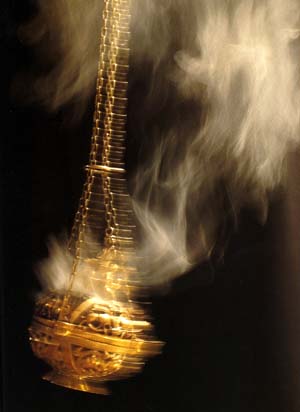
He then went on to tell me how the work, like other elevation toccatas (pieces that were composed or improvised for the point in the Mass where the newly-consecrated host and chalice are raised for the people to see), was no more meant to be an event than incense was — that it was intended to float in the air and not be perceived as doing much.
I thought of this as I followed up on a New York Times article today by sampling a work called “Presence and Reflection” by an ensemble called Redhooker. It’s pretty uneventful. Or, put another way, it has minimal, carefully-chosen events that are spread out over a larger time period than the West is mostly accustomed to.
My awareness of this kind of thing is often increased when I listen to music with a friend who is one of my favorite musicians and is far less tolerant than I am of such tendencies. Much music in vogue nowadays makes him extremely irritated. “He really thinks he can get by with staying in the same key for the whole piece?” is a typical reaction. “I’m going crazy waiting for something to happen!” Clearly we’re dealing with different concepts of music and therefore different expectations. Part of this is no doubt due to the incorporation of non-Western techniques and goals. Inevitably, some of it will be a cover for laziness or lack of imagination. But it also makes me think of something else, namely the longstanding struggle in the visual arts over what constitutes “art” and what is just “decoration.” To someone like me, the distinction between what are called the “decorative arts” and “art” art can seem very arbitrary. In Western classical music we may have arrived at a similar situation where repeated patterns, either artfully arranged or leaving some acts more or less to chance, come to be more comparable to fine wallpapers or book bindings than to the event-oriented music that we have grown accustomed to during many centuries. If development, tension/release, modulation, departure/return and such are our measure of a work of musical art, we’re going to be disappointed with a whole lot that is out there.
Now, the Frescobaldi example demonstrates that — at least in the church — the impulse for music that is more atmosphere than happening is not wholly new. But the atmosphere of elevation toccatas has not usually been that of our prime performance venues. But now Carnegie Hall or La Poisson Rouge are likely (and equally likely) to host music that is not “too fascinating.”
Add to: Facebook | Digg | Del.icio.us | Stumbleupon | Reddit | Blinklist | Twitter | Technorati | Yahoo Buzz | Newsvine
Consumption
April 17, 2010
Today the Metropolitan Opera’s broadcast of Verdi’s La Traviata reminded me of an old story about Jellico, Tennessee’s own Grace Moore. (Did you know that Elvis named his Graceland after her?) She was singing a recital in which audience members kept annoying her by coughing. After a while, she announced from the stage that she had recently sung for a sanatorium full of tuberculosis sufferers. They, she said, had been entirely silent during her singing.
A week ago tonight, the more attentive audience members at a concert I attended were sorely tried by the coughing of folks who were evidently very near to death. (The same thing happened at the Met this afternoon while poor Violetta was trying to die over the din.) It reminded me that, in the programs of my very favorite concert hall, Barcelona’s Palau de la Música Catalana, they have printed a notice to this effect:
Nota
Una prova efectuada en aquesta sala de concerts demostra que una simple tos, mesurada instrumentalment, equival a la intensitat d’una nota «mezzo-forte», emesa per una trompa. Aquest mateix so, pal·liat mitjançant un mocador, és equiparat a un lleuger «pianissimo».Note*
A test performed in this concert hall shows that a simple cough, measured by instruments, is equivalent to the intensity of a note played mezzo-forte by a horn. This same sound, modified by a handkerchief, is equivalent to a slight pianissimo.
Why can’t all halls do something like that? Do any of you know of other venues that tackle the problem in such a direct and helpful manner?
*My translation
“Finesse, Charisma, and Beautiful Nuances”
April 17, 2010
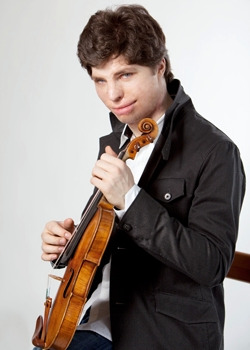
I have already had something to say about the violinist Augustin Hedelich when he received a negligent review for a heroic Carnegie Hall debut.
There is a certain recompense from the newspaper in question now. But I bring him up at this point because of a perceptive remark that he makes in that new article. Coming from whatever Italians call “the sticks,” he has this to say about new media and its effects on budding musicians:
Mr. Hadelich said YouTube was now an invaluable educational asset for musicians from rural areas without access to regular teaching or concerts.
“I think it will really change where the good players come from, not only from the big cities,” he said.
I think he’s absolutely right, and that YouTube is only the beginning.
Antiphony
April 16, 2010
Did you ever wonder what those two facing organs in Italian churches were for? Here’s one thing they could do:
The echo effects in the second piece are especially charming and, like everything else in these performances, must be really effective with the stereo effects in the room itself.
Where Seldom is Heard a Discouraging Word
April 15, 2010

Deer and antelope really can play together.
Even occasional readers of these virtual pages are aware that conventional reviews are not their métier. While we are not exactly living in a golden age of the reviewer’s art, I do not consider that the greatest lack that we labor under, nor do I feel it my vocation to fill that breach. What I reckon there is a market for is something for which I’m much better suited: that of the enthusiast — a relatively informed enthusiast, it is to be hoped, but a nonetheless energetic pointer-outer of good stuff.
In that vein, I want to point to two events last week that gave me various kinds of hope. First was a night at Zankel Hall in celebration of the 4Oth anniversary of the invaluable Oral History of American Music project at Yale. That phenomenon has been singled out here before, but now we had a deftly-concocted concert that combined the virtues of the recorded, spoken medium with the live means of a concert. When you have more-than-life-sized images of Leonard Bernstein being, yes, an enthusiast for Aaron Copland’s Piano Variations on a sofa beside their beaming composer, then immediately lights go up on a piano and pianist who deliver a vivid performance of the work … well, this is very valuable indeed. Most of the evening went that way, and there were many highlights. Those highlights are detailed in the review already given in the New York Times.
The Yale University School of Music, which is home to the OHAM and some of whose students, faculty, and alumni gave the concert, is the only conservatory in the Ivy League. Founded in 1894, it first provided one-year professional finishing for the men who had already concentrated on music in Yale College, and it certainly turned out a good many remarkable musicians who were oriented to both the liberal arts and to the creation or execution of music. The first name to come to mind in that connection was also the first subject of the OHAM, Charles Ives. But, as time went on and as even women were accepted into its courts, the school became a small and select conservatory and is now the only American one besides the Curtis Institute that doesn’t charge fees for instruction. Bard College, which has its own claims to distinction, has decided to make the idea of a liberal-arts grounding paired with musical professionalism its own. It is a courageous thing to found such a program in these times. Oberlin College and its Conservatory have cultivated that ground (as well as having pioneered coeducation) for more than a century and a half, their Conservatory being the oldest continuing one in the country. So starting something new along these lines is a brave thing.
The aims and the likelihood that the new Bard College Conservatory of Music will achieve them were, if we’re all lucky, exemplified by the performance of George Perle’s magnificent Concerto No. 1 for Piano and Orchestra by Melvin Chen. Dr. Chen, who also is Associate Director of the Conservatory, is a Ph.D. in chemistry (Harvard), holds two master’s degrees from Juilliard (in piano and in violin), having earlier received a Yale College degree in chemistry and physics. The work, from 1990, was conducted in a remarkably wide-awake fashion by the well-known President of Bard, whose own diversity of gifts and practice need no praise from me. But, lest other virtues of the concert by this already-remarkable orchestra be insufficiently emphasized, I point to another Times review.
In that same paper today, there is a feature article on a seemingly unrelated topic that nevertheless comes to mind here. It details the exploits of a journalist who disobeys prime statutes of the field, since he participates in and promotes, rather than objectively “covering,” the social life that surrounds the international world of fashion. Like this blog, he doesn’t claim any responsibility to expose all aspects of what he sees and hears: “I don’t lie,” he says. “I just try to find what was positive and only speak about that.” I know just what he means.
Taking Easter Week Off?
April 9, 2010
Not quite. Still at the computer but just buried in other projects. I will return.
Not Everyone Can Be Conrad or Nobokov
April 4, 2010

I had just finished reading this interesting article on the problems that foreign journalism students have in writing in a second language, if that language is English, when a friend pointed out to me a paragraph that he found charming. It is the mission statement of the classical-music service of Radio France online:
Without adhering systematically to the demagogic formula: ” the public is right always “, it is necessary for us well to agree that it is not always wrong: to hold account of its observations is least things on behalf of a radio of ” public ” service.Consequently, with two additional concerts diffused during the weekend, there are four hours more suggested to our listeners who will find – in addition – the appointments which them ” fidélisent ” throughout the week: this alternation of comments of sensitizing and information.The ” plural ” spirit of France Musiques will continue to appear by the opening of the chain to all the forms of expression: traditional musics, original film tapes, jazz, contemporary creations,etc.
Since it is difficult to believe that a passage like that sprang forth from any human head, I assumed that it came from an automated online translator. So I fed it back into the Goggle translation machine. This is the result, which some will find entertaining:
Sans adhérer systématiquement à la formule démagogique: «le public a toujours raison», il est nécessaire que nous sommes bien d’accord que ce n’est pas toujours tort: pour tenir compte de ses observations au moins les choses au nom d’une radio de “public service” . Par conséquent, avec deux concerts supplémentaires diffusés pendant le week-end, il ya quatre heures de plus proposé à nos auditeurs qui se trouve – en plus – le rendez-vous qui les “fidélisent” tout au long de la semaine: cette alternance de commentaires de sensibilisation et de information.The ” pluriel de «l’esprit de la France Musiques continuera à comparaître par l’ouverture de la chaîne à toutes les formes d’expression: musiques traditionnelles, des bandes originales de films, jazz, créations contemporaines, etc.
Tip of the hat to Jonathan Mortimer
 RogerEvansOnline.com