The Power of a Commanding Rhythm
November 15, 2010
The Royal Guard of Norway:
And led in by their Viking predecessors, who went into battle on skis:
Color
November 13, 2010

If you are red-green color-blind, you will see the number 2 above, as I do.
Most discussions of Olivier Messiaen quickly turn to the subject of color, since his was an extreme instance of synesthesia. As a musician with a moderate degree of red-green color-blindness, I’ve long been interested in how my condition might affect the perception of music. Though Messiaen’s linking of color and tone was far more radical than mine, the general question of color is to some extent transferable among our senses (as when we speak of “loud” colors, for example). My own color-blindness is of a sort in which I see all the colors as different (and my pallet is extremely satisfying and my taste not noticeably different from the norm), but it has been proven to me scientifically that my colors are not your colors. My curiosity about the way one sense affects another is enhanced by the fact that the best musician of my acquaintance is completely color-blind but has the absolutest of absolute pitch. Since he’s also a student of Homer, I have often thought of them both as I recall sunsets over the Mediterranean (a passion of mine) and my conviction that Homer’s wine-dark sea really does look like wine at a certain moment in the process. Now I stumble on this interview in the Paris Review, from which I quote:
What’s the best explanation for Homer’s describing honey as green, oxen as wine-colored, and iron as violet? And why did the natives of Murray Island call the sky black, of all colors!
Well, as for the first question, I can’t explain it better than William Ewart Gladstone did one hundred and fifty years ago: “Colours were for Homer not facts but images: his words describing them are figurative words, borrowed from natural objects. There was no fixed terminology of colour; and it lay with the genius of each true poet to choose a vocabulary for himself.” For Homer, the word that ended up meaning “green” meant something like “fresh” or “pale,” and could be applied with perfect sense to fresh and pale looking things of both green and yellow hue. The distinction in hue between yellow and green was not one that seemed very important in his day. Similarly, in many cultures “blue” is just considered a particular shade of black, and finding a particular name for this particular shade is not a very pressing matter, especially as blue material objects (as opposed to the vast nothingness of sky or even the sea) are extremely rare in nature. So it makes perfect sense, if some nagging anthropologist comes to question you about the color of the sky, to use the nearest color on your palette, and say “black.”
The book under discussion there deals with the idea that color-perception is as much a cultural matter as the perception of music is. The romance of music as a “universal language” has long since been debunked, but it seems that color is also unstable from culture to culture.
And it just occurs to me that, since my variety of genetic color-blindness is common in males and not present in females (though inherited through the mother), the effects of any links between color and music would also vary, not just from individual to individual and culture to culture, but between the sexes as well.
Transcending Genre
November 9, 2010
There are moments here that I find profoundly musical, and all of it feels affirming:
Shirley Verett (1931–2010)
November 6, 2010

Until a few moments ago, I didn’t think I had anything to add to the eulogies that will surely flow in torrents for the wonderful Shirley Verrett. Two of my greatest operatic thrills were of her doing: the first Met Troyens in which, due to the indisposition of Christa Ludwig, she sang the parts of both Dido and Cassandra; and the Siege of Corinth that was intensively publicized as the Met debut of Beverly Sills, who was very fine, but who more or less saw the show stolen out from under her by the amazing Verrett. But thousands share those memorable experiences with me.
What persuaded me to add my voice to the tributes was a Facebook posting (thanks, Christopher Temporelli!) of this performance of THE Mozart Alleluia:
I know nothing of her training in early performance-practice, but she does the most important thing: she “tucks” the least important notes and emphasizes the major tonal points. And a thrilling performance with all the right contours is her (and our) reward. There is also that undefinable something that doesn’t bear, or need, discussion.
And I won’t be impertinent enough to comment on this sublime interpretation of the bereaved Orpheus:
Che cosa posso dire?
Comment Would Be Superfluous
November 5, 2010
Everything But Lunch
November 3, 2010

Remember when “everybody” was swapping those old floppy disks with pirated copies of the WordPerfect program on them, while the profits of WordPerfect every day went further through the roof (which they continued to do until hit by the steamroller that was Microsoft)? That was an early digital example of the permeability of the wall between giving things away and making a profit indirectly, through ubiquity, that has been a leading characteristic of the new-media revolution — one that such outfits as the Electronic Frontier Foundation were quickly founded to preserve and encourage. But the Wild West air behind that foundation’s name is no longer the only one breathed by the culture of free-use on the internet. Now comes a substantive guide to Public Domain and Creative Commons: A Guide to Works You Can Use Freely, including musical scores of works not under copyright. I use such resources every single day and now find some difficulty in imagining how it felt not to have them.
Tip of the hat for link to this resource: Michael Ochs
Cultural Cutbacks in Financial Crisis
October 31, 2010
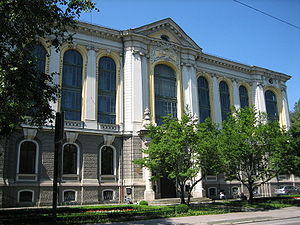

All around us, the arts and humanities are being reported as experiencing cutbacks out of all proportion to other sectors of society. Whether or not any, all, or none of these can be justified is a multi-faceted question. But every once in a while an instance sticks out. Considering everything Germany has been through since 1537 when the great Augsburg library collection came into existence, it is quite remarkable that it may be dissolved and dispersed so relatively early in the current economic downturn. This is a collection of unique value for, among other subjects, Renaissance and Baroque music. To have it experience such a scattering of its materials will constitute a humanistic tragedy. An account of what’s happening, in German, English, and Castilian can be found at this link, as well as instructions for writing an e-mail of support. If you are moved to write to authorities, templates are provided for letters that you may send to the Augsburg city government.
“You Are a Chord”
October 30, 2010
While selected sound is always on my conscious mind, during the past few days I’ve mentioned to a couple of musician friends the fact that I’m noticing the unchosen noise of the city in a new, and often painful, way. As a consequence, I reckon, of spending so much of the past few months in my own relatively serene environment (because of writing a book pretty intensively) and spending such a large proportion of my outdoor time in Central Park (only a block away), I now suddenly find common street sounds almost unbearable. This feels like a reversion to my earliest days in New York: in my early twenties — being country-bred and not habituated to a large city — I felt it necessary to wear earplugs in the streets and subways. At some point I became hardened, evidently. This new TED Talk encourages me to be more attentive to my renewed impulse to avoid the abuse of cruel noise:
 RogerEvansOnline.com