The Dying Gaul and The Felled Footballer
December 2, 2013
Occasionally art imitates life in a way that jumps out at you.
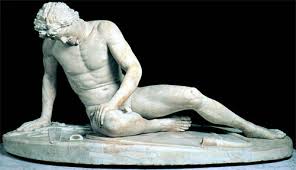
Rome, 220 B.C.

Bilbao, 2013
Letter from Samuel Barber at the Age of 9
November 12, 2013

Dear Mother: I have written this to tell you my worrying secret. Now don’t cry when you read it because it is neither yours nor my fault. I suppose I will have to tell it now without any nonsense. To begin with I was not meant to be an athlet [sic]. I was meant to be a composer, and will be I’m sure. I’ll ask you one more thing.—Don’t ask me to try to forget this unpleasant thing and go play football.—Please—Sometimes I’ve been worrying about this so much that it makes me mad (not very).
A Blessed Composer: Àngel Rodamilans (1874-1936)
October 20, 2013

When, last Sunday, the Catalan Benedictine Àngel Rodamilans was beatified, it occurred to me to wonder how many (or how few) composers have been honored in that way. The only one I can think of is Hildegard of Bingen. Given the importance that official church documents place on music in the life of the church, we might expect a little more musical presence among the blessed. (There are plenty of saints who made music — like Robert Bellarmine, who played violin and not forgetting the legendary figure of Cecilia, who may or may not have been a musician.)
Twenty-five years ago I heard about Rodamilans and his very cruel martyrdom from two of his pupils (Ireneu Segarra and Gregori Estrada, now deceased), and they gave me an album of his works. Here’s a sample of his style:
Catalonia Addresses the World
September 21, 2013

The three hundredth anniversary of the horrible end of the Siege of Barcelona approaches. It brings with it vivid recollection of an almost unbelievably bloody genocide against a people who, suddenly abandoned by the English allies who had encouraged Catalonia to resist the imposition of a monolithic Bourbon government, fought off the combined armies of France and Spain for over a year. The genocide was pointedly cultural as well as corporal, and the inhabitants of Catalonia are keenly conscious of their ancient proto-democratic institutions that were then destroyed and have never been fully restored. Even worse, the rights that they have achieved since the death of the last dictator that Spain imposed on them are every day being whittled away more. A Web site called “El món ho ha de saber” (The world has to know it), has this admirable short summary of the challenge to let the world know Catalonia’s intentions, which are being carefully distorted by powerful interests. I thought it worth translating for the English-reading sector of that greater world:
Catalonia is getting ready to commemorate the tercentenary of a defeat. It was a huge defeat that led to the loss of the nation’s liberties, the extinction of the country’s institutions, and an enormous crackdown on all levels aimed at destroying us as a people.
Three hundred years later, however, this defeat, which has caused so much suffering to so many generations of Catalans, can only be seen as a great victory. This is because, three centuries after the disaster of 1714, not only has Catalonia not lost its national consciousness, but, on the contrary, that consciousness is more alive than ever, since our country is now close to deciding, freely and democratically, our future.
At the very gates of this decisive process, it is essential to let the world know that the desire of Catalans to be masters of our own fate is not just a bolt out of the blue caused by a brutal economic crisis. The greater world must be aware that our nation has a thousand of years of history, and that the desire for the freedom has endured ever since the defeat of that fateful September 11, 1714.
The world must know that the future of Catalonia is not against anything or anyone, and that Catalonia’s liberty will help to make the world a little more free.
Cuba, the United States, Sitges, and Me
September 19, 2013
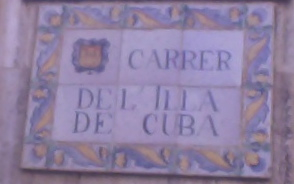
The vast expansion of social media has changed the role of blogs drastically, and there are those who now consider blogs to be obsolete. When I began this site in 2008, it certainly loomed much larger in my confrontation with the world than it does now. Longtime readers will have noticed the much-decreased frequency of posts here as Twitter and Facebook have become quick and easy release-valves for ideas, links, questions, and general contact of a virtual kind.
However, as some of you will know already (thanks to those very same media, in which my reach has, like that of many, grown almost shockingly large), I have changed my base of operations to a spectacular seaside town in Catalonia. The cultural impact of this may cause me to post more in this space, since the stimulus of the environment may call for this kind of outlet more often.
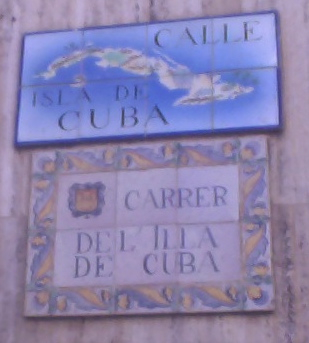
For example, I can’t avoid commenting on the irony of my new street address (a ceramic sign for which can be seen at the head of this post). The complicated relationship between Cuba and the United States did not by any means begin with the deranged state of affairs of the last half-century. The results of the Cuban revolution that are unhappy have sometimes been taken personally by me. As the person responsible for the current-events bulletin board in my sixth-grade class at Miller-Perry Grammar School, I plumped vigorously for the victory of that pro-American democrat, Mr. Castro. He was even a guest on Edward R. Murrow’s indispensable television show, Person to Person, in which the t.v. cameras went into the celebrity’s home and talked with him informally. Castro’s good English and calm demeanor soon became much less in evidence, of course — not to mention his hospitality to media, except that controlled by him and saturated with his phenomenally prolix orations.
But other countries, without condoning the darker side of Castro’s rule, have had a much saner relationship with that remarkable island and its people. That doesn’t mean that their relationship was less complicated, however. One of the greatest blows that Spain has ever felt was over the loss of Cuba as a prime colony. That deprivation was felt differently in Catalonia, where the loss was not one affecting national pride so much as the pocketbook. For Catalans were heavily invested in Cuba, and in more than one sense. They not only were exploiting Cuba for financial gain, resulting in massive fortunes, but many Catalans developed a deep love for the Cuban people and their ambience. Thus, with the Americans driving out citizens of Spain, these magnates returned to Catalonia determined to recreate, back home on the Mediterranean, their prized Caribbean felicity. They built elaborate villas with romantic walled gardens refreshed by both Mediterranean breezes and the sound of habaneras. This development coincided with the climax of a historic renewal of specifically Catalan cultural vigor known as their Renaixença.
In the biography of Xavier Montsalvatge that I published last year, I commented on this fact (so important to Montsalvatge’s use of Cuban culture as a way of being Catalan under the watchful eye of Francisco Franco’s minions). One of the great ironies of my new residence is highlighted by the underlined sentence, in which I mention the very street that has now become my home:

The dictadura of Franco complicated every aspect of Catalan culture, symbolized by the fact that immediate decrees making all public signs in Catalan illegal conspicuously affected street signs. Thus all street signs had to be torn down and replaced with signs only in Castilian:
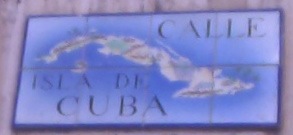
A Catalan friend who lived through those times has sometimes mentioned to me this matter of pride for him: while the fascists tore down the Catalan signs in the late Thirties, the restored public use of the language has resulted in street signage in both languages — the dictatorship’s signs simply being supplemented by the Catalan ones. It might have been perfectly understandable if the previously imposed signs had been torn down, even as a sort of symbolic revenge after years of cruel repression; but that did not happen. This is more than a statutorially monolingual culture being replaced by an actually bilingual one; it is the difference between intolerance and tolerance. And it implies much else that makes it a joy to live in this place, among these people.
Branagh’s Genuinely MAGIC FLUTE
June 10, 2013

THE MAGIC FLUTE: A Film by Kenneth Branagh
Wolfgang Amadeus Mozart
Sung in English | Running time 134 minutes
Lyubov Petrova – Queen of the Night
René Pape – Sarastro
Tom Randle – Monostatos
Joseph Kaiser – Tamino
Amy Carson – Pamina
Ben Davis – Papageno
Teuta Koço – First Lady
Louise Callinan – Second Lady
Kim-Marie Woodhouse – Third Lady
Silvia Moi – Papagena (young)
Liz Smith – Papagena (older)
Director: Kenneth Branagh
Libretto: Adapted by Stephen Fry
Producer: Pierre-Olivier Bardet
Costumes: Christopher Oram
The Chamber Orchestra of Europe
Music Arranged and Conducted by: James Conlon
Last month I attended an assaig general (i.e., dress rehearsal), at the Gran Teatre del Liceu in Barcelona. The opera was a new production (new for them; it had seen the light in Munich) of It turco in Italia. It was delightful. Rehearsed to a fare-thee-well, with action that seemed motivated rather than pasted on, it was blessed with comedy that was actually funny. Every tool was pressed into the service of characterization. (For example, the trampish tendencies of a married character were efficiently communicated when she even flirted with stage hands.) The question kept arising in my mind: did the director devise action that skilled singing actors were realizing, or did he call forth behavior appropriate to these particular singers? Rarely having seen anything approaching this level of precision of stage-work in New York opera houses, I was mostly asking myself: how can we more consistently get this level of professional acting out of first-class singers, in well-prepared ensemble productions?

A moment in IL TURCO IN ITALIA in Barcelona
Well, Sir Kenneth Branagh has an answer. Bring to bear on opera the techniques of film-making, with its multiple takes, the luxury of directorial nursing in the midst of actual performance, and the lack of necessity for repeat performances every few nights. Now, of course, Branagh is not the first to take opera to the medium of film — nor even the first top-drawer director to do it for Flute. Igmar Bergman of blessed memory did that unforgettably, and in his country’s Swedish vernacular. Branagh’s movie is in English that Stephen Fry came up with (who, being a master of so many trades, probably wouldn’t have fatally shocked us if he had imitated Mozart’s original librettist and sung the role of Papageno too).
The story is moved to World War I and loses little or nothing by the transfer. The original plot is murky at times, and though this rendition is sometimes mystifying, too, its vitality and general entertainment value are never in question. If you like Branagh’s Shakespeare, you’ll like his Mozart.
As for the cast: admirer of Joseph Kaiser’s singing though I’ve been, I’d never have thought he would inhabit the screen as though he’d been playing leading-man roles for years, while all the time singing with a consistency and clarity that do him and his teachers and mentors great credit. His performance is above praise in every respect.
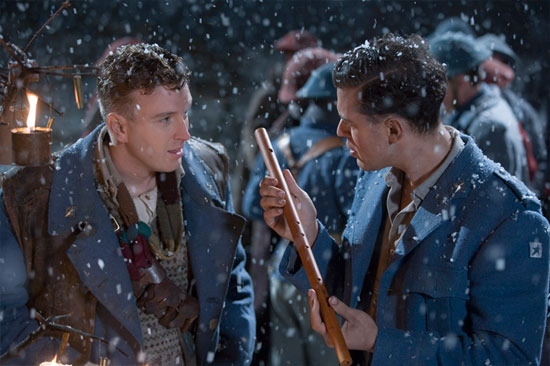
Another advantage of a film is that luxury casting of a sort uncommon in a chain of performances in an opera house becomes feasible: hence the welcome appearance of a major star like René Pape as Sarastro.
With regard to the rest of the singing: the level is remarkably high all through by the singers not otherwise singled out here. Of course certain things become easier on film than in the opera house (Sarastro’s lowest notes and the boys’ trio often not being up to an ideal volume in many live stagings), but one never feels that there is undue manipulation or that any vocal effects are owed to switches and dials.
The orchestra employed is of course one of the world’s virtuoso ensembles, but even at that its eloquence here is constantly striking. There simply doesn’t seem to be a false move musically. (And it’s lovely to have another crack at the overture during the closing credits. It almost sounds new after all the action that has transpired since its first hearing.) Though the scenery ranges from battlefield to field hospital to all kinds of outdoor realistic and imaginary locations, the acoustic for the music is, wisely, kept as that of a particularly elegant concert hall.
There are things that any hardened opera fan will bridle at here and there, but no matter; this is a perfectly valid retelling of a story that has always been a little problematic outside the house and atmosphere of its premiere. It is playing in cinemas around the United States this week, and I hope that the comparative neglect of it in this country so far will be overcome, if only by word of mouth from the people whose ears and eyes have been charmed by this consistently entertaining film. It takes its noble music seriously and always renders justice to Mozart’s miraculously expressive achievement.
A Musician at His Post
May 21, 2013

On my last Sunday serving in St. Paul’s Chapel of Columbia University May 5, 2013, a singer in the choir snapped this photo. I’ll always value my time there (my first liturgy there having been when I was 25 years old, with the Woodstock Jesuits).
Architectural Crime
April 6, 2013
Contrary to common belief, not every architectural decision in Barcelona is infallible.
This fun moderniste building:

became this:

(And keep in mind, as you look at them, that the black-and-white photo if of a very colorful building, while the color photo is of … well, you can see for yourself.)
Hat-tip to Liz Castro
 RogerEvansOnline.com