Sweating the Small Stuff
June 5, 2009
 I found it rather endearing when Nicholas Kristof apologized yesterday on Facebook for a grammatical error in his column for Wednesday’s New York Times. My question, though, was: Shouldn’t it be the editors apologizing rather than the madly globe-trotting and cause-championing prolific writer?
So, while Kristof is removing the mote from his eye, I want to complain about the mote (admittedly not quite a beam) in a Times caption-writer’s eye. For some time now, I have been startled to see in that influential paper captions for photos of classical musicians that employ such locutions as “Krystian Zimerman on the piano.” The use of on there I take to be acceptable and idiomatic pop or jazz slang. The hitherto-customary “Krystian Zimerman at the piano” or, perhaps better, “Krystian Zimerman playing the piano” seems to me to represent usage worth maintaining — if only because portraying a much more artistically-healthy relationship between interpreter and instrument.
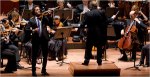
Today’s edition includes a review of Tim Fain (whom I knew as Timothy but notice that his own Web site now calls him Tim — which I think is fine, a fact that I hope indicates that I’m not just being a prig about classical-music conventions) and the Riverside Symphony. The photo has this caption: “George Rothman leading the Riverside Symphony, with Tim Fain on violin, on Wednesday, in their last program of the season.” Please.
(If you think I’m being just silly about this, feel free to say so, giving me your reason why. I’m willing — even eager — to be talked out of these irritating situations.)
Who Knew?
June 4, 2009
 Office choirs? The Guardian writes about them as though they are an everyday thing. Is this a trend I’ve been missing?
Frederica von Stade
June 1, 2009
Happy birthday to a most remarkable artist.
Antonín Dvořák: “Mesícku na nebi hlubokém” (Silver moon upon the deep dark sky) from Rusalka, Op. 114
Frederica von Stade, mezzo-soprano; the Boston Symphony Orchestra, Seiji Ozawa, conductor
My Son the Musical Lawyer
May 29, 2009
 The tale of how a kid’s father learned that music could make his son a good lawyer, and how the kid was wiser yet.
Making Opera Matter
May 28, 2009
 Alex Ross, whose work seems to go from strength to strength, gave a typically visionary keynote address at the recent Opera America conference in Houston. Though I was in the front row, I have greatly enjoyed viewing a video of the address since I came home. I commend it to you.
Don’t Fence It In
May 27, 2009
 It is a peculiarly modern, and startling, experience to stumble online upon something that you have published in the past and pretty much forgotten about. I did so this morning when I came upon a review I had written four years ago of a history of classical music in the United States. Despite the fact that I recall its having been cut cruelly, for space considerations, just before publication, I find that I still stand squarely behind its main argument about the spaciousness of classical music. And I think the fight against letting our view of it become too narrow is still one worth waging.
At the same time, I hasten to acknowledge the usefulness of some of the data included in the book under review. For example, the mind still boggles at this fact: On Christmas Day 1909, Oscar Hammerstein’s Manhattan Opera presented Tosca and Tales of Hoffmann in New York, Faust and Aïda in Philadelphia, Le Jongleur de Notre Dame, Cavalleria Rusticana and Pagliacci in Pittsburgh, and Mignon and Le Caïd in Montreal!
Où, indeed, sont les neiges d’antan?
UPDATE: Almost as though in response to the plea above for a broader approach (which would also be a deeper one) to our heritage, I have coincidentally just received an e-mail alert from the Society for American Music of an upcoming conference hosted by “The Exile Society and the Friends of the Schwenkfelder Library & Heritage Center” on “Eighteenth and Nineteenth Century Sacred Vocal Music In PA German Culture.” We live in a time when many groups, large and small, are delving into the true variety that the American musical culture involves. Looking only at the big, endowed institutions of the carriage trade falsifies the picture crucially.
 It strikes me that the best thing about this program, which so many are finding addictive, is this: a percentage of those whiling away the hours with it will inevitably be people who are listening more closely to musical differences than they ever have. Else why would they be so enthralled with the effects that their actions are having?
Closer listening is always a good thing.
What Do We Mean By CLASSICAL MUSIC?
May 21, 2009
 A question that often comes up in discussions with colleagues involves the term classical music, its inadequacies, and what we might use instead of that designation. Without going into the subject as much as I hope to in future, I note that the online list of the American Musicological Society is entertaining a related question. Jeremy Grimshaw, of the Brigham Young University School of Music, points to the 1879 edition of the Grove Dictionary and its entry on the term, one of the first systematic takes on the usage that is now thrown around so universally, perhaps thoughtlessly, and certainly unmethodically:
CLASSICAL is a term which in music has much the same signification as it has in literature. It is used of works which have held their place in general estimation for a considerable time, and of new works which are generally considered to be of the same type and style. Hence the name has come to be especially applied to works in the forms which were adopted by the great masters of the latter part of the last century, as instrumental works in the sonata form, and operas constructed after the received traditions; and in this sense the term was used as the opposite of ‘romantic,’ in the controversy between the musicians who wished to retain absolutely the old forms, and those, like Schumann, who wished music to be developed in forms which should be more the free inspiration of the composer, and less restricted in their systematic development. See ROMANTIC. –C.H.H.P.
[Sir Charles Hubert Hastings Parry]
Until, towards the end of that paragraph, we learn that Schumann is not, for Parry, a classical composer, the definition from 140 years ago makes pretty good sense for guidance to our own usage. But times change, and music changes. When will our terminology change to reflect more exact reality?
 RogerEvansOnline.com