The Element of Surprise in Music — and the Super Bowl
February 7, 2010

There is a story of an 18th-century English gentleman who was showing off his newly redesigned garden in the fashionable style of Capability Brown (a landscape artist who leaves many tracks in literature, from Jane Austen to Tom Stoppard).
“And here, Sir, we come to my Ha-Ha. We call it that because the surprise of suddenly coming upon it causes the stroller to cry, ‘Ha ha.'”
To which his visitor asked: “But what, Sir, do you call it the second time you encounter it?”
The fine science blogger Jonah Lehrer, who has been cited here before, has lately been writing about music and our psychological pleasure in it. A Harvard music professor has written this to him:
If we derive pleasure from anticipating potential connections – and especially being surprised by thwarted expectations – then it becomes difficult to explain why we would want to listen to a piece more than once: the novelty factor wears off, the uncertainty factor becomes less pronounced. In principle, the piece should get less interesting each time we hear it. Experience, however, shows that this is not the case: we greatly enjoy re-hearing familiar pieces. The whole recording industry makes a lot of money on the basis of this phenomenon.
Which leads Lehrer to ask, among other things:
This, of course, raises the larger question of why certain pieces of music don’t go stale. Why are we still listening to Bach’s fugues, or Beethoven’s symphonies, or Kind of Blue? What is it about these particular soundwaves that allows them to evade the corticofugal boredom?
Today is the Super Bowl. While most viewers of it are all caught up in the excitment and suspense that mostly hinges on the outcome, a higher level of appreciators of the game are much more involved in the process. The highest level of connoisseurs of football may watch the game, or certain plays, for weeks, months, or years, with pleasure and understanding.
I think a Bach fugue enjoys much of this quality — besides many others, of course. The person who is musically equipped to do so — or just curious and perceptive or focused (or just lucky) — will be so interested in the process that, as may be the case with a few tennis matches in history, it is a source of unending pleasure. Surprise becomes the least of it.
From Marseilles to Rome to Berkeley
February 6, 2010
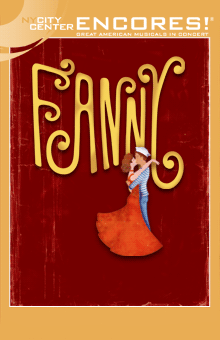
News to me — but fascinating news — how a trilogy of novels went from page to film to Broadway musical to cult restaurant. How an evocative work of art can inspire a diversity of other ventures in excellence.

Rejection: It Happens to Everybody
February 4, 2010
Once Samuel Goldwyn tried to get George Bernard Shaw to sell him the movie rights to some of his work. After much discussion, they never came to an agreement: “The trouble is, Mr. Goldwyn,” declared Shaw, “you are interested only in art and I am interested only in money.”
In a week in which the Grammies have been awarded and the Oscar nominations announced, I have come upon this account of a dramatic rejection of a finished film score by John Corigliano (who has had a nice haul of both awards). It’s a pleasure to see him adopt exactly the right attitude about having had his work replaced for the new Mel Gibson thriller The Edge of Darkness. He seems to have kept art and commerce in perfect balance. Now can we hope for the release of a CD presenting Corigliano’s score, which had already been recorded under Leonard Slatkin?
Forty Days and Forty Nights: Candlemas
February 2, 2010

Yes, it’s Groundhog Day, but it’s also forty days after Christmas. That’s when Mary was required by Mosaic law to go to the Temple and be “purified” of the taint of childbirth. (And we think our lives are complicated.) This is a major feast in all the ancient churches and used to be a great folk celebration as well.
Down with the rosemary, and so
Down with the bays and mistletoe;
Down with the holly, ivy, all,
Wherewith ye dress’d the Christmas Hall.
— Robert Herrick (1591–1674), “Ceremony upon Candlemas Eve”
It used to serve as the end to the Christmas celebration. In the old days, feasts tended to have long tails, whereas now we prefer long anticipations — as in Christmas decorations right after Halloween.
But the Presentation of the Lord in the Temple (which has gone by many other names as well) has always struck me as a day that we ought to use to highlight the value of old people. It was the aged priest Simeon and the venerable prophetess Anna who really knew what a world-shaking thing was going on in the Temple that day — which it certainly was for history, whatever one’s religious beliefs — and their faithfulness and patience reach a climax in Simeon’s great song that is now sung all round the world every night of the year at Compline:
Lord, now lettest thou thy servant depart in peace :
according to thy word.
For mine eyes have seen :
thy salvation;
Which thou hast prepared :
before the face of all people;
To be a light to lighten the Gentiles :
and to be the glory of thy people Israel.
— Luke 2: 29-32 in the translation of the Book of Common PrayerGlory be to the Father, and to the Son :
and to the Holy Ghost;
as it was in the beginning, is now, and ever shall be :
world without end. Amen.
Many will remember the entry of that text into modern popular culture with the theme music of the television dramatization of John le Carré’s Tinker, Tailor, Soldier, Spy, in which a lovely paradox had a young boy singing the words of old Simeon:
Which brings full circle the irony of the Alleluia Verse at Mass on the feast:
Senex puerum portabat: puer autem senem regebat.
The old man carried the child, though the child was his ruler.
The singer in that video, by the way, is Paul Phoenix. He is now a member of the King’s Singers.
And here are many other musical takes on the Nunc dimittis of Simeon.
Those Who Worry That the Web May Be Destroying High Culture …
January 31, 2010

… should have a look at the reviews of Tuscan Whole Milk, 1 Gallon, 128 fl oz.
Evolutionary Evidence for Origin of the Lullaby?
January 31, 2010
From this:
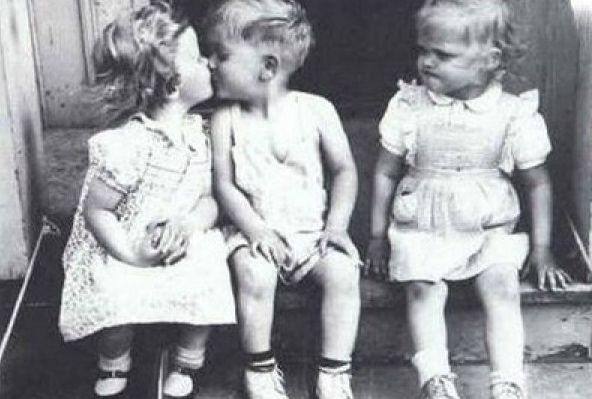
to this:
Kissin versus the BBC
January 28, 2010
 This site is so happily preoccupied with the three topics proclaimed in its masthead that even the three most fascinating subjects in the world — politics, sex, and religion — do not tempt it to deviate. But the position of music and musicians in society and influence of music and musicians on issues certainly are within its realm of interest. Thus the sudden thrusting of himself into a controversial political matter by Evgeny Kissin commands attention.
I well remember when a super-shy, retiring — even shrinking — Kissin emerged from the Soviet Union. I wrote the liner notes for his first three CDs that were recorded in the West and was at the twenty-first birthday party that RCA Victor Red Seal gave him, as well as other, similar occasions. In those days he wouldn’t say boo to a goose. Thus I am startled to see him speaking up against so mighty an entity as the British Broadcasting Corporation on an explosive issue and in forceful tone. Aside from the matter of his personal evolution, what is really compelling is the evident fact that he expects — and in this I think he’s correct — that he will be listened to, not because he is a known deep thinker or persuasive polemicist on this or any other political issue, but because he is an important musical performer. Any sequel to this will be interesting to watch.
Perhaps we can hope for a public debate between him and Daniel Barenboim? Dueling pianists indeed.
Hat-tip: Aleba Gartner
 RogerEvansOnline.com