Shirley Verett (1931–2010)
November 6, 2010
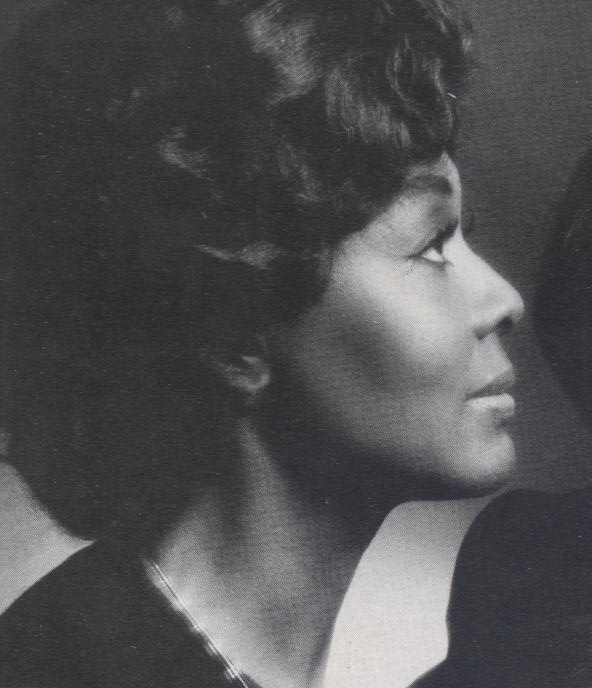
Until a few moments ago, I didn’t think I had anything to add to the eulogies that will surely flow in torrents for the wonderful Shirley Verrett. Two of my greatest operatic thrills were of her doing: the first Met Troyens in which, due to the indisposition of Christa Ludwig, she sang the parts of both Dido and Cassandra; and the Siege of Corinth that was intensively publicized as the Met debut of Beverly Sills, who was very fine, but who more or less saw the show stolen out from under her by the amazing Verrett. But thousands share those memorable experiences with me.
What persuaded me to add my voice to the tributes was a Facebook posting (thanks, Christopher Temporelli!) of this performance of THE Mozart Alleluia:
I know nothing of her training in early performance-practice, but she does the most important thing: she “tucks” the least important notes and emphasizes the major tonal points. And a thrilling performance with all the right contours is her (and our) reward. There is also that undefinable something that doesn’t bear, or need, discussion.
And I won’t be impertinent enough to comment on this sublime interpretation of the bereaved Orpheus:
Che cosa posso dire?
Comment Would Be Superfluous
November 5, 2010
Everything But Lunch
November 3, 2010

Remember when “everybody” was swapping those old floppy disks with pirated copies of the WordPerfect program on them, while the profits of WordPerfect every day went further through the roof (which they continued to do until hit by the steamroller that was Microsoft)? That was an early digital example of the permeability of the wall between giving things away and making a profit indirectly, through ubiquity, that has been a leading characteristic of the new-media revolution — one that such outfits as the Electronic Frontier Foundation were quickly founded to preserve and encourage. But the Wild West air behind that foundation’s name is no longer the only one breathed by the culture of free-use on the internet. Now comes a substantive guide to Public Domain and Creative Commons: A Guide to Works You Can Use Freely, including musical scores of works not under copyright. I use such resources every single day and now find some difficulty in imagining how it felt not to have them.
Tip of the hat for link to this resource: Michael Ochs
Cultural Cutbacks in Financial Crisis
October 31, 2010
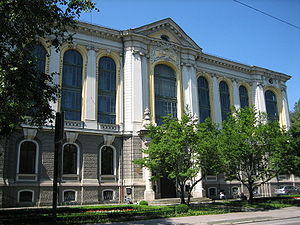

All around us, the arts and humanities are being reported as experiencing cutbacks out of all proportion to other sectors of society. Whether or not any, all, or none of these can be justified is a multi-faceted question. But every once in a while an instance sticks out. Considering everything Germany has been through since 1537 when the great Augsburg library collection came into existence, it is quite remarkable that it may be dissolved and dispersed so relatively early in the current economic downturn. This is a collection of unique value for, among other subjects, Renaissance and Baroque music. To have it experience such a scattering of its materials will constitute a humanistic tragedy. An account of what’s happening, in German, English, and Castilian can be found at this link, as well as instructions for writing an e-mail of support. If you are moved to write to authorities, templates are provided for letters that you may send to the Augsburg city government.
“You Are a Chord”
October 30, 2010
While selected sound is always on my conscious mind, during the past few days I’ve mentioned to a couple of musician friends the fact that I’m noticing the unchosen noise of the city in a new, and often painful, way. As a consequence, I reckon, of spending so much of the past few months in my own relatively serene environment (because of writing a book pretty intensively) and spending such a large proportion of my outdoor time in Central Park (only a block away), I now suddenly find common street sounds almost unbearable. This feels like a reversion to my earliest days in New York: in my early twenties — being country-bred and not habituated to a large city — I felt it necessary to wear earplugs in the streets and subways. At some point I became hardened, evidently. This new TED Talk encourages me to be more attentive to my renewed impulse to avoid the abuse of cruel noise:
On Being a Musician in Her 107th Year
October 27, 2010
UPDATE: Martin Anderson of Toccata Classics and Toccata Press writes, in part, on the e-mail list of the American Musicological Society:
What the video doesn’t touch on is Alice’s extraordinary connections: her mother was a childhood friend of Mahler; she herself studied with Conrad Ansorge, making her a grand-student of Liszt; her elder sister was married to a close friend of Kafka, who would take Alice and her twin sister out into the woods and tell them stories — “We were like three little children”, Alice told me (as two of them were, of course); “He had zese great big eyes”; and she knew Zemlinsky — as well, obviously, as the composers incarcerated with her in Terezín. I did ask her if Ansorge had communicated any playing tips from Liszt, but “No, nothing like that”.
The co-author of her biography (it is sentimental, which Alice certainly isn’t) brought out a CD to coincide with the German edition of the book which revealed her as a great pianist — really: that’s an adjective I use very sparingly. I got to know Alice in her late 90s, long after she had stopped playing in public (she still plays at home every day), and so took her musicianship on trust. So I was bowled over when I heard this CD — private recordings from her 70s and 80s, on her out-of-tune upright at home,
with the sparrows singing in the background. She’s playing Beethoven, Schubert, Schumann, Debussy, Bach (IIRC), and the sense of pulse is absolutely secure; she understood the very core of the music — I’d put her on a par with, say, Serkin and Horszowski in terms of her depth of insight. An enormous loss, then, that as far as I’m aware, she never had recording
career of any sort.
A Boy and His Computer
October 21, 2010
In a manner that we will surely see more of as time moves on, a young enthusiast merges the digital (in both senses) and “ancient musick.”
Playing Musical Compositions Will Never Be the Same
October 19, 2010
Musicians! Tired of memory slips and page-turners? Help is on the way!
 RogerEvansOnline.com