Happy St. Cecilia’s Day
November 22, 2011

A Song for St. Cecilia’s Day, 1687
FROM harmony, from heavenly harmony,
This universal frame began:
When nature underneath a heap
Of jarring atoms lay,
And could not heave her head,
The tuneful voice was heard from high,
‘Arise, ye more than dead!’
Then cold, and hot, and moist, and dry,
In order to their stations leap,
And Music’s power obey.
From harmony, from heavenly harmony,
This universal frame began:
From harmony to harmony
Through all the compass of the notes it ran,
The diapason closing full in Man.
What passion cannot Music raise and quell?
When Jubal struck the chorded shell,
His listening brethren stood around,
And, wondering, on their faces fell
To worship that celestial sound:
Less than a God they thought there could not dwell
Within the hollow of that shell,
That spoke so sweetly, and so well.
What passion cannot Music raise and quell?
The trumpet’s loud clangour
Excites us to arms,
With shrill notes of anger,
And mortal alarms.
The double double double beat
Of the thundering drum
Cries Hark! the foes come;
Charge, charge, ’tis too late to retreat!
The soft complaining flute,
In dying notes, discovers
The woes of hopeless lovers,
Whose dirge is whisper’d by the warbling lute.
Sharp violins proclaim
Their jealous pangs and desperation,
Fury, frantic indignation,
Depth of pains, and height of passion,
For the fair, disdainful dame.
But O, what art can teach,
What human voice can reach,
The sacred organ’s praise?
Notes inspiring holy love,
Notes that wing their heavenly ways
To mend the choirs above.
Orpheus could lead the savage race;
And trees unrooted left their place,
Sequacious of the lyre;
But bright Cecilia rais’d the wonder higher:
When to her organ vocal breath was given,
An angel heard, and straight appear’d
Mistaking Earth for Heaven.
GRAND CHORUS.
As from the power of sacred lays
The spheres began to move,
And sung the great Creator’s praise
To all the Blest above;
So when the last and dreadful hour
This crumbling pageant shall devour,
The trumpet shall be heard on high,
The dead shall live, the living die,
And Music shall untune the sky!
— John Dryden
“I’m hoping that technology will figure out a way for musicians to live off music.”
November 16, 2011

Amidst a lot of wacky stuff, Björk, in this interview, makes uncommon sense about the life of a musician, the place of technology, how formats have formed habits (like the idea of an “album”), and how a relaxed approach to recording has increased her joy in music.
Point of View
October 31, 2011

This site is not turning into a Z. Woolfe fan-page, but for a second post in a row, I feel bound to call your attention to an article of his. This because he has done something I have long yearned to see in reviews. He actually reports on the perspective from the humblest of seats (or, in this case, standing-room), as well as from the Daddy and Mammy Warbucks sector.
The hopes one nurtures for daily criticism may be faint, but they are real so long as such intelligence has a platform.
She Ruled. Still Does.
October 31, 2011

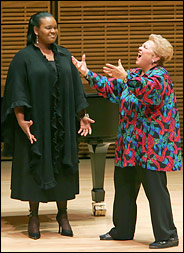
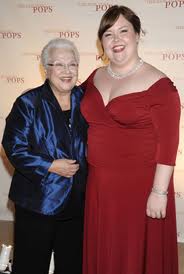


Do I need a special reason to pass on to you this fine interview by the perceptive and articulate Zachary Woolfe with the ever-incomparable Marilyn Horne? No.
On the Anniversary of the Statue of Liberty
October 30, 2011

There are works of art that it sometimes seems impossible to evaluate dispassionately because they are too close to us. Such, for me, is this majestic utterance of Emma Lazarus:
The New Colossus
Not like the brazen giant of Greek fame,
With conquering limbs astride from land to land;
Here at our sea-washed, sunset gates shall stand
A mighty woman with a torch, whose flame
Is the imprisoned lightning, and her name
Mother of Exiles. From her beacon-hand
Glows world-wide welcome; her mild eyes command
The air-bridged harbor that twin cities frame.
“Keep, ancient lands, your storied pomp!” cries she
With silent lips. “Give me your tired, your poor,
Your huddled masses yearning to breathe free,
The wretched refuse of your teeming shore.
Send these, the homeless, tempest-tost to me,
I lift my lamp beside the golden door!”
Fingernails on the Blackboard
October 29, 2011

What makes unpleasant sounds unpleasant? These guys have an explanation — and they’re musicologists!
The Myth of the “Average Consumer” of Classical Music
October 27, 2011

A study says that going for the exceptions is far more profitable.
In the Grand Tradition of Ear-Training Mnemonics
October 27, 2011
It may be the best thing since Ut queant laxis:
(Tip of the hat to Judith Malafronte)
 RogerEvansOnline.com