Chopin at the Opera II
February 2, 2008
continued from yesterday
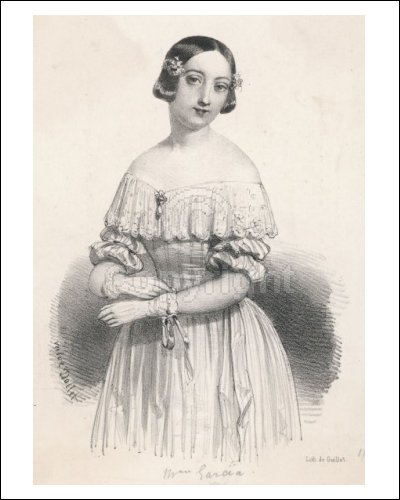 Chopin delighted in making the piano sing, and the vocal origins of his distinctive keyboard melody are key to understanding or performing his works. In Chopin’s mazurkas the traffic flows in the opposite direction, for they owed their first wide popularity to a singer, the celebrated Pauline Viardot (née García, pictured above), who set words to mazurkas and sang them in her recitals. Chopin complained that, once they became audience favorites, she stopped listing them in London playbills as “Mazurkas of Chopin” and began to call them “Mazurkas arranged by Mme Viardot.”
Such mazurkas occasioned some of Chopin’s most innovative harmonic adventures: Wagner is prefigured, and posterity is shown new tonal possibilities. It is appealing to picture the greatest Polish composer, now become the toast of cosmopolitan Paris, refreshing his repertory by retrieving and exploiting some of his earliest musical memories. For not only had parlor mazurkas been all the rage in the Warsaw of Chopin’s youth, but visits to village festivals had revealed to him the startling originality of the authentic folk mazurka. The highly individual charms of that rustic dance (characterized by strong secondary accents within a three-beat measure whose variety was far removed from the waltz’s predictability) were at his disposal whenever he wished to stir up his memories — memories that would call forth compositions that Western Europe understandably heard as markedly original. The mazurkas were sometimes deemed too inventive to be understood at first hearing.
Read the rest of this entry »
Chopin at the Opera
February 1, 2008
 Frédéric Chopin had a consuming interest in singers and singing. As composer, performer, and teacher, he exalted the legato of a shapely vocal phrase as the pianist’s melodic ideal. That, joined with his ability to make small-scale dramas out of “salon” pieces, makes a Chopin piano recital the nearest instrumental equivalent of an intimate Lieder recital.
The singing that commanded Chopin’s keenest attention, however, was in bel canto opera, for nineteenth-century Europe followed opera fervently. New ideas in music came from the opera house in those days, and Bellini’s operas provided the model for the sort of long, soaring melody that Chopin idealized.
The very nature of the piano’s sound — the tone percussively born, and quickly dying away — made it impossible for the player to imitate vocal melody literally. But in music impossibility gives full scope to illusion. It is the Chopin pianist’s glory to create the illusion of a procedure that is objectively unattainable on the instrument.
Read the rest of this entry »
Thinking About Bach at the Keyboard II
January 29, 2008
continued from yesterday
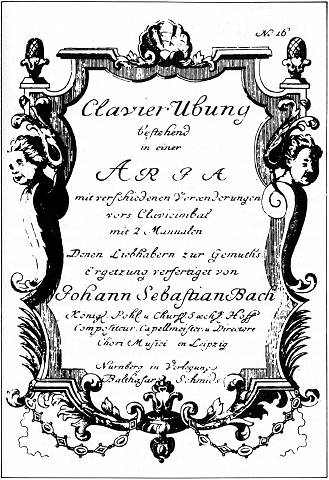 The contribution of the Goldbergs to an equally important experiment may have been obscured by an interesting tale that has long been attached to them. Forkel, in his 1802 Über Johann Sebastian Bachs Leben, Kunst und Kunstwerke, first published what was to become the familiar legend of
the former Russian ambassador to the electoral court of Saxony, Count Kaiserling, who often stopped in Leipzig and brought there with him the aforementioned Goldberg [his house musician], in order to have him given musical instruction by Bach. The Count was often ill and had sleepless nights. At such times, Goldberg, who lived in his house, had to spend the night in an antechamber, so as to play for him during his insomnia. Once the Count mentioned in Bach’s presence that he would like to have some clavier pieces for Goldberg, which should be of such a smooth and somewhat lively character that he might be a little cheered up by them during his sleepless night. Bach thought himself best able to fulfill this wish by means of Variations, the writing of which he had until then considered an ungrateful task on account of the repeatedly similar harmonic foundation. But, since at this time all his works were already models of skill, these variations also became so under his hand. Yet he produced only a single work of this kind. Thereafter the Count always called them his variations. He never tired of them, and for a long time sleepless nights brought: “Dear Goldberg, do play me one of my variations.” Bach was perhaps never so rewarded for one of his works as for this one. The Count presented him with a golden goblet filled with 100 louis d’or. Nevertheless, even had the gift been a thousand times larger, their artistic value would still not have been paid for.
Thinking About Bach at the Keyboard
January 28, 2008
 The Italian Concerto and the “Goldberg” Aria with Variations were meant to show two different approaches to music for the keyboard. Though Bach published little in his lifetime, he did see to it that both these works were issued in his summa on keyboard technique, the four-volume Clavier-Übung (Keyboard Study). Here is the layout of the volumes:
I. Six Partitas (suites of dances), 1731
II. Italian Concerto and French Overture, 1735
III. Organ compositions: chorale-preludes, two-voice pieces, and the “St. Anne” Prelude and Fugue, 1739
IV. “Goldberg” Variations, 1741–2
The Italian Concerto is the ultimate product of one of Bach’s long-term projects: to transplant to German music the concerto style as the Italians had developed it. A major result was his many concertos that set soloists in relief against orchestra; but even more inventive were Bach’s efforts, between 1708 and 1717, to devise concertos that a keyboard player could perform without an orchestra. The seven organ examples included three that were transcribed from the composer who represented the avant-garde of concerto-making, Antonio Vivaldi. They used the smaller organ division nearer the hearers (the Rückpositiv) for the concertino solo parts, and the larger, higher-up division (Oberwerk) for the full-orchestra ripieno; thus could one player perform a whole concerto.
During the same period, Bach was experimenting with sixteen “concertos” for clavier alone, six of which were also arranged from concertos by Antonio Vivaldi. In these he went yet a step further: he removed the concerto’s usual element of spatial contrast and trusted the player to provide even that illusion by skillful use of purely keyboard resources. The naturalization of Italian orchestral techniques to the German keyboard could go no further — except by producing his own completely new “Italian” concerto. And by 1734 Bach was so fluent in the modern Italian style that he could confidently call an original work, in an engraved and published book, an Italian Concerto, when it was neither from Italy nor with orchestra. Metaphor and illusion in music can go no further.
Tomorrow: the “Goldberg” Variations
Winter Dreams
January 25, 2008
 The Philadelphia Orchestra’s bringing Tchaikovsky’s first symphony to New York amounts to innovative programming, since concert-goers are so accustomed to the more emotionally complex later symphonies. I’m taking it as an excuse to revisit that fresh work myself.
TCHAIKOVSKY: SYMPHONY NO. 1
However much Tchaikovsky extended and refined his musical vision through the years, he never ceased to refer affectionately to the “sweet sin of my youth” that was his First Symphony. Just before he set about composing it, he had spent a good deal of time at the piano with symphonies of Mendelssohn. They showed the young Tchaikovsky that an intensely personal Romantic vision could be reconciled with symphonic procedures. Mendelssohn’s “Italian” and “Scottish” Symphonies in a sense gave permission for the emotional outpourings of the symphony Tchaikovsky called “Winter Dreams.”
But those outpourings were a little too spontaneous — and far too copious — for Tchaikovsky’s friendly but outspoken critics. The descriptive atmosphere of the music fortunately survived the extensive revisions that followed, calling forth much admiration from Russian audiences. The work then went unheard, except as an occasional curiosity, until the latter half of the 20th century; but both it and the Second Symphony highlight facets of the composer’s musical personality that appear in a very different light in the later symphonies.
Read the rest of this entry »
Fry the Handelian
January 21, 2008
 The Times of London reports that the astounding polymath Stephen Fry, writer, actor, comedian, novelist, columnist, filmmaker, television game-show host, and blogger of genius is planning a movie that will go into Handel’s personal life. Since that’s a subject that the composer has managed to keep pretty dark for three hundred years, such an announcement would be worthy of note even without Fry’s earned reputation for seriousness of purpose and thoroughness of craftsmanship.
One of my first thoughts on reading the news was a hope that Fry might actually play the rôle of Handel in the film, since both his dramatic gifts and his very physicality might be at least as appropriate for the musician as they were for Wilde. But the fact that he broke an arm in Brazil last week might get in the way of that.
The mention of the singer Mrs. Cibber in the Times article reminded me that the revered society figure Mrs. Delany had been one of her defenders. Since student days I have been collecting information on Handel’s London career, trolling through letters and diaries. So I’ll use a coming big movie as an excuse to pass on some of that information. I imagine I’ve covered some of the same ground below that the movie will tread:
HANDEL AS SEEN BY A MUSIC-LOVING LONDON LADY
In the year ’10 I first saw Mr. Handel who was introduced to my uncle by Mr. Heidegger … We had no better instrument in the house than a little spinet of mine, on which the great musician performed wonders. I was much struck with his playing, but struck as a child, not a judge, for the moment he was gone, I seated myself at my instrument and played the best lessons I had then learnt. My uncle archly asked me if I thought I should ever play as well as Mr. Handel. “If I did not think I should,” cried I, “I would burn my instrument!” Such was the innocent presumption of childish ignorance.
And such were the means whereby one of the most powerful musical personalities of the Western tradition fit himself into the society he aimed at pleasing. And thus, by her own account, began the association between the visiting “composer of Italian musick” and the child who was to become the most admired old lady in England. Mary Granville (later known as Mrs. Pendarves and later still as the celebrated Mrs. Delany) was an intelligent amateur of music, a tireless supporter of Handel’s music in particular, an intimate of the royal family, a friend of Swift in his later years, and—fortunately—an indefatigable and brilliant writer of letters. Through her good offices we have as lucid a description as we could ask of Handel as he appeared to the highest stratum of London society. Much as she was to encounter him over years, and in many situations, it is fitting that her first impression of him was as an inventive performer devising music for the pleasure of the company he found himself in.
Even when Handel was young, Miss Granville found his appearance solemn, resolute, and “greedy” (he was often called gluttonous); he seemed to her unengaging in manners and droll in accent. She, like most of her neighbors, nevertheless found him ultimately irresistible. On the first occasion of their meeting, when he was still in the first flush of his Italian experiences, he must have been at work on Rinaldo (“the first opera that ever he made in England”), and had only just begun his temporary role as a fashionable novelty in the capital. Unlike myriad other short-term foreign favorites of the leisure classes, he would convert his celebrity into something more lasting. The lady would later know enough to take sides intelligently in the rivalry between Handel and Buononcini, among others, while the sideline skeptics recited this markedly unprophetic jingle:
Some say, compared to Buononcini,
That Mynheer Handel’s but a Ninny;
Others aver that he to Handel
Is scarcely fit to hold a Candel.
Strange, all this Difference should be
‘Twixt Tweedledum and Tweedledee.
All things connected with Mynheer Handel took on a certain interest for society. It even surpassed the craze for keeping up with the leading Italian singers, although Mrs. Delany, in a letter to her sister, is interested (with a type of curiosity that Handel himself always managed to keep at bay) in the very private affairs of Cussoni, the soprano:
Mrs. Sandoni [Cussoni’s married name] is brought to bed of a daughter: it is a mighty mortification it was not a son. The moment she was brought to bed she sung La Speranza, a song in Otho … Mrs. Leigh is transported with joy at living once again in dear London and hearing Mr. Handel’s new opera performed by Faustina, Cuzzoni, and Senesino.
(The respectable Mrs. Delany’s minute interest in the stars was not merely that of a pharisee or scandal-monger. Hearing the notorious adultress Mrs. Cibber sing “He was despised” in the first London performance of Messiah, the pious lady exclaimed, “Woman, for this be all thy sins forgiven!”)
 RogerEvansOnline.com