The World’s Youngest Septuagenarian
May 26, 2008
 William Bolcom is seventy today. In a year of major composer birthdays, this one comes as something of a surprise, perhaps. If anyone is in the high noon of his musical day it is Mr. Bolcom.
Why Make Music?
May 22, 2008
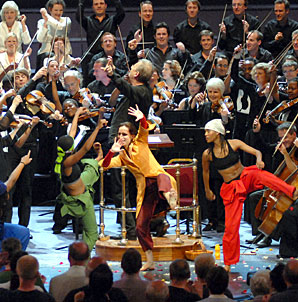 In an address in England last month to a conference of the Incorporated Society of Musicians, Frank Furedi asked hard questions and gave harder answers about the rôle of music in society and, more specifically, in politics.
Good Things; Small Package
May 20, 2008
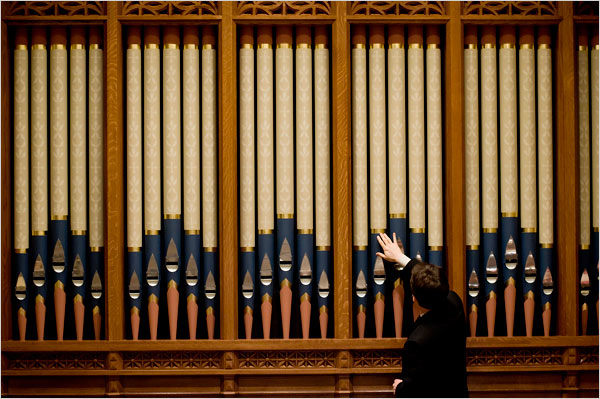 Even though Jack Bethards designed and executed the instrument to be versatile and complete, he told me that he was at first a little taken aback when he heard that the dedicatory recital last Saturday would feature Liszt’s monumental Fantasy and Fugue on the Chorale “Ad nos, ad salutarem undam,” based on a theme from Meyerbeer’s opera Le Prophète. But the enormous success of the performance itself was no accident and testified to serious progress that a niche-within-a-niche of the musical world has been making.
Musica Sacra et Profana
May 15, 2008
 One wonders if Allesandro Cadario realizes how unusual it is for someone to come to New York for the first time and have a work premiered at Lincoln Center. For that’s the fortunate situation the young Italian composer-conductor finds himself in. His Cantata for Revival will have its first hearing at the Rose Theater on Monday night, performed by Musica Sacra, whose late conductor Richard Westenberg commissioned it. The new music director of the ensemble, Kent Tritle, will lead it, along with Orff’s ubiquitous and emphatically non-sacred Carmina Burana, in its version with two pianos and percussion.
Part of the novelty of the new work lies in its instrumentation: seven cellos, piano, percussion, mixed double choir, three soloists (soprano, mezzo-soprano, baritone), and eight tuned crystal glasses. Its text is Biblical and in English.
In a conversation with the Milan-based Mr. Cadario, his pride in his origin in Gian Carlo Menotti’s hometown was expressed, as was his admiration for Leonard Bernstein. While I didn’t question him about how much his own style derives from these 20th-century masters, that may be in the back of the mind as the new work is unveiled on Monday. That and how it would feel to be 29 and first visiting a world capital to hear one’s own new work. Buona fortuna indeed!
Bringing Some of Yale to Carnegie Hall
May 8, 2008

In the 19th century, education in the liberal arts and the professions was handled in very different ways in different places. For example, in Germany a university education generally resulted in a law degree, but then that credential might be employed in a great variety of ways. In England a lawyer might or might not have had university studies at all when he began to “read law” in preparation for the Bar. Though lawyers like Abraham Lincoln followed that traditional path, Americans began early on to ally the study of the law with universities, but as a specialized study within the larger institution.
Musicians have been trained just as variously. Read the rest of this entry »
Il faut continuer
April 28, 2008
As balance to the well-merited sensation that the rapid-fire high Cs at the Met are causing these days, check out this completely different excerpt (from a live Vienna broadcast) in which pathos invades the comedy to great effect (as it always does in the greatest comedies like Cosí fan tutte). Even the interpolated high D-flat is employed for an expressivity miraculously divorced from mere showing off.
And none of this should be allowed to overshadow the brilliant work of Natalie Dessay in this triumph. Here’s a sort of video synopsis of her more showy moments:
Let it be noticed that she also excells in the limpidly expressive passages, like the “Il Faut Partir,” which can be heard at this link. It’s almost as though Popeye’s beloved Olive Oyl had suddenly become a casta diva.
A Night to Remember
April 22, 2008

History was made last night at the Metropolitan Opera House. Juan Diego Flórez was already having a remarkable first act in the first night of the new La Fille du régiment. But soon after he launched into “Pour Mon Âme,” it seemed pretty evident that the Met crowd would emulate their peers at La Scala and demand an encore (something that the Milan house had broken tradition to allow for the first time since Chaliapin in 1933).
After wild applause, not only did he do again what he had done to perfection once already — nailing in the process a total of 18 pristine high Cs — but he did so with enough variation in his stage manner and musical details to make the effect more than that of mere repetition. I have been unable to find anyone who can recall a prior instance of what happened next: a standing ovation in the middle of a scene.
Now, in such precedents, there’s always a danger of confusing opera with baseball and getting all worked up about “records.” And it would be especially unfortunate to be disproportionate in this case, since the production (already a hit in Vienna and London) is extraordinarily fine and the cast is full of first-rate performances that on any other night would be big news in themselves. But this is not a review, so I don’t need to be conscientious in that respect. (I trust many others will do everyone justice in print.) For now, I’m more than willing to grant the audience, and myself, the great pleasure of having been in the Metropolitan Opera House for one of those moments that we can impress or bore the youngsters with decades hence.
And, if you want to hear instances of the ease with which Flórez sings what has become his calling-card, look up performances of “Pour Mon Âme” or “Ah! Mes Amis” (of which it forms the second part) on this page of YouTube.
Video highlights of the whole production can be seen here.
UPDATE: You can now hear the actual “Pour Mon Âme” performances in question — ovations and all — on the New York Times site.
The Old Armory Sings Again
April 20, 2008

Starting in student days, I’ve performed or heard the Stravinsky Mass in highly varied circumstances. One memorable occasion fell on a cold, wet English January Sunday. The choir of King’s College, Cambridge sang it at the morning service, with a congregation that was outnumbered by the choir and instrumentalists. Another unforgettable hearing also occurred in that country (where it is far more likely to be found as part of the liturgical repertory than here in America), at a regular Saturday-morning Mass at Westminster Cathedral. In this case it was accompanied — to surprisingly good effect — by the organ in the apse.
But in the extreme resonance and utilitarian architecture of the late-19th-century armory on Park Avenue? The old-society WASPs of the Seventh Regiment would have stared, but last night was an important and liberating night for New York music, in a place whose previous concert events lie far back in another century. The start of the concert was held up for a while as a goodly portion of the audience stood in front of the building to see Pope Benedict drive by, and this was only a foretaste of how unfamiliar this event would feel to a regular local concert-goer. I have written here before about the imaginative use of different venues by George Steel’s Miller Theatre, and my imagination is still running wild as a result of their concert last night of sacred music by Stravinsky. Trying out three different areas in the fraction of the vast space that the performers and audience occupied, I found the acoustical issues challenging but not insuperable.
The performances were wonderful and profited by being freed from the conventional conditions of a concert hall. Future events — many of a sort that cannot yet have been even dreamed of — will tell us what the space can do for us musically. The building, now to be known as the Park Avenue Armory, could become a wonderland for creative types. I know I had some pretty wild thoughts last night: for example, what if some large Romantic organ of the type that lived in Paris’s old Trocadéro could be installed at one end? Could it be an opportunity for restoration of secular use of such pipes to our musical life? Stranger things have happened.
 RogerEvansOnline.com