Scandale!
July 17, 2009
 Good things can come out of bad. After a stunningly dishonest article in the Wall Street Journal in which a non-pianist who had not even attended the Van Cliburn International Competition (though leading the reader to believe he had) dogmatically and viciously contradicted the eminent judges and slandered the talents of the winners (and a fine orchestra and string quartet into the bargain), the commentary thus provoked has been extremely fruitful. Examples of it, from one highly-qualified and well-situated commentator, are here, here, and here.
Some of my own reaction to one of the Gold Medalists is already registered. While the old established print media continue to complain and hang crepe about their declining status and exchequer, one feels impelled to ask one more time: which of the sources here conduces to accurate musico-journalistic reporting and the flourishing of art, the formerly eminent old establishment newspaper or the frisky online blogger? Which could we better do without if we had to choose?
Leonhardt in Autumn
July 15, 2009
 Many today spend their careers trying to figure out, with the help of what documents survive, how music of the past was performed. When this is done for musical reasons and produces artistic results, it is an unmixed blessing. I’ve just come upon an interesting interview with Gustav Leonhardt in which he sounds a striking warning:
And we have to remember that so many of the treatises of the seventeenth and eighteenth centuries were evidently written because the author was angry with what he saw going on around him; he saw people doing things he thought were incorrect and wanted to correct them. With Bach we have a tendency to accept that whatever we know of the circumstances of the acoustics or the number of his performers was his ideal. So therefore the acoustics of St. Thomas’ represented what Bach wanted. We don’t know anything about such matters. He might have hated the acoustics of St. Thomas’, or the fact that the gallery was too high, and so on, just accepting what he had and getting on with the job. We give far to much credibility to the idea that everything a composer met with in his working conditions was what he wanted.
The interview goes on to make provocative points about the rehearsal of chamber music (your ensemble is no good if it requires a lot of talk and rehearsal) and conducting (it’s the easiest thing in music performance, if the highest-paid).
Minority Rites
July 11, 2009
 One of the happiest developments for those of us with interests that inhabit what are called niches is that no niche-interest is too small to get its full due through new media. There seems to be a blog for everything, and communication between people involved with the rarest pursuit can find fellow-enthusiasts somewhere in the world to gratify and stoke that zeal. Marketing has come to see the power of this phenomenon under the label of the “long tail” — out of which fortunes are being made on what would once have been deemed unprofitable minority concerns.
Some of these niches, of course, predate digital media but nevertheless profit from them and the communication they forward. Those interested, for example, in the history of the design, technology, manufacture, preservation, and restoration of pipe organs have long merited their reputation as a particularly hardy lot. The Organ Historical Society was founded in 1956, largely under the influence of the doyenne of organ historians, Barbara Owen, for whom that adjective hardy would constitute a laughable understatement. At the time when the Society was founded, the keenest interest among historians and amateurs was focused on the mechanical-action pipe organs that had predated the innovations involving pneumatic and electrical means, starting in the late 19th century. Their interest was far from being all abstract, for valuable monuments to artistic creativity and technological genius were being destroyed constantly in those days, simply for want of an appreciation for their irreplaceable value — a value often obscured by poor maintenance or the redundancy or altered purpose of the venues that housed them.
Read the rest of this entry »
Yankee Doodle Diva
July 6, 2009
 We have appreciated Joyce DiDonato here before, and the American mezzo-soprano daily extends the artistic celebrity that she deservedly enjoys round the world. But, on her country’s Independence Day, she demonstrated for British audiences physical bravery and performance-heroism that recall Greg Louganis’s return from injury to triumph in the 1988 Olympics.
Joyce DiDonato has provided her own account of the evening here, with followups here.
UPDATES FROM OTHER SOURCES:
Intermezzo
Financial Times
The Telegraph
Live Journal
Prima la Musica
The Independent
Parterre Box
Jacksonian Democracy
June 29, 2009
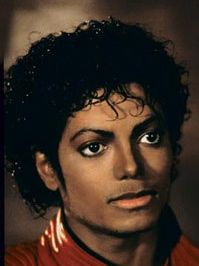 What we like to call, with disdain, the media circus surrounding the death of Michael Jackson was predictable. I’m finding, though, that the reactions of people I know are not so much so.
There has been an intermittently stimulating discussion of the list-serv of the American Musicological Society that appropriately asks the question of how fitting the toolbox of the scholarly musicologist is to the artistic legacy of Michael Jackson. Since modern musicology is conversant with the language of reception of art and the influences, upon it and by it, that are not altogether musical, the subject need not be an embarrassment to dispassionate research. But passionate research is what many will enter into when it comes to a figure whose effect on masses of humanity is not yet completely understood.
One blogger has taken up the task of aggregating serious writing on Michael Jackson — a worthy and particularly 21st-century-media thing to do. It will be interesting to watch how it develops. It can be expected to produce a mixture of scientific content wrapped in a commonplace wrapper and commonplace content disguised by scientific lingo (and I certainly know which I prefer).
I Feel Compelled to Point Out
June 22, 2009
 The young woman, Neda, who died from gunshot wounds while unarmed and unaggressive on the street in Tehran, died in the arms of her music teacher.
I can’t be the only musician who is moved by this.
Music Criticism vs. Fantasy Life
June 17, 2009

It is a perennial accusation made against worshipers that they make their gods in their own image. I’m on record below as being a big fan of Le Poisson Rouge, but in today’s New York Times we are told
So you can imagine how gratified the composer [Arnold Schoenberg] would have been to hear this fresh, keenly dramatic account of “Pierrot Lunaire” presented at an informal club for an eager and receptive audience.
Whoa there.
Schoenberg famously put on his ideal concerts for years in Vienna. These were notoriously ernst affairs. Would the man who didn’t even allow applause take to the easy-going Poisson Rouge atmosphere? I think not. Not the man who said, “If it is art, it is not popular. And if it is popular, it is not art.”
Another thing that the chief critic of the Times may be forgetting is that, if Schoenberg had had his way, said critic might not even have been allowed at the Poisson Rouge performance, since Schoenberg customarily posted a sign at the door saying, Kritikern ist der Eintritt verboten (“Critics are forbidden entry”).
Is It Still Serious Music If the Violist Smiles?
June 15, 2009
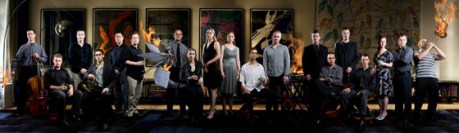
Le Poisson Rouge has been cited here before for its presentations and means of presentation. I’ve now been there for five very different occasions, and last night brought the best of those. In a program also flagged here recently, Alarm Will Sound gave a Derek Bermel evening.
While the music was consistently fine and the performances were of the highest virtuosity, the main point I want to make is one of attitude. I remember, years ago in the New Yorker, the estimable Andrew Porter’s expression of astonishment and pleasure when a chamber musician showed by a smile that he was pleased with a happy turn of phrase that he had just executed. We are not surprised when a member of an early-music group does this, and rock musicians of course have such facial demonstrations as an indispensable part of their stock-in-trade. But conventional “classical” instrumental musicians who aspire to be taken seriously (say, the player in most of your major string quartets or — goodness knows — the white-tie-sporting symphonic musician who dreams of a career in the Berlin Philharmonic) knows that the poker-face is part of the uniform. He’d no more laugh at a humorous phrase in Haydn than he’d wear flip-flops with his tails.
Thus, when the tacit violist in the front row right away reflected in the movement of his body that he was artistically involved in someone else’s playing, it not only increased my own involvement with the performance but it felt a little transgressive, too. But only for a moment. These folks are offering challenging “classical” music as though it’s something to be enjoyed. The fact that they aren’t ashamed to show their own enjoyment in their countenances and body-language gives us permission to imitate their involvement and share in their resulting satisfaction.
May their tribe increase, I say.
 RogerEvansOnline.com