The Astonishing Progress of Auto-Tune
September 3, 2009
________________
Tip of the hat to Ezra Klein and Patrick Appel
José Antonio Abreu and El Sistema Honored in Sweden
September 1, 2009
It’s rewarding to see glamorous prizes go to deserving objects:
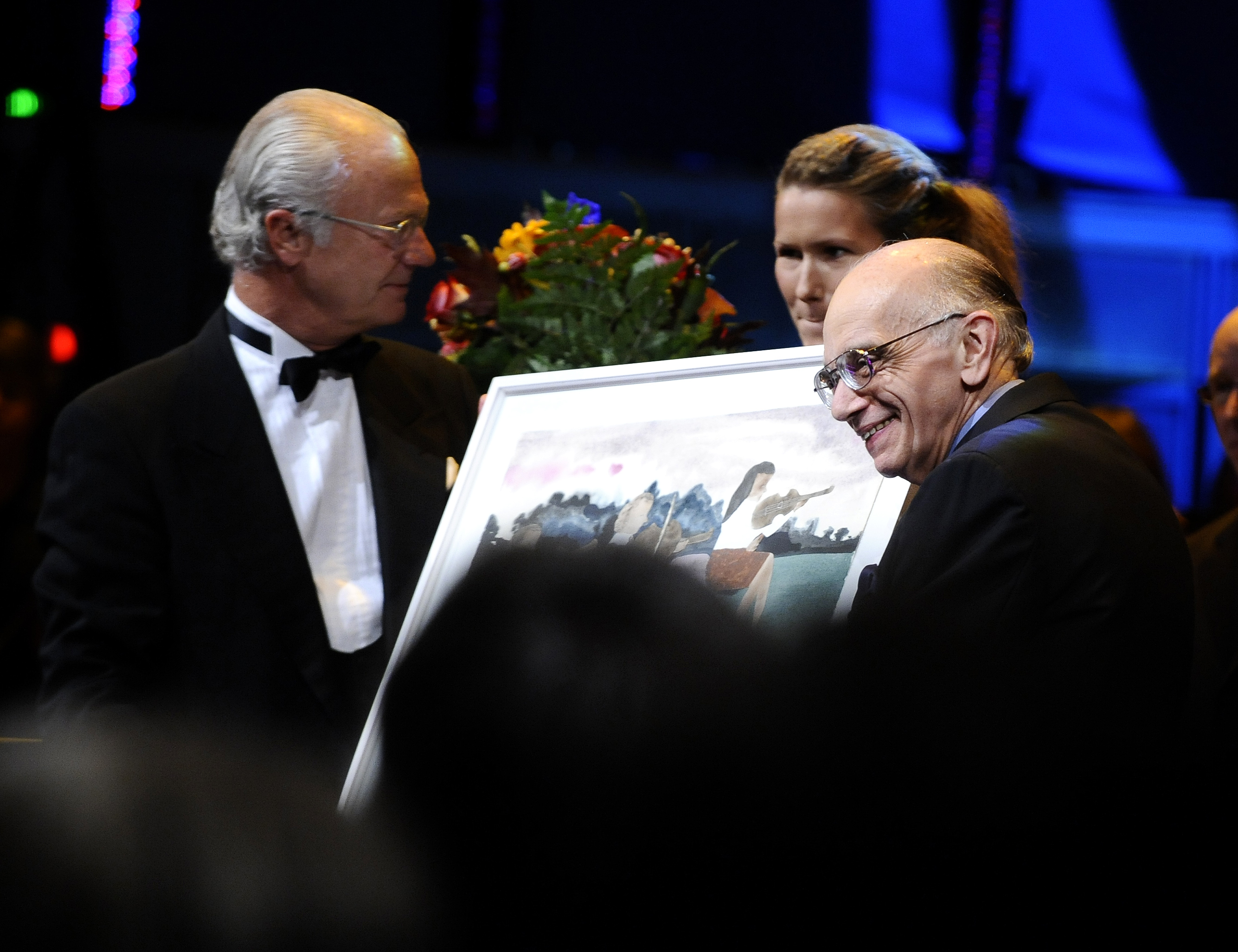
“Material poverty shall be conquered by musical richness. Social justice and cultural justice are aspects of a single dimension,” said José Antonio Abreu.
Abreu dedicated the award, which he received from Sweden’s King Carl Gustav XVI, to the educators who have worked with him in the Sistema Nacional de Orquestas Juveniles e Infantiles de Venezuela.
Peter Gabriel received his award a few minutes after Abreu’s, also in the amount of a million Swedish crowns ($129,000) along with a commemorative painting and bouquet. Gabriel was honored because of his “visionary, extroverted work that seeks to break down barriers.”
Gabriel and Abreu exchanged mutual praise in a press conference where they showed interest in working together and in which the conductor invited the British musician to come to Venezuela.
The Polar Prize was created in 1989 by Stig Andersson, publisher, composer, and manager of the Abba ensemble. Since 1992, the Prize has honored such performers as B.B. King, György Ligeti, Keith Jarrett, Bob Dylan, Ray Charles, Pierre Boulez, Elton John, Bruce Springsteen, Stevie Wonder, Dizzy Gillespie, Sonny Rollins, and Gilberto Gil.
…………….
Translation from today’s news article in El Nacional
This site has previously referred to El Sistema here and here.
Taking the Tempo-Marking GRAVE Literally
August 31, 2009

(Tip of the hat to Mark Nelson)
Aural Music History
August 25, 2009
 When I was a student, there was a woman who worked, rather inconspicuously, in a corner of a study room just to the right of the front door of the Yale music library. My friends and I became vaguely aware that she was doing something connected with an activity called oral history. It didn’t seem to resemble anything we then thought of as scholarship. We certainly had no idea that what she was doing was of enormous importance and that her name would soon become widely known and honored for having captured information in the form of recordings — recordings of voices that were often about to be silenced for ever.
The Yale Music School has put online samples of the vast store that Vivian Perlis was then beginning to amass and organize. Want to hear Charles Ives sing and play a song of his? You can do it here, where Elliot Carter, for example, can be heard talking about his personal contacts with Ives. You can also hear Aaron Copland admit how afraid he was to go to Paris to study with — of all things — a woman in the ‘Twenties, and how he and another strong woman came up with a name like Appalachian Spring.
A Thousand Digits — per square millemeter
August 23, 2009

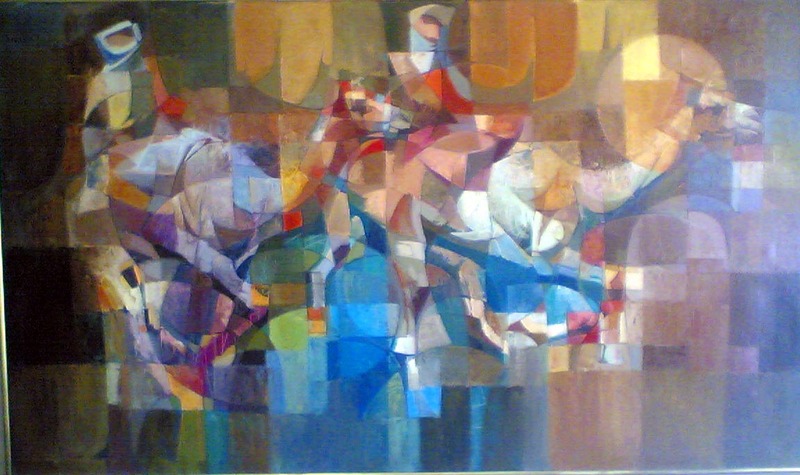
When the artist Josh Siegel displayed his latest painting, I admired it greatly. His early orientation had been to abstract impressionaism, but he had lately been mostly a figurative painter. The picture illustrated above is his first abstract in a decade. One speculates as to what effect current digital facilities for graphic creation had on this (to my mind, very fine) stylistic departure. His more usual stock-in-trade can be seen here.
Very excitingly, the actual process of creation can be traced online. Look here to see how he made the painting.
I find it exhilarating.
A Report on Music in Italy Just Before World War II
August 20, 2009
The Musical Times of June 1937 published a fascinating report by Kaikhosru Shapurji Sorabji on the state of music as he found it in Rome. It begins with pointed criticisms of Roman benightedness and then continues (as a subsequent entry here will show) by placing Italian musical culture far above that of his British readers. The experienced reader of music criticism will find much to read between the lines :
Back in Rome after a lapse of a few years, there are a number of matters that I have examined or re-examined with interest.
First, I observed the same monotonously stereotyped programmes of recitals and concerts to which I am accustomed at home [Plus ça change. — R.E.], the only difference being that insipidly familiar items acquire a temporary and unfamiliar visual piquancy in their Italianized names — this is especially diverting in the case of the battered threadbare rags of Lieder. To see ‘Der Jüngling an der Quelle’ become ‘Il giovane all’ Sorgente,’ ‘Waldeinsamkeit’ ‘Solitudine nella foresta,’ ‘Maria’s [sic] Wiegenlied’ ‘Ninna Nanna della Virgine’ is most odd [Imagine a time when a song of Reger qualified as a battered threadbare rag of Lieder. — R.E.] ; and still odder to hear those infuriatingly familiar strains wedded or rather forced into a mariage de convenance with Italian words! The falsification is quite indescribable, and the Italians, most clear-headed and realistic of peoples, knew what they were about when they stigmatized ‘Traduttore, traditore.’ Still odder is it to hear the whole delivered in a full-bloodedly baroque Italian manner of presentation, like the giddy aberrations of Sicilian 16th-century pastry-cook church decoration and architecture. For it must be said that the italian singer, even on those rare occasions to-day when he really is that and not a fish-salesman manqué, has a singular lack of flexibility of style or power of stylistic adaptation, such as is fairly common among even third-rate English performers. An artist like Dino Borgioli, whom I have many a time had occasion to refer to in enthusiastic terms, is the rarest of rare exceptions. A Borgioli is very rare anywhere, and even more so in Italy.
To be continued.
Seek and Ye Shall Seek
August 14, 2009

Seeking. You can’t stop doing it. Sometimes it feels as if the basic drives for food, sex, and sleep have been overridden by a new need for endless nuggets of electronic information. We are so insatiably curious that we gather data even if it gets us in trouble.
The fascinating, if not alarming, article quoted lays out research on the neurology of seeking and how its rewards differ from those of finding. It does so with reference to the digital searching that many of us do so much of — and some of us pride ourselves on doing so effectively. The findings may well be sobering.
But I have a couple of supplementary thoughts:
(1) I was trained in musicology and attendant disciplines by pre-Internet worthies who delighted in spending hours and days and months and years in, say, the British Library (where I have also done my time with somewhat modified rapture). While the process and rewards were on a very different time-frame for them, I can’t help wondering if the phenomena really differed in kind from what many — scholars and non-scholars — now experience (much sped-up) while negotiating the World Wide Web.
(2) Are some of the sensations described really so dependent on new media or even on explicit research? I’m working right now on a piece of music that is a couple of hundred years old. I’m under the impression that I’m being the beneficiary of a torrent of insights about this work that lead from one to another. There is before me no image of a final, complete revelation of ultimate truth. But there is the thrill of each small insight that gives birth to another — in a temporal frame that is unpredictable and, to something in my brain (or what feels like my soul), infinitely delightful.
Is there really anything new under the sun in kind, or only in degree?
UPDATE: Here’s an article that adds some nuance to aspects of the Slate piece, including why people who know somthing about, e.g., music always are looking for more knowledge, whereas people who don’t know anything about it don’t want to know anything.
FURTHER UPDATE: An article that disagrees with aspects of the original SLATE article actually gives support, it seems to me, to my hypothesis about the rewards of musical searching. And it seems that studying a piece of music gives us both the learned kind of reward (since certain skills are involved that must be acquired) and the instinctive rewards since, whether music is as necessary as food or not, it is as ubiquitous among humans as food is. And, at least for some of us, the rewards are comparable. We can actually hunger for music, and we find some music more nourishing than other music. The skills are acquired, but the need and its fulfillment are inborn.
The Arts Are Essential, Especially in Troublous Times
August 13, 2009
Rachel Maddow, speaking at Jacob’s Pillow:
Sometimes we choose to serve our country in uniform, in war. Sometimes in elected office. And those are the ways of serving our country that I think we are trained to easily call heroic. It’s also a service to your country, I think, to teach poetry in the prisons, to be an incredibly dedicated student of dance, to fight for funding music and arts education in the schools. A country without an expectation of minimal artistic literacy, without a basic structure by which the artists among us can be awakened and given the choice of following their talents and a way to get to be great at what they do, is a country that is not actually as a great as it could be. And a country without the capacity to nurture artistic greatness is not being a great country. It is a service to our country, and sometimes it is heroic service to our country, to fight for the United States of America to have the capacity to nurture artistic greatness….
Not just in wartime but especially in wartime, and not just in hard economic times but especially in hard economic times, the arts get dismissed as ‘sissy.’ Dance gets dismissed as craft, creativity gets dismissed as inessential, to the detriment of our country. And so when we fight for dance, when we buy art that’s made by living American artists, when we say that even when you cut education to the bone, you do not cut arts and music education, because arts and music education IS bone, it is structural, is it essential; you are, in [Jacob’s Pillow founder] Ted Shawn’s words, you are preserving the way of life that we are supposedly fighting for and it’s worth being proud of.
 RogerEvansOnline.com