Music and Upper-Body Exercise
November 1, 2009
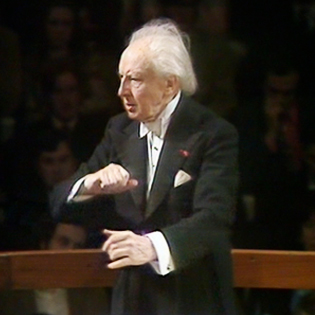
Ever noticed how many conductors seem to live to a healthy old age?
New Medium, Old Message
October 27, 2009
Old Medium, New Message
October 27, 2009

The enormous discography of the tenor Robert White has gone out into the world (starting when he was the child star Little Bobby White) in 78 rpm, 45 rpm, LP 33 1/3 rpm, cassette, CD, and mp3. Last month, the singer had the extraordinary opportunity to record on the wax of a 1909 Edison cylinder recorder. In that early process, the sound is captured, with no electricity at all, by purely mechanical means. The recorder’s motor is powered by a wind-up spring mechanism, just as when Mr. White’s father, who preceded him in radio and recording stardom as “The Silver-Masked Tenor,” made his first recordings in 1915. Even though the electrical microphone changed the process of sound recording quite drastically in 1924, this audio file makes it clear that the old method was remarkably effective, too:
Since George W. Meyer’s song “Brown Eyes, Why Are You Blue?” was written just as electrical recording was being introduced, this may be its first outing on wax. The new performance was recorded with Vince Giordano and his orchestra (“The Night Hawks”) before a live audience direct to the cylinder. The engineer, Peter Dilg of the Baldwin Antique Center, is a specialist in historic recording devices. Thus, in Robert White (whose birthday is today), the Juilliard faculty now can boast an Amberol Cylinder Recording Artist.
 You know that feeling that goes something like: “I can’t believe how lucky I am to be learning this”? I had that one a lot last week at mediabistro.com‘s amazing two-day conference (called UGCX) on user-generated content for the Web. One brilliant perception was presented after another — things that I can use in many aspects of my work to multiply its effectiveness. Of course, as in most things in life, the best ideas are based on common sense applied in a new way. Probably these breakthroughs are most dramatic in media because so much is so new and self-replenishing that all the common-sense aperçus are always very far from being used up. And what has served one field or industry well may not even have been thought of in another where it can produce terrific results.
That guru of social media, Ian Huckabee, has written about his own reactions, and — as usually happens when I experience something beautiful — I wish many of my friends could have been there so we could rehash the smorgasbord of thrilling ideas together. As it is, I’ll just have to collar some of them and try to convey how important, and really practical, so much new thinking on the importance of user-generated content now is for social media and the causes and products it can promote. But relax: instead of falling victim to my enthusiastic rants, you can just check out this link and this one — not to mention this one — for some sample summaries of what went on, or Twitter using the hash tag #UCGX.
Musical Creationism at Carnegie Hall
October 18, 2009

AND THERE WAS LIGHT!
Last night John Eliot Gardiner brought his Orchestre Révolutionnaire et Romantique and Monteverdi Choir to Carnegie Hall to perform Haydn’s most popular choral work, The Creation (or, as this performance, sung by English-speakers for English speakers, sang it, Die Schöpfung). It was a wonderfully detailed and altogether thrilling performance, but I want to share here a couple of aspects of the evening that were not essentially musical but have much effect on the experience of music.
All too often in classical music, the performers on stage seem to forget that they are performers in any but a narrowly sonic sense. They often seem to forget that the audience is made up of people who have more than one sense and that all these ways of perceiving work together to make up our experience.
It is true that many a valuable artist is simply not gifted with anything but musical tools — musical, that is, in its narrowest possible definition; and, when the single gift is of sufficient magnificence, we’re right to be grateful for what we get. But stable, world-famous touring organizations really have no excuse not to consider how their behavior can enhance or inhibit the musical experience. (I have railed here before on the poker-face with which some musicians would seem to communicate, visually, the absence of a human soul behind their playing or singing.) This is why it brought special pleasure last evening to note the care with which, so to speak, the table was set and the meal served.
What amounted to a simple, graceful “choreography” for the singers was very striking to me. Instead of the conventional stand-up-to-sing/sit-down-to-wait-out-others’-singing that we see at oratorios, in which people bob up and down in a routine and utilitarian manner, this chorus stood in attentive union throughout the orchestral overture, with their scores out of sight in their right hands. Towards the end of that dramatic overture, the bass who was to sing the introductory recitative readied himself to sing, well before his time. When he came to the mysterious incantation (in German), “And darkness was upon the face of the deep,” there arose a mist of choral sound softly singing “And the Spirit of God moved upon the face of the waters.” And all that moved was that Spirit, since the chorus stood stock-still, their scores still unopened, as they led up to the most famous “special effect” of Haydn’s masterpiece, the sudden C-Major fortississimo on the word “LIGHT.”
It would be difficult to overemphasize how important someone’s simple decisions were for the the success of these marvelous moments and to that culminating coup de théâtre of the First Day of Creation that Haydn had prepared for us.
And perhaps best of all: it was entirely unobtrusive. Had I not been so experienced at both arranging and observing such details, I’m convinced that my reaction would have been an apparently “only musical” one. But surely we all know by now that it is impossible to draw tidy boundaries between the music and its accompanying actions and conditions.
The second pleasant surprise was a personal one. Because of professional reasons and the powers and motives that normally bring me to such concerts, I tend to be seated at the orchestra level (not, I feel bound to disclose, out of any grandiosity or opulence on my part). So last night was the first time in years that I have been in the balcony of Carnegie Hall. I was immediately struck by something (besides the advantages a mountain goat would have in dealing with the incline of those steep rows of seats). Turning to the old friend — an inveterate denizen of world-wide concert-life — who had procured tickets for us, I whispered: “What is it about The Creation that brings out such a young audience?” As I pronounced the words, I began to suspect the truth.
“That’s the way it always is up here, Roger.”
Oh.
While the statistics on the ages of concert attendees presumably don’t lie, this experience of being surrounded by an amazing number of really young people in singles, couples, and small groups of friends, led me to wonder how much of the gloom in music journalism about an aging classical-concert population is influenced by the writers’ sitting night after night down in the expensive seats surrounded by the folks Alan Rich used to call “Daddy and Mammy Warbucks,” when a much younger crowd is upstairs.
Talent Must Sometimes Assert Itself
October 17, 2009
From a historical account of the revolutionary 1937 Disney film Snow White:
Finding a voice suitable for Snow White was one of the animators’ hardest pre-production tasks. One day, Disney’s casting director telephoned Guido Caselotti (a well-known voice coach who was married to an Italian prima donna) to get some voice talent references. Overhearing the conversation, Caselotti’s 19-year-old daughter, Adriana, got on the phone to sing and banter in a young girl’s voice. The embarrassed father ordered her off the line, but not before the casting director had invited her to audition. After Walt heard her, the rest, as they say, was history.
And here’s the result:
Making Ordinary Things Fun (What a Concept!)
October 16, 2009
Orfeo amb Clarinet*
October 11, 2009
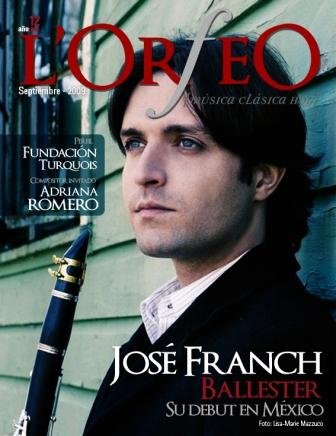 This site has already flagged the extraordinary young clarinetist José Franch-Ballester. If I’m right about his artistry, those of you within reach of Le Poisson Rouge will want to go hear him there on this coming Tuesday. He’s doing a concert with a pianist about whom I hear good things, Adam Neiman, who will also play a Chopin Ballade on his own. Last time I heard Mr. Franch-Ballester, the clarinetist from Valencia did the best Poulenc Sonata (with Anna Polonsky) that I have ever heard. Now he is going to play it with Mr. Neiman — who also, as composer, has contributed the piece that is opening the program, about which he tells me:
The Two Elegies for Clarinet and Piano are actually my own arrangements of my Two Elegies for Voice and Piano which I wrote 10 years ago. The original songs are lyric, mystical, and powerful vocalises, and I maintained the simplicity of the original vocal line while making it truly idiomatic for the clarinet. Both works are emotional and spiritual journeys captured in sound, and they are very close to my heart.
The concert’s at 7:30 p.m., and here’s the program:
Adam Neiman: Two Elegies for Clarinet and Piano (world premiere)
Chopin: Ballade No. 4
Brahms: Sonata No. 2
Arturo Márquez: Sarabandeo
Poulenc: Sonata for Clarinet and Piano
Kenji Bunch: Two Pieces from Cookbook
* That’s Valencian for Orpheus with Clarinet.
 RogerEvansOnline.com