Evolutionary Evidence for Origin of the Lullaby?
January 31, 2010
From this:
to this:
Kissin versus the BBC
January 28, 2010
 This site is so happily preoccupied with the three topics proclaimed in its masthead that even the three most fascinating subjects in the world — politics, sex, and religion — do not tempt it to deviate. But the position of music and musicians in society and influence of music and musicians on issues certainly are within its realm of interest. Thus the sudden thrusting of himself into a controversial political matter by Evgeny Kissin commands attention.
I well remember when a super-shy, retiring — even shrinking — Kissin emerged from the Soviet Union. I wrote the liner notes for his first three CDs that were recorded in the West and was at the twenty-first birthday party that RCA Victor Red Seal gave him, as well as other, similar occasions. In those days he wouldn’t say boo to a goose. Thus I am startled to see him speaking up against so mighty an entity as the British Broadcasting Corporation on an explosive issue and in forceful tone. Aside from the matter of his personal evolution, what is really compelling is the evident fact that he expects — and in this I think he’s correct — that he will be listened to, not because he is a known deep thinker or persuasive polemicist on this or any other political issue, but because he is an important musical performer. Any sequel to this will be interesting to watch.
Perhaps we can hope for a public debate between him and Daniel Barenboim? Dueling pianists indeed.
Hat-tip: Aleba Gartner
Remember When “Social Media” Meant Engraved Invitations?
January 25, 2010
A Bumper Crop
January 24, 2010

Anthony Tommasini has an article in today’s New York Times about the coincidence of the Schumann and Chopin birth-bicentenaries falling in 2010. The link between them, as he tells us, was Schumann’s earnest championing of Chopin’s music. Since Schumann was a very influential writer on music, this was significant to the success of a Polish immigrant to Western Europe who rarely played in public. (Tommasini passes over the less affirmative fact that Chopin, in return, treated Schumann and his music with something like contempt.)
While the 2010 double anniversary deserves to be celebrated, and will be, I’m equally interested in the fact that so short a period of time as four years produced such a large helping of the most influential musicians of an era. A simple and selective list is striking:
1809 Mendelssohn
1810 Chopin
1810 Schumann
1811 Liszt
1813 Wagner
(Am I alone in often carelessly thinking of Liszt as being much older than Wagner — perhaps because Liszt’s daughter married a man who turns out to be about the same age as her father?)
And this is to deal only with some who are now considered composers of the very first rank. What about Félicien César David (1810 – 1876), Carl Otto Ehrenfried Nicolai (1810 – 1849), Samuel Sebastian Wesley (1810 – 1876), Charles Louis Ambroise Thomas (1811 – 1896), Ferdinand Hiller (1811 – 1885), Sigismond Thalberg (1812 – 1871), Stephen Heller (1813 – 1888), or Charles-Henri Valentin Alkan (1813 – 1888)? They all made real marks on a music world very unlike our own, though the esteem in which they’ve been held has been markedly variable over the years.
Speaking of someone whose reputation was very high, then sank for a time, and is now perhaps more exalted than ever: one Giuseppe Fortunino Frencesco Verdi was born down in Italy in the same year as Wagner, showing that it must have been the air of those four years, not the soil, that yielded such an unexampled bounty.
Seal of Approval?
January 22, 2010

To mark the second anniversary of RogerEvansOnline, the Supreme Court of the United States used the word blog in an opinion for the first time:
Today, 30-second television ads may be the most effective way to convey a political message. Soon, however, it may be that Internet sources, such as blogs and social networking Web sites, will provide citizens with significant information about political candidates and issues. Yet, §441b would seem to ban a blog post expressly advocating the election or defeat of a candidate if that blog were created with corporate funds. The First Amendment does not permit Congress to make these categorical distinctions based on the corporate identity of the speaker and the content of the political speech.
– Associate Justice Anthony Kennedy
UPDATE – January 25: First the Supreme Court and now the Holy See: Benedict XVI used the word blog in a document yesterday:
… the latest generation of audiovisual resources (images, videos, animated features, blogs, websites) which, alongside traditional means, can open up broad new vistas for dialogue, evangelization and catechesis.
When two of the most tradition-bound institutions must consider blogs when they think of eternal verities, well, we’re not talking about mere trends here.
Name That Libretto
January 21, 2010
Tip of the hat to Kim Witman and her colleague Lorenzo da Ponte
On Avoiding This:
January 19, 2010

In a field not without its wise guys, Michael Kaiser is one of its wise men. I read him often and almost as often quote him — usually in his assertion that tough times call for better art, not merely less expensive art. His explications of this principle have become almost as famous as his legendary ability to turn around organizations in decline.
But, in a short piece in yesterday’s Huffington Post, he adds important nuance to this. Namely: don’t be so concerned with doing better next season that you neglect opportunites to salvage matters this season.
Dethroning Music or Restoring Context?
January 18, 2010
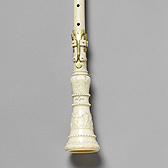

There is much understandable consternation that the Victoria and Albert Museum, with one of the great musical-instrument collections of the world, is shutting down their galleries for these instruments — in favor of an enlargement of their display of costume and fashion. At first blush, I was alarmed at this. When I was a young pup, I interned in our own national collection of musical instruments at the Smithsonian, and one of the guiding lights we looked to for conservation and display was the sister operation at the V&A. But while other collections, like those of the Metropolitan Museum or Yale, seem to flourish (the Met is even now building new galleries for their own), the V&A is shutting their dedicated gallery down.
I remember being told right away at the Smithsonian that a big difference between that collection and that of the V&A was that the London museum classified musical instruments as furniture, whereas Washington put them under history and technology. The resulting difference in attitude can of course be a major one.
As a thoughtful, if alarmist, Evening Standard article points out, the classical-music business is booming in London, and such a cutback might seem rather counterintuitive, if not mad. What the article doesn’t mention is that the instrument galleries at the V&A have been open only one day a month, so that the intention of distributing historical examples around the museum into other appropriate galleries might in fact increase the exposure of the objects. And, more to the point, it might greatly increase their impact.
For, in fact, there are two main reasons for such collections. One is that they are a resource for historians and for makers of musical instruments. Only a fraction of this huge collection has ever been on exhibit, and the rest are stored for research and conservation purposes. These uses will not be impeded by the new arrangements — in fact, they might well be enhanced, since objects on display were not available for this kind of examination. The other purpose was for the education of the public. But this meant that only the people who were motivated to go to the musical-instrument galleries got the benefit of the information that these displays could impart. Might it in fact carry a much larger intellectual and cultural payload for people to encounter Queen Elizabeth’s virginal in a context of, say, Tudor furniture? Or to come upon a dancing-master’s violin in a context involving social life, education, or aristocratic homelife? An African thumb-piano might be much more at-home surrounded by sculptures from its own tribe rather than being in a gallery with a Cristofori piano.
Far be it from me to forestall anyone’s pleasure in the sort of default doom-and-gloom that infects so much of our “high” cultural life. Therefore, I’m not contradicting the concern over this issue (which now has a Facebook page, which I was happy to join). If Sir Roy Strong were still running the V&A, I’d feel quite confident that an enlightened strategy was afoot. I know little about the current régime but see no reason not to hope for the best. Nothing, it would seem, about the announced measures are irreversible, and these were galleries that — even apart from their being almost entirely closed to the public — were clearly in desperate need of revitalization. So the public debate can only be healthy — so long as we recall that fruitful debate is never one-sided.
 RogerEvansOnline.com