Christus Victor
April 3, 2010
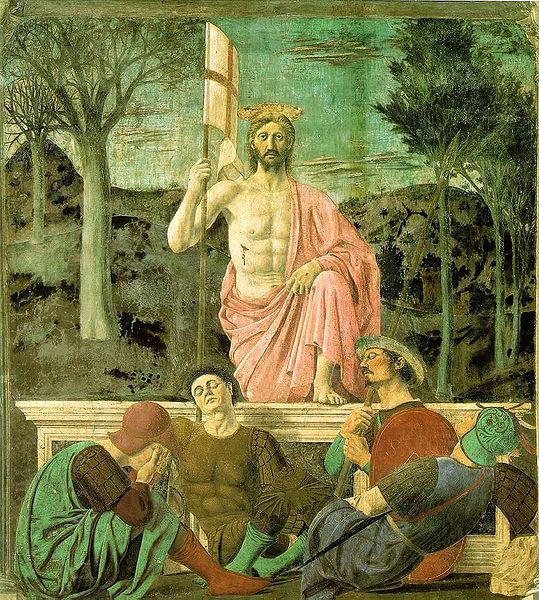
The Resurrection of Christ by Piero della Francesca (c.1420--1492)
My favorite over-the-top Edwardian Easter anthem (Stanford), on a super-dramatic medieval text (St Fulbert of Chartres).
Come, Ye Daughters, Share My Anguish
April 2, 2010

A Bach Saint Matthew Passion Webcast from The Netherlands, one of the innumerable local performances of the work this time of year — each different, with its own flavor.
Flourishing Art
March 31, 2010

Les Arts Florissants in Concert at the Leipzig Gewandhaus
The French troupe Les Arts Florissants have just left us. By us, I mean Brooklyn and anybody who could get there to hear and see their wonders. Why can’t they forsake Paris and just stay around here? What does Paris have that …? Never mind.
I’m one of those who have followed them for years. And to follow is to admire. I saw the now-historic production of Lully’s Atys that made them international stars, and if it didn’t change my whole life it certainly changed that not inconsiderable part of it that deals with the French Baroque and its tributaries. Lully, I had learned somewhere in an expensive education, was pretty thin stuff. Not as they delivered it, even as seen in this ancient sound-challenged video:
When I was in music school, a rumor went round that a guy from a few years before had run off to Paris and was intending to tell the French how to perform and appreciate music that they had themselves long neglected. There was lots of chuckling that Bill Christie was heading for a tumble. I, being too ignorant even to have an opinion, just heard all this and stored it away. I had heard a very fine harpsichord recital by him when he came back to collect a doctorate, but a recital does not a whole new operatic culture make.
But his Atys years later was revelatory, as have been many of the things I’ve seen and heard from his gang since. They did at least the second Dido and Aeneas that they’ve done in New York on this last visit, and this clip from the most famous bit should remove any doubt that modern production values and Baroque musical drama can coexist fruitfully:
We see Dido die and feel as centuries have felt at her fate, while hearing some of the most sublime music ever devised.
Why can’t more opera companies be so innovative — while also being not so much preservative as revivifying? I went to a rehearsal of their Fairy Queen last Friday. Mind you, this rehearsal was four days after the first performance of the run. Can you imagine the Met doing such a thing? Well, they simply opened the doors, charged people $20 to watch a 45-minute spot-check (i.e., the conductor giving “notes”) of how the production was going, with some commentary addressed to the audience. I, for one, did not feel in the least cheated by the brevity or the opportunism of the affair (photo below of the orchestra during the event). It was really quite wonderful, and one felt connected with an important enterprise. This is what I call intelligent marketing. Besides, at the “Baroque Cabaret” that they gave the weekend before, a BAM official had said that “When we do an opera series, we lose more money by intermission than we do in our whole theater season.” Glad to help, ma’am.

This is What Total Commitment Looks Like
March 26, 2010
And sounds like. The great Magda Olivero turned 100 this week.
A Composer Whose Time Has Come
March 23, 2010
 This from my friend Paul Desenne in Caracas.
Ten Books
March 21, 2010

In his own blog, Tyler Cowen has listed the ten books that have influenced him most and asked other bloggers to do the same. He is also aggregating other people’s lists. I choose to take the seat-of-the-pants approach and am writing the first ten that I think of rather than poring over this. Not the ones that I think I should say or the ones that necessarily would most influence me today.
Richard Adams: Watership Down
George Eliot: Middlemarch
James Alison: The Joy of Being Wrong
C.S. Lewis: That Hideous Strength
Anthony Trollope: Autobiography
Bruno Montsaingeon: Mademoiselle: Conversations with Nadia Boulanger
Robert Hughes: Barcelona
Oscar Wilde: The Importance of Being Earnest
James Boswell: The Life of Samuel Johnson, Ll.D.
Dorothy Parker: Complete Short Stories
UPDATE: Looking this over one day later, I’m fairly shocked by one fact: Dorothy Parker is the only American writer in the list.
ANOTHER UPDATE: I’ve been asked why the Bible is not on my list. Because I assume that practically everyone in our society has been influenced, if not most influenced, by that book or gathering of separate books. If you ask me my favorite drinks, should I list water? Or must breathing figure in my list of favorite activities? Even the person in our culture most adverse to its teachings is mightily “impacted,” as the cant goes, by that volume.
Rising Stars Light the Sweetest Path
March 20, 2010
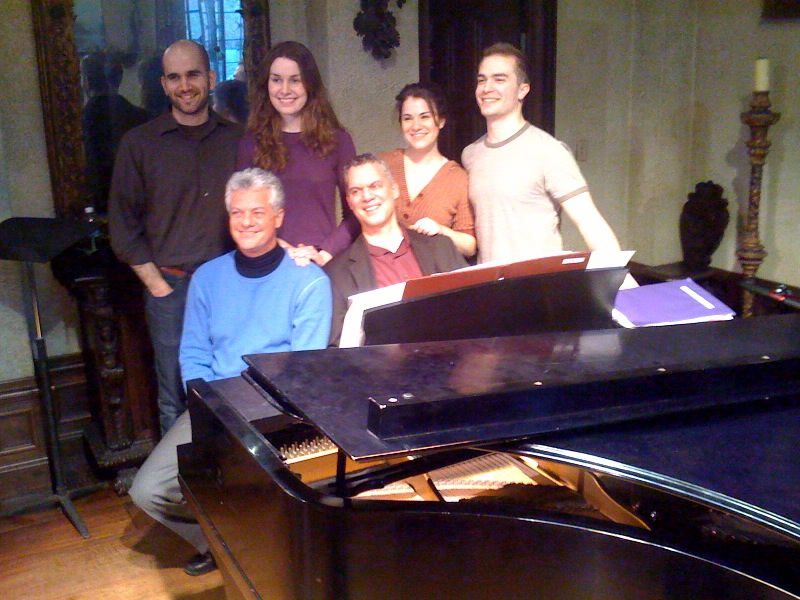
I’m sure that I was far from alone among readers of The New York Times on March 4. When I read the article “At Caramoor, a Focus on Songs of the Belle Époque,” I thought: “Now that’s something I’d like to know more about.” Imagine my delight, then, when I heard from Michael Barrett, Executive Director of the Caramoor Center for Music and Arts, inviting me to come up to the fabulous estate — for once, the over-used fabulous is precisely the mot juste — in Katonah, New York, for a day of observation and informal interaction with the participants who had already spent a week living, learning, cooking, debating, and making music together.
It would be hard to imagine a project more perfect of its kind. Steven Blier, Artistic Director of the two-decade-old New York Festival of Song, of which he is a co-founder with Mr. Barrett, is in his second year of running for Caramoor this ten-day “spring break” concentration of minds and voices on a compelling subject that varies by the year. This year it was the French art song — or mélodie, as they say — that fell under their study, scrutiny … just what is the right word? As I watched Blier and Barrett and the four young singers at work, I must say that images of both the dining room and the kitchen kept coming before me. They were falling upon this material with an appetite that was certainly sometimes ravenous, but also full of the more refined approach of the epicure and a Julia Childlike preoccupation with the original creation of the poetry and music and, now, its re-creation.
Seeing the singers in a conference with their two mentors was a lesson in cooperative interaction, but it was when they entered upon a run-through of the actual concert-to-be that I got to the meat of what had been going on here. The first singer to come out interpreted the theme song for the week, Fauré’s “Le Plus Doux Chemin (The Sweetest Path).” The baritone John Brancy was something of a known quantity, since I see him around musical events quite often and had heard him — first when he was a high schooler, appearing on the PBS show From the Top. His rich, perfect vocal production and entirely professional stage presentation made it difficult to believe that he is just 21 and is still an undergraduate at the Juilliard School.
Then came Matthew Peña, a tenor who was new to me. The moment he began to sing, however, a magnetism that was the essence of the song he sang seemed to take over everything about him. He is somewhat more experienced, since he already has two degrees from Oberlin and one from the Manhattan School of Music, but it was his first interaction with this NYFOS crowd — I almost said cult — and it was clear that he was going to fit right in.
He was then joined for a serene but passionate love-duet by Charlotte Dobbs, a soprano who, like her tenor partner has already been through a liberal-arts education (at Yale) and is a graduate student at the Curtis Institute. But, unlike him, she also has done time with Steven Blier at Juilliard . Her demure interaction with the more extrovert Peña in this song did not quite prepare me for some of what was to come from her later, especially in the sensuous Ravel “Vocalise en forme de habanera.”
When Rebecca Jo Loeb bounced out on to the stage, it was not surprising that she was going to sing about an amorous elf. Though this mezzo-soprano projected a much more serious affect later in this varied program, she does excel at the songs that allow her to communicate in a mischievous manner with the audience. But I thought it spoke well of her that her high point came with a song in the grand tradition by the great mezzo Pauline Viardot. Since she brings with her an education at the University of Michigan, the Manhattan School, and Juilliard, we were seeing interaction of four bright young talents with a nice mixture of backgrounds.
In addition to the well-known expertise of Blier and Barrett, the group had had input the day before my visit from the French opera star and singer of song Jean-Paul Fouchécourt, who is in the country for the opening of the New York City Opera spring season, in which he portrays the male lead in Emmanuel Chabrier’s L’Etoile. Since, in this program, we were never far from some song by Chabrier — a particular favorite of Steven Blier — Fouchécourt must have seemed like a Gallic prophet to these singers, some of whom were encountering large doses of French poetry and music for the first time. Indeed, he said he found them to be veritable sponges.

Jean-Paul Fouchécourt
This kind of avid absorption must be very gratifying to all the devisers of this ambitious mentoring project. Indeed, I had a chance to hear of her own satisfaction from Eileen Schwab, whose idea the mentoring program in vocal song was. Through the support of the Terrance W. Schwab Fund for Young Vocal Artists, the program grew out of Caramoor’s other mentoring programs, for instrumentalists and opera singers. This seems very important, since mentoring is one of the greatest needs in the musical art — not to mention in all of society — if skills learned in studio and classroom, and drilled in the practice room, are to take flight in the real world. But Mrs. Schwab’s enthusiasm was not just because of the process. I was hearing from her after the culminating New York concert in the Merkin Concert Hall. It was the result of all that work that inspired a rapt audience to ovation after ovation for a particularly meaty survey of French mélodie, from Gounod to Poulenc — with not a longeur all evening.
So is it the process or the result that is the point? I’d say we really don’t need to choose, since the concert that thrilled audiences in both Caramoor and New York treated the public to a valuable finished product; but, with these extraordinary young singers, we have not even begun to see the good things that will flow from their experience at Caramoor. And Steven Blier and Michael Barrett have plenty more up their commodious sleeves, as well.
Opened, and Well Opened
March 19, 2010
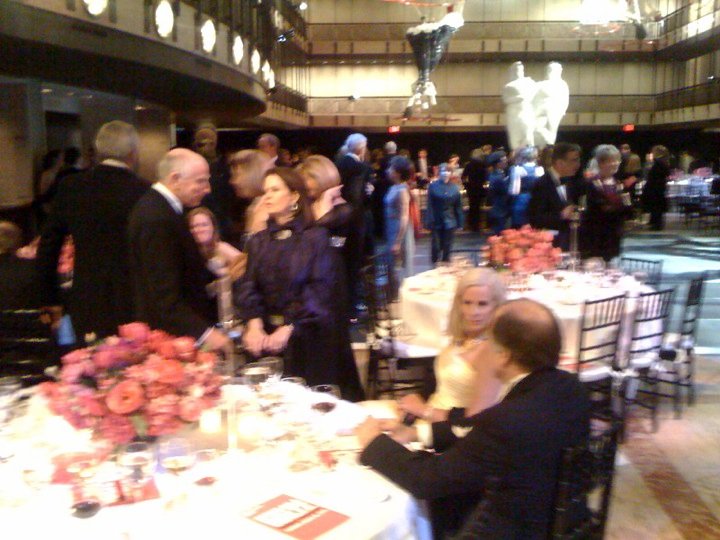 It’s a great pleasure to be able to say that the important spring season of the New York City Opera opened last night not only with a French operetta perfect of its kind, but with a general élan about the place that is greatly inspiriting for the many who have missed the company’s presence near the center of the city’s cultural life. The impression persists from the fall season — and is, if anything, augmented — that this company has a new lease on life.
The largely Gallic cast, and entirely Gallic flavor, of this very well-integrated mounting of L’Étoile by Emmanuel Chabrier (about whom a little more tomorrow) is very fine indeed, but to a New Yorker a special gratification must be a more residential element: the crack orchestra and a chorus that even approached the supererogatory Broadway level of choreographic gameness. For an evening of lighthearted, stylish entertainment, this show — which runs till April Fool’s Day — is a rare treat.
 RogerEvansOnline.com