Today’s Good News About the Future of the World
May 3, 2010
UPDATE: Perhaps even more impressive:
Hat-tip to Steve Best
Modern Production Design: Sweet or Bitter
May 1, 2010
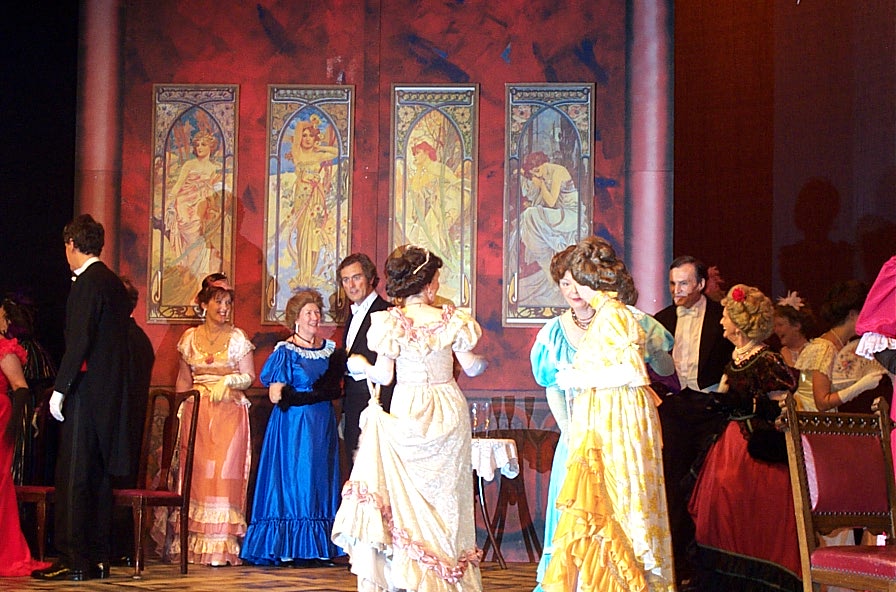
The whole subject of how opera productions should look is much controverted these days, especially in online discussion. Much is made of the idea that Broadway and its practitioners are influencing, for conspicuous example, the Met. Some find this a blessing and some a bane. But we should remember that Broadway shows have changed at least as much as opera productions have. Here is a set of video views of Noël Coward’s 1929 Bittersweet, which was presented in that year both in the West End and on Broadway. It should help clear our minds of any idea that lavish, hyper-realistic productions began with one Signor Zeffirelli.
Tip of the hat to Robert Francks
Idea Man
May 1, 2010

Opera Chic has the most extensive interview with George Steel that I’ve seen since he took over the New York City Opera. In it, he not only lays bare some of his hopes for that company, but does some remarkably thoughtful processing of opera history and its implications for truly popular art today.
The Russian French Swiss American Stravinsky
April 26, 2010
 Over at Avery Fisher Hall, they’re wallowing in Stravinsky — under the title “The Russian Stravinsky.” Is there any other Stravinsky, you might ask? Well, yes, it seems so. Richard Taruskin, as usual contrarian but right, tells us all about it.
I was able to hear Les Noces, The Symphony of Psalms, and Firebird after the Icelandic volcano let St. Petersburg’s Mariinsky Theater Chorus get through, and I’m certainly glad that I did — and that it did.
Coming up is one of my favorite Stravinsky works, which happens to have been commissioned by the Philharmonic. The main point of this post is to point out that they have taken the extraordinary step of posting online a free recording of the composer conducting the Symphony in Three Movements at the time of the premiere. Though I’ve certainly heard more fetching performances of it, it’s always a privilege to hear what the composer was able to get out of the orchestra when the piece was spanking new.
(And, by the way, I here register a rare disagreement with my colleague La Cieca, who spoke on Facebook of the work’s title as the “least palatable opus name.” I always found “Symphony in Three Movements” particularly elegant in a neo-classical sort of way.)
Everyone’s Friend Flicka
April 22, 2010
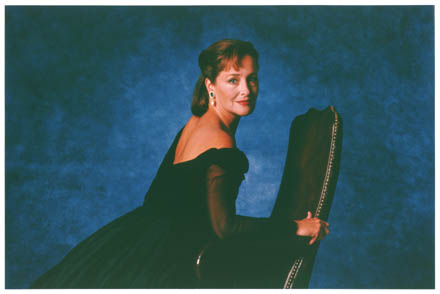
Tonight brought an extraordinary event in Carnegie Hall as Frederica von Stade gave what was billed as her New York Farewell Concert.
Many people say that they have trouble separating an artist’s art from his or her character. I ordinarily seem not to be one of them. My response to Wagner’s music, to take an extreme case, seems completely separate from my view of his beliefs and moral character. To mention Frederica von Stade is to cite an equally extreme case, though assuredly in the opposite direction. It’s difficult not to feel that her generosity, both of spirit and of practical action, makes her art all the more potent. I can’t really say, since I’m such a total fan of both the woman and her art.
But they certainly can be separated in some ways, for she manages to do it herself. She does nothing in her musical performances to capitalize on the inescapable reputation she has for what Evelyn Lear publicly proclaimed the other day as saintliness of a Mother Theresa caliber. In fact, as she sang William Bolcolm’s and Arnold Weinstein’s brilliant song “Amor” tonight, she made the indelible performances of it by Bolcolm’s wife and muse, Joan Morris, seem utterly chaste by comparison. When she sang Offenbach’s hilarious “Ah, Quel Dîner,” she wasn’t just a little tipsy, she seemed in danger of sliding under the piano — and even staggered as she walked onto the stage. She can convey these different atmospheres and characters with such complete conviction (while dressed in an enormous ball gown and hung with jewels) that we forget for the moment her own sterling personal reputation. This conclusively testifies to her integrity as an artist. Many other things testify to her integrity as a woman: a recurring late-night activity among some of my friends is to trade stories of her often extravagant but discrete kindness.
Wagner believed in the possiblity of a Gesamtkunstwerk. Frederica von Stade has shown us that a life, too, can be a complete work of art.

Not for the first time, I’m led to think how much medieval scholars would have loved the World Wide Web, and how many of its best tendencies are continuations of medieval practices that have fallen into abeyance since. (C.S. Lewis once said that the Middle Ages would have adored the modern alphabetized file box filled with index cards. Remember index cards?) Here’s a snippet from a new post that has attracted considerable comment:
In the longer run I expect “annotated” books will be available for full public review, th[r]ough Kindle-like technologies. You’ll be reading Rousseau’s Social Contract and be able to call up the five most popular sets of annotations, the three most popular condensations, J.K. Rowling’s nomination for “favorite page,” a YouTube of Harold Bloom gushing about it, and so on.
This, like so many other new opportunities, represents a democratization of a medieval practice that has become less practical in an age of mass-published books but grows ever more practical with digital distribution and the growing viability of niche markets. I have seen manuscripts of Aristotle with Aquinas’s commentary on the text in the surrounding margins in smaller script, with a further surround of margins full of subsequent commentary in even smaller writing (and sometimes different color). These once provided extremely important study texts (and often served lecturers for the text of their lectures; that may have been their primary purpose, in fact). Now, of course, they are vital to scholars of the history of ideas. Tomorrow we have the chance to continue this sort of practice on a much larger scale, with far wider accessibility. And we need not limit such layered commentary to written texts. The same kind of commentary on commentary on commentary can be used for, e.g., art criticism or musical analysis.

Music and Technology March Forward Hand in Hand
April 22, 2010

This was a first for me. Though I did subsequently print the score, it was useful to be able to try it out this way beforehand.
If we want to hunt for ironies, the fact that the music was 17th-century Italy and the delivery-system 21st-century Cupertino should be enough for us. But that sort of thing is more common every day.
UPDATE: At least I didn’t do this:
Happy Day Chez Roger
April 20, 2010
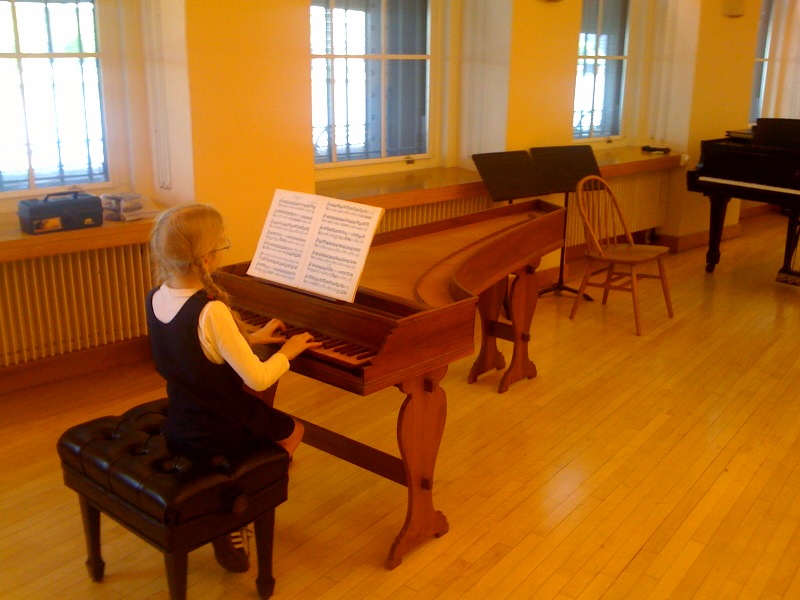
Today, after months of restoration by Peter Fisk, my wonderful Italian harpsichord (Dupree, 1977) came home — and just in time for my 10-year-old pupil to play the Daquin “Coucou” on it for her school recital.
 RogerEvansOnline.com