“I Made That Sound”
June 7, 2010
While she’s talking about actors, she speaks clearly to the mission of musicians as I conceive it.
Tip of the hat to Catherine Pisaroni
A Reverberation, Not an Echo
June 2, 2010

Sitting down to review a concert in St. John the Divine and then complaining about its spacious acoustics is about as helpful as writing about water and emphasizing that it’s wet or blaming ice for being too cold (New York Times: “A Chorus of Echoes, for Better and Worse“). Banal in the extreme.
But surely anyone charged with writing about music needs to know the difference between reverberation and an echo — that what she was hearing was not echo but seven seconds of admittedly massive reverberation. An echo of course repeats a sound, whereas reverberation has the effect of sustaining the sound. Having spent much of my career making music in reverberant churches, I have cheerfully pointed out the difference to people who asked how much “echo” there was. It is galling, however, to find that a music writer for the New York Times is in need of such an elementary explanation: except for very special effects, an echo would be musically disastrous, whereas much of the music devised in history depends to a large degree on consistent reverberation for its full effect. (Rock musicians know this perfectly well as they add digital “reverb” — not echo — to their amplified or recorded effects.)
It is perhaps graceless for a humble blogger to point this out, but the continuing decline of newspapers with their claim to special expertise, editorial control, and accuracy would be truly disastrous for music were it not for the at least counterbalancing presence of online media.
Happy Birthday, Frederica von Stade
June 1, 2010
From New York, Via London
May 31, 2010

My friends Stephen Hough and Robert White have been mentioned (favorably, of course) here before, more than once. Now they are together in an interesting and typically insightful post on Stephen’s London Telegraph blog. (And I note that he is now Americanized enough to call the wireless a radio!)
UPDATE: Hear Stephen in a fascinating, if short, BBC feature on mathematics and music.
Viva Italia!
May 30, 2010
Oh, to have been there!
It’s Just an Illusion
May 27, 2010
 It’s such a commonplace that we may not much think of it. In music performance we count on making things seem evident that simply aren’t objectively true. Some of them are so present that we hardly notice them: the piano, with its fast-dying-away tones is physically incapable of legato. But thanks to the artistry of good players, we have the impression of smooth, connected, cantabile piano-playing. Piccolo players, playing high arpeggios, sometime seem to place shimmering high chords above an orchestral texture, when those evident chords are really individual, sequential notes.
Last night, after a relaxed dinner with an old friend that I had not seen in some months, I played a couple of harpsichord pieces for him. He’s an educated musician who, however, knew nothing about how a harpsichord works. In answer to his queries, I removed the jack-rail and showed him how a jack functions: plucking the string as the key causes it to rise, damping the string as the key is released and the jack falls. “How then,” he asked, “are you making some notes louder than others?” That’s one of the greatest compliments a harpsichordist (or organist) can get — playing, as we do, an instrument on which there is no direct control over the intensity of the individual note. Having a listener confirm that the illusion of varied volume is getting through is a real affirmation.
I then gave my friend a little demonstration of how the illusion of comparative dynamics is created, but all the time I was glorying in that question he had asked.
It was ever thus. Illusion is everything in art.
A Window on Sills
May 26, 2010
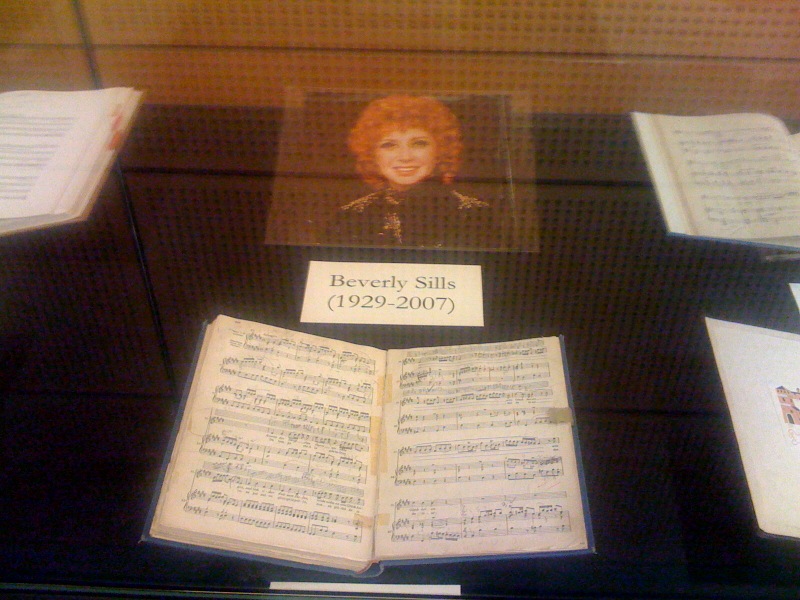
The wonderful Music Research Division of the New York Public Library at Lincoln Center (where I’m spending a great portion of my time lately) has a very good display in honor of Beverly Sills, whose birthday came yesterday. It consists of working piano scores for some of her roles. They are of course worn, much marked-up, and remarkably evocative.
Here is a view of her score for Handel’s Giulio Cesare, her performance in which first made her a household word. She has added a staff for her elaborate ornaments and included dynamic and articulation markings:

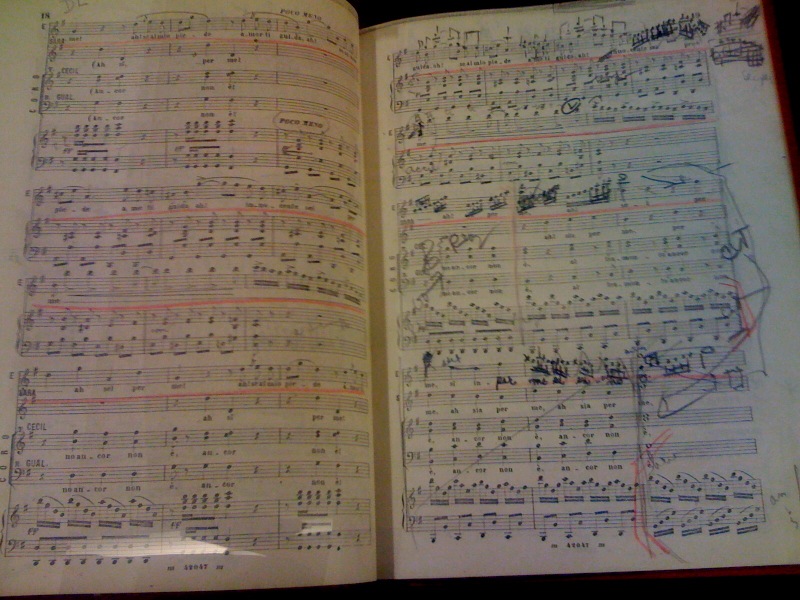
I was particularly interested in seeing her score for her celebrated appearances as Queen Elizabeth in Donizetti’s Roberto Devereux, a memorable portrayal that I’m happy to say I saw several times. In addition to the kinds of musical markings that we see in the Handel, she here includes notes for stage movements as well:
And here is her bookplate:

Opera in Spain: Robust Art in a Limping Economy
May 20, 2010

Gran Teatre del Liceu, Barcelona

Teatro Real, Madrid

Palau de les Arts Reina Sofia, Valencia
In the worldwide economic downturn, Spain — the world’s ninth-largest economy — provides a particularly dramatic example of dizzying rise and decline. One of the most vigorously growing economies in recent years, it had been projected to surpass Germany in per capita income by 2011. Much of this was based on the real-estate boom that has also been central to the global downturn. Industrial production in Spain is now down 25 per cent, bankruptcies have multiplied alarmingly, and unemployment has risen above 20 per cent.
Faced with such a serious financial recession, how are the arts faring in a country where government funding has always played an important role in supporting the arts? And what of opera, that most expensive of art-forms, in this financial atmosphere? It turns out that the three leading opera companies seem to be following the principle that you don’t meet economic challenges effectively by reducing the quality of your offerings. We see a number of imaginative initiatives, not only involving “outreach” — a term the mere use of, sometimes is felt to get management off the hook — but also of responsiveness to changes in the expectations of the public.
Barcelona’s Gran Teatre del Liceu, the grand old lady of opera on the peninsula, is behaving like a vital young organization on the make. Its trilingual Web site confronts you with three categories: Liceu, Petit Liceu, and Campus. We see a schedule of thirteen major operas on the main stage, but these are accompanied by concerts large and small, designed to enhance that repertory. These range from an imaginative presentation of Prokofiev’s Peter and the Wolf in connection with his less familiar (and far less cuddly) The Gambler. This season, the anti-war War Requiem is paired with Britten’s 1949 opera for children; it is sung by children with audience participation and concerned with solidarity between children of different social classes. This season they have cut back on supplemental events in the Foyer, but are even taking advantage of that reduced expenditure to broaden the program: in future seasons they aim at partnering with other institutions around the city with the prospect of moving the smaller concerts out of the Foyer and into further-flung venues — thus increasing both geographic dispersal and constituency.
Most opera companies these days try do something for the kiddies, but the Liceu, with its integrated Petit Liceu, goes all-out. This season, besides Peter and the Wolf, there is an interactive show for children to explore the power of song in nature and in their own emotions; a “magic voyage through the world of opera”; a danced dramatization of a children’s story; and special children’s versions of The Magic Flute and Rossini’s Cinderella and Barber of Seville, adapted and directed by the popular Tricicle comedy team.
Under Campus comes the Open Opera program, in which HD transmissions of Liceu productions go to universities, which incorporate them in their curriculum. Similarly ambitious is the Orchestra of the Academy, made up of young professional instrumentalists from all over Europe and providing major concerts, beside occupying the pit for some productions at the Liceu.
If the Liceu is inclined to cut back on the richness of its offerings under economic stress, they are disguising it particularly well.
In Madrid, we find the revived Teatro Real— right across from the Royal Palace and, like the Liceu, receiving about half its income from the State — in evidently fine condition as well. The arrival of the always-newsworthy Gerard Mortier (lately of the Paris Opera) will be seen as a vote of confidence from abroad and of aspiration at home. As at Barcelona, we see that imagination is valued as much as funding — or one is perhaps seen as a prerequisite for the other. The Teatro Real is reaching out to a larger public by offering free tours (including backstage) late at night after a performance and presenting a course for elementary-school teachers all over Spain called Opera: A Vehicle for Instruction. In addition, significant discounts on tickets are available to those age 26 years or less.
All this outreach is justified by a pretty impressive repertory: fifteen operas interspersed with filmed operas, guest concerts and dance troupes.
Having looked at an old house with a continuous tradition (Barcelona) and at what is essentially a new company in a historic opera house (Madrid), many of us will be particularly interested to see what an entirely new establishment in a spectacular new arts complex is up to. Valencia’s Palau de les Arts Reina Sofía, whose music director Lorin Maazel until this season headed the New York Philharmonic, is not stepping shyly into the operatic limelight. After last season’s complete Ring cycle (conducted by Zubin Mehta and staged by La Fura dels Baus in a coproduction with the Maggio Musicale Fiorentino and recorded in HD), supplemented by related concerts, this season’s varied offerings started off with a much-talked-about run of Les Troyens in a production by La Fura dels Baus, conducted by Valery Gergiev (coproduced with the Mariinsky Theater and Teatr Wielki). Significantly, productions from the Palau are being used extensively by other companies, including the Los Angeles Opera. In June, after the end of the opera season, they celebrate the Festival del Mediterrani, which is also supervised by Mehta and includes three more operas.
This is much more a multi-use house than the other two and, as might be expected in a younger company, the overtly educational efforts are more limited — though Valencia is clearly serious about their young-artists program, putting it in the hands of none other than Plácido Domingo. It will be an interesting situation to watch.
It appears that in Spain, the more established a company is, the less it depends on sheer monetary power. A new company understandably must rely on basic funding to set itself up as a formidable musical and dramatic presence, whereas the confident historic house becomes a fountain of imaginative and sometimes outrageous productions, matched with venturesome outreach efforts — initiatives that are not just pasted on or opportunistic but are true to its main product. It would appear that the amounts of money available from struggling central and local government will not be the whole story for these companies. Both those in countries with a history of massive governmental support and those that have long depended on private funding may find much to learn from what happens in Spain. Already they provide an object lesson in how artistic and marketing ventures that are intimately connected can construct a unified front for an organization. This can happen only when both spring from the same vision and process. Such an approach clearly holds great promise for non-profit arts in societies today.
Roger Evans wrote a version of this article for the DCM newsletter.
 RogerEvansOnline.com