The Linguistic Universe of the Olive
May 19, 2014

It is an exceedingly rare thing for Google to let me down — or, put another way, for my skill in wielding Google to let me down. But yesterday I typed the words, “vintner and producer of olive oil,” and I have ever since wondered what you call a person who makes that ancient elixir from the olive. Living in Catalonia, where olives are such a fact of life, words derived from the fruit’s name abound, as I’m sure is the case in all other Mediterranean languages. (Joan Plowright’s married name, after all, means “Lady Olive Tree” in French.*)
In Catalan, an olive tree can be masculine (oliver) or feminine (olivera), but the olive itself is always feminine (oliva). A true indication of the penetration of olives in daily life is the fact that there are no fewer than three adjectives for things pertaining to olives: olivinc, olivós, and olivaci. (Spell check is struggling mightily against me in this post.) The drab green color sometimes known as khaki in English is verd d’oliva on army uniforms in Catalan. You don’t need two words to designate an olive grove; either olivar, oliverar will do.
But I still haven’t found a word for the man or woman who turns the olivers into olives (the plural of oliva in Catalan looking identical to the English plural), and then into the treasured oli d’oliva. Thanks to one of my favorite dictionaries, I know how to hold out the olive branch to someone (either ram or branca d’oliver). But I’m convinced that one of you will tell me a one-word occupational name. I have always assumed that the cognom of one of the most important Catalans in history, Abbot Oliba, might be a clue, but as a I think about it now, the instability and interchangeability of Bs and Vs in Iberian languages probably just makes his name mean olive.
So come on, readers: do for me what Google didn’t do this time!
* Typing that made me curious enough to check, and (thanks, Google) Lord Olivier was indeed of French ancestry.
Artistic Patrimony
April 28, 2014

“James A. Flaherty” (1903) by Thomas Eakins
It is a commonplace, almost a reflex, in criticizing institutions like the Vatican, to ask why they don’t sell their artistic treasures and give the money to the poor. That would certainly seem to answer a direct suggestion of the church’s founder to “go and sell all your possessions and give the money to the poor” (Matthew 19:21). On the other hand, I once read an economist’s calculation of how many seconds of relief the world’s poor would gain from selling off all the art in the Vatican museums. It wasn’t much. Without devaluing even the smallest respite to such suffering, an enlightened view of human nature might recognize other kinds of hunger apart of the merely nutritional — hunger that art has its own way of satisfying with a nurture beyond the physical. Besides which, an institution like the Vatican Museums (and other great ones) deliver value to great sections of humanity that the sale of the works to a few billionaires would hardly effect.
It may surprise those well-meaning critics that these issues are at least as controversial in the church as they are among the church’s detractors. A recent article on a significant blog, frequented largely by Catholics of a reflective, culturally-aware kind, has taken up a concrete instance in which an American archdiocese found itself in possession of minor works by a historically significant American artist at the same time that they wanted money to renovate some buildings. The works, by a young Thomas Eakins, documented relationships that he formed as a non-Catholic seeking solace in conversations with clerics at the Philadelphia seminary. He gave the portraits of these men as gifts reflecting his gratitude. While these are not works of art recognized as having significance for the whole of humanity, they instance a stage in a significant painter’s journey through grief, consolation, faith, and doubt. The comments to the article (whose contents will surprise many — among whom I include myself — in the extent to which the hierarchical church has thought through the issues occasioned by artistic possessions) show a vast panorama of thoughtful responses to the problem.
Eakins was not just any local painter. His most famous painting is important in the history of the popular understanding of surgery. And one of his paintings,
Eakins’ only religious work, a “Crucifixion” painted in 1880, could not attract a buyer because it was deemed “too graphic.” It was donated to the Philadelphia Museum of Art by the Eakins family in 1929.
And, as an illustration of how many considerations may come into such a discussion, a British commenter even enters charges of homoeroticism in Eakins’s art as a consideration.
While, in the reaches of eternity, we may well feel that all the great art in the history of what used to be called Christendom is of less value than the peace of mind of a single abused child; and while we should not over-value what “moth and dust doth corrode and thieves break in and steal,” art is not just a piece of merchandise. It records and contains pieces of the human spirit, which is also a legitimate concern of the church.
To Music
March 19, 2014
Hearing Kaufmann sing about the “Lindenbaum” in that video, I’m carried back to childhood, where I learned an English-language version of the song. So, for better or worse, as he sings “Am Brunnen vor dem Tore/ Da steht ein Lindenbaum,” my mind provides the counterpoint of “Beside the well and doorway/ There stands a linden tree.” That might be considered a little impure as a listening experience, but it brings up for me long personal association with this music and the approximate atmosphere of its text. When the musical climax comes, I’m recalling:
And on its many branches
I carved the name I love.
In sorrow or in sadness,
They call me from above.
At least those are the rather soupy words that I remember (and the German original is hardly restrained). The subject of translations of sung texts into a local language is a hoary, complex, and irresolvable one, but I can’t regret having trudged through the decades with English words bearing the music of “Der Lindenbaum” in my head any more than I regret that, when I hear “An die Musik,” there is a ghostly “Thou lovely art, my joy and consolation” going on in the background. I can’t even remember what school or what music teacher taught us to sing those songs of Schubert, but all my schooling was in public institutions. How many children are receiving such lifelong-lasting gifts now in the schools?
If I had not had such teaching — given, remember, to all my classmates as well — how different might my life have been? I don’t know what these Lieder meant to the rest of them, but they couldn’t have hurt. As for me, I could hardly have known that the climactic words to which I sang “An die Musik” (To Music) were fairly prophetic:
Thou lovely art!
I give my live to thee!
And, Speaking of Translation
February 12, 2014

When I worked for international classical record labels, I was particularly alert to differences of English usage around the world, not only as a matter of courtesy and tact but in the interests of commerce. This consciousness also emerges in everyday conversation, since I live in a cosmopolitan community in which foreign languages are not the only source of verbal challenge, the majority of English-speakers that I encounter daily not being Americans. (My only English conversation yesterday was with a half-Greek, half-German woman who lives on a Spanish-governed island in the Mediterranean.)
Today, in writing an electronic message, I spoke of a recent event “on the Carrer de Verdi” — a street in Barcelona. But, since I was writing to an Englishman, I changed — considerately, I thought — “on the Carrer de Verdi” to “in the Carrer de Verdi.” As often happens in such situations, meditations and speculations on usage sprang up unbidden. Why, I thought, do we have this difference in British and American usage? Is it possibly because, in a town setting like that of, say, Oxford (the kind of place where standard usage may be assumed to have been established), entering into a comparatively narrow street is rather like entering into a sort of structure, albeit open to the sky. In a country initially and fundamentally rural, as the United States long were, it would feel absurd to speak of such-and-such farm, with structures set well back from the road, as being in a particular country road, any more than, nowadays, a certain shopping center would be in a six-lane highway. The same might even apply to American towns, where the streets tend to be wider than in Europe, except in the older, formerly colonial parts like Wall Street, where tall buildings create urban canyons. Even if my guess about the reason for the difference is wrong, I can’t say that I regret the fact that a single English monosyllable can set off such chains of speculation.
I’m also reminded that the distinction occurs in Anna Russell’s famous disquisition on Wagner’s Ring Cycle when she evokes laughter by speaking of the Rhine Maidens’ scene as opening not on the river, but in it. And, come to think of it, while I’m content to type this post in the Carrer de l’Illa de Cuba, no one lives in the actual island of Cuba, but on it. It’s an efficient language in which a single letter can make such a difference.
In the Garden of Words, Concepts, and Usage
February 11, 2014
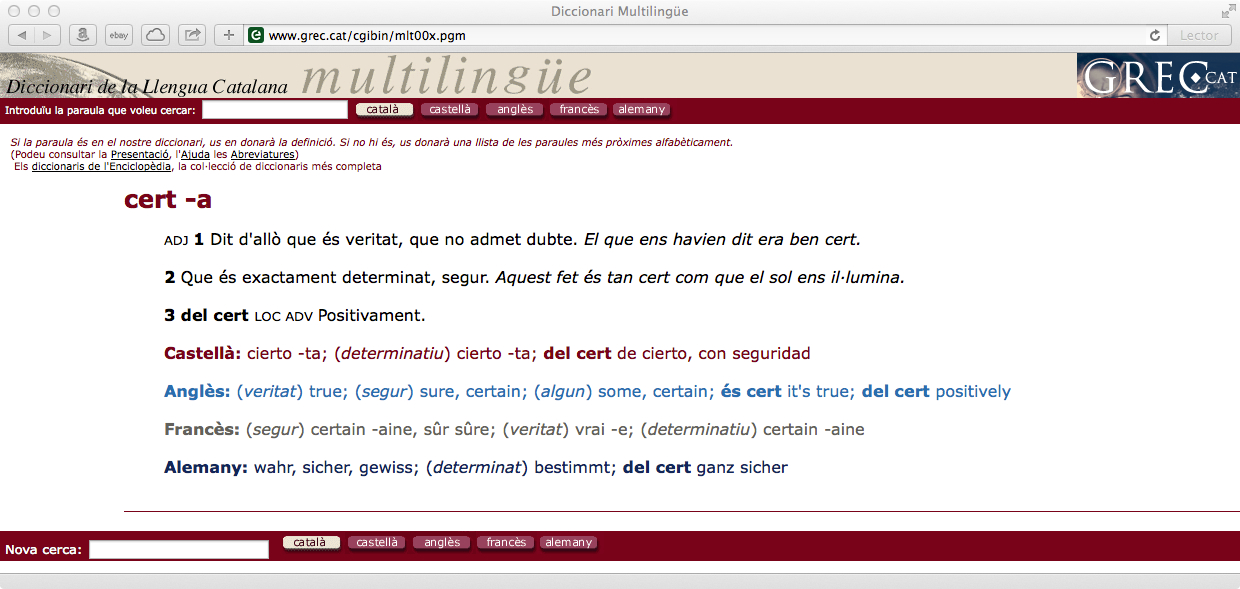
For many years, I was a great collector of dictionaries. Nowadays, I’m likely to be reading a newspaper on a train and be pleased that I can look up a word on my phone, or to be reading online and stay online to go to the appropriate dictionary. I’m particularly impressed with the dictionaries for the Catalan language, including this comprehensive one, which gives excellent OED-level definitions in Catalan when you simply write the word in the box on the upper left. But my newest favorite is the Diccionari de la Llengua Catalana Multilingüe, which gives the definition in Catalan, Castilian, English, French, and German. Why learn a new word in just one language when you can learn or review it in several? You can also enter a word in any of those languages and get full information concerning the use of its Catalan equivalent. (After you type in the word, you click the name of the language that the original word is in.)
Of course, a large selection of such dictionaries, as well as allied encyclopedias, can also be bought in big, sturdy hard copy. And if you go to this main page and enter a word in the search field, it will yield up references in various dictionaries and encyclopedias. (And, English speakers, keep in mind that, when it tells you that there are 1.978 entries for your word, the period in that number is equivalent to the comma in English-language usage, not a decimal point.)
Stop. Look. Judge.
February 5, 2014

A fake Chagall
A friend who did a Ph.D. degree in art history at Harvard told me about his first class, called simply Connoisseurship. It seems that the professor brought an object into the class and set it in front of them without comment. They were then to look at it and come to conclusions. Provenance. Meaning. Techniques. Quality. Lot of things came into play. Even authenticity, since the object was sometimes a forgery or copy. I’d think such skills would be useful to any person, even a CIA officer. But, Mr. Obama and many other people of the lawyer class don’t seem to see this.
Perspective: Jacques Thibaut
January 24, 2014
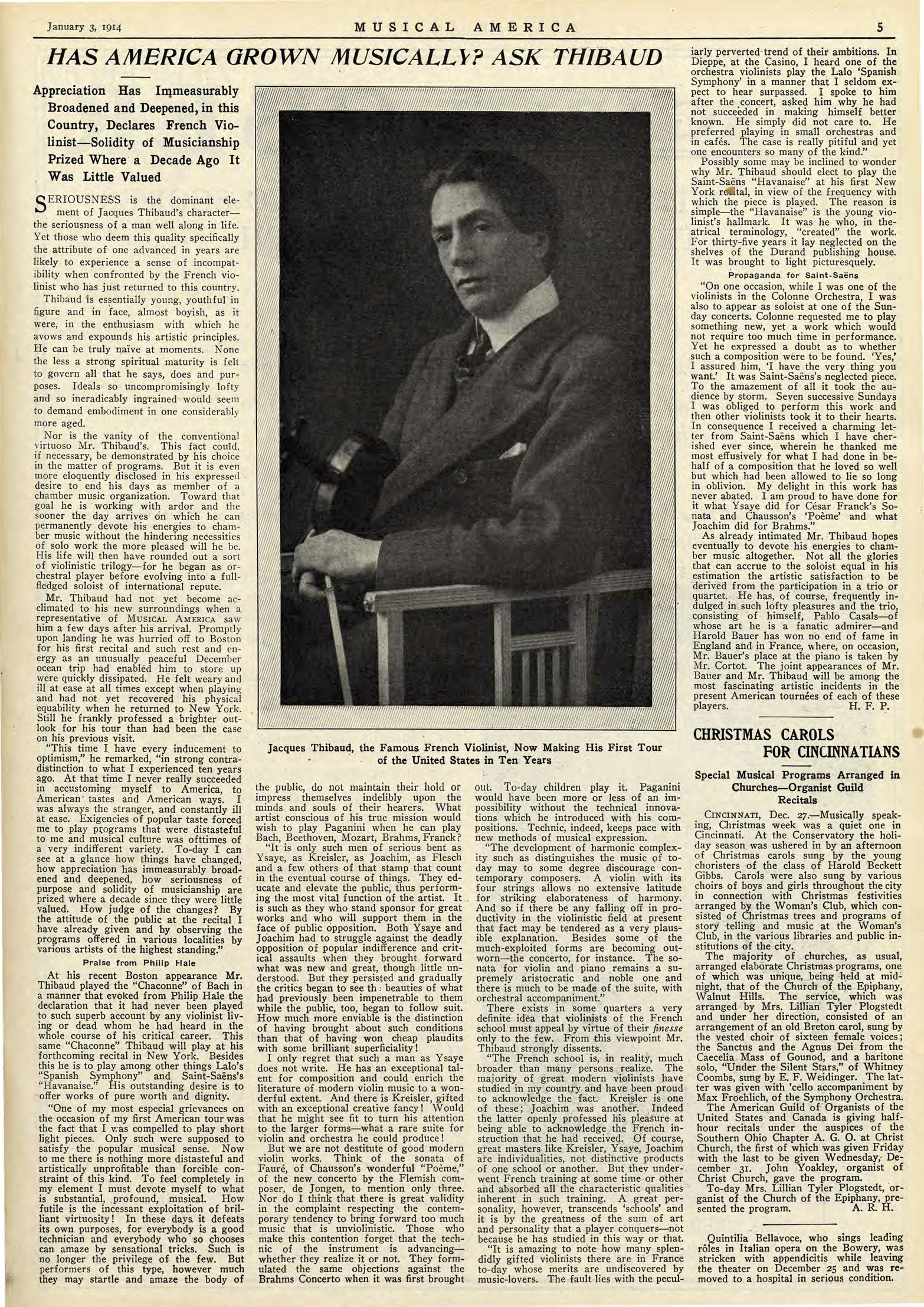
A hundred years ago, Jacques Thibaud was young but thoughtful (click to enlarge):
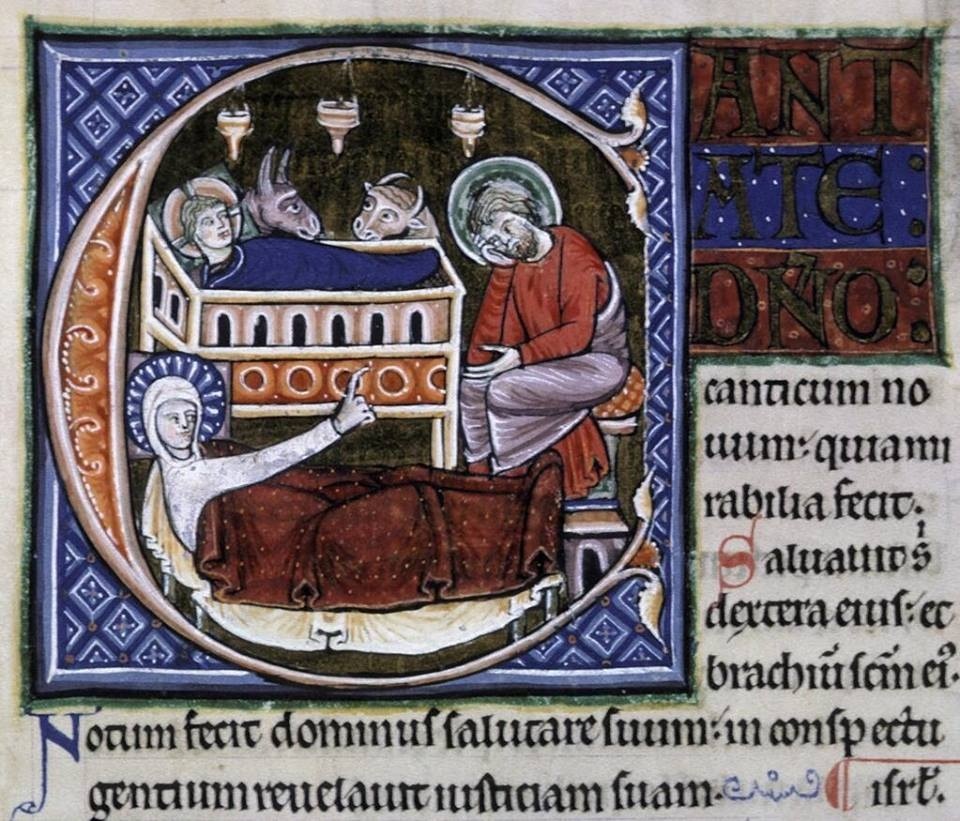
Happy Christmas 2013
December 25, 2013
 RogerEvansOnline.com