Does Being Online Alter the Way Our Mind Works?
June 17, 2008
 In a thought-provoking essay in The Atlantic, Nicholas Carr reminds us how new technology has raised disquiet in thoughtful minds in the past:
Just as there’s a tendency to glorify technological progress, there’s a countertendency to expect the worst of every new tool or machine. In Plato’s Phaedrus, Socrates bemoaned the development of writing. He feared that, as people came to rely on the written word as a substitute for the knowledge they used to carry inside their heads, they would, in the words of one of the dialogue’s characters, “cease to exercise their memory and become forgetful.” And because they would be able to “receive a quantity of information without proper instruction,” they would “be thought very knowledgeable when they are for the most part quite ignorant.” They would be “filled with the conceit of wisdom instead of real wisdom.” Socrates wasn’t wrong — the new technology did often have the effects he feared — but he was shortsighted. He couldn’t foresee the many ways that writing and reading would serve to spread information, spur fresh ideas, and expand human knowledge (if not wisdom).
The arrival of Gutenberg’s printing press, in the 15th century, set off another round of teeth gnashing. The Italian humanist Hieronimo Squarciafico worried that the easy availability of books would lead to intellectual laziness, making men “less studious” and weakening their minds. Others argued that cheaply printed books and broadsheets would undermine religious authority, demean the work of scholars and scribes, and spread sedition and debauchery. As New York University professor Clay Shirky notes, “Most of the arguments made against the printing press were correct, even prescient.” But, again, the doomsayers were unable to imagine the myriad blessings that the printed word would deliver.
 Much is made, in today’s New York Times obituary, of Stewart Mott’s benefactions to political causes, most of them minority in nature. Unmentioned was his zeal and financial support for early-music projects and ensembles. He was one of the financial backers of the historically crucial New York Pro Musica Antiqua, which was such news in my childhood. (I remember seeing performances by them on the Today show during school-morning breakfasts.) Later, when a student of Gustave Reese and John Reeves White, I heard many a casual reference to Stewart Mott as someone who must be consulted or thanked for this or that.
Among the statements issued upon his death, perhaps Ralph Nader’s comes closest to implying why he was such an angel to the musical efforts of many, saying that Stewart Mott was “about the most versatile, imaginative philanthropist of his time. He threw himself into projects and was a pioneer in many fields well before the large foundations.” It was noticeable that supporters of early-music explorations were often the funders of progressive political causes.
So let’s add a postscript to the man’s memorials: while his living on a chinese junk in the Hudson or maintaining a farm on a Park Avenue roof will always grab more journalistic inches, let him also be remembered for a zeal for the uncovering of surprising music from the past for the astonishment of our present.
A Medieval Theory Lesson
June 3, 2008
UPDATE: I have been notified that the original video, above, has been removed from YouTube. It does, however, exist — without the English subtitles — here.
The World’s Youngest Septuagenarian
May 26, 2008
 William Bolcom is seventy today. In a year of major composer birthdays, this one comes as something of a surprise, perhaps. If anyone is in the high noon of his musical day it is Mr. Bolcom.
Why Make Music?
May 22, 2008
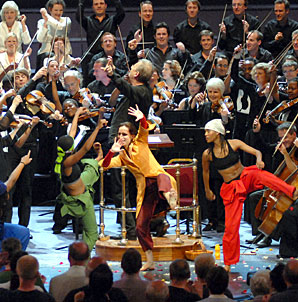 In an address in England last month to a conference of the Incorporated Society of Musicians, Frank Furedi asked hard questions and gave harder answers about the rôle of music in society and, more specifically, in politics.
Good Things; Small Package
May 20, 2008
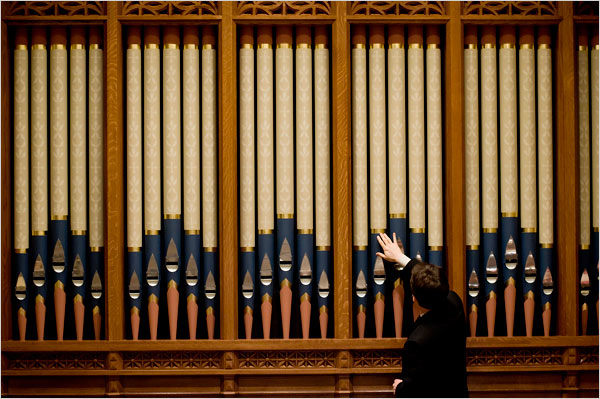 Even though Jack Bethards designed and executed the instrument to be versatile and complete, he told me that he was at first a little taken aback when he heard that the dedicatory recital last Saturday would feature Liszt’s monumental Fantasy and Fugue on the Chorale “Ad nos, ad salutarem undam,” based on a theme from Meyerbeer’s opera Le Prophète. But the enormous success of the performance itself was no accident and testified to serious progress that a niche-within-a-niche of the musical world has been making.
Musica Sacra et Profana
May 15, 2008
 One wonders if Allesandro Cadario realizes how unusual it is for someone to come to New York for the first time and have a work premiered at Lincoln Center. For that’s the fortunate situation the young Italian composer-conductor finds himself in. His Cantata for Revival will have its first hearing at the Rose Theater on Monday night, performed by Musica Sacra, whose late conductor Richard Westenberg commissioned it. The new music director of the ensemble, Kent Tritle, will lead it, along with Orff’s ubiquitous and emphatically non-sacred Carmina Burana, in its version with two pianos and percussion.
Part of the novelty of the new work lies in its instrumentation: seven cellos, piano, percussion, mixed double choir, three soloists (soprano, mezzo-soprano, baritone), and eight tuned crystal glasses. Its text is Biblical and in English.
In a conversation with the Milan-based Mr. Cadario, his pride in his origin in Gian Carlo Menotti’s hometown was expressed, as was his admiration for Leonard Bernstein. While I didn’t question him about how much his own style derives from these 20th-century masters, that may be in the back of the mind as the new work is unveiled on Monday. That and how it would feel to be 29 and first visiting a world capital to hear one’s own new work. Buona fortuna indeed!
Bringing Some of Yale to Carnegie Hall
May 8, 2008

In the 19th century, education in the liberal arts and the professions was handled in very different ways in different places. For example, in Germany a university education generally resulted in a law degree, but then that credential might be employed in a great variety of ways. In England a lawyer might or might not have had university studies at all when he began to “read law” in preparation for the Bar. Though lawyers like Abraham Lincoln followed that traditional path, Americans began early on to ally the study of the law with universities, but as a specialized study within the larger institution.
Musicians have been trained just as variously. Read the rest of this entry »
 RogerEvansOnline.com