A Sticky Post
September 13, 2008

You can now sign up to receive a discreet e-mail notification whenever there’s something new on RogerEvansOnline.
Or you can subscribe to the site through your customary reader.
Just go to the About page, scroll down, and click on either the e-mail or reader link.
It’ll be good to be that much more in touch with all those who have been coming here regularly!
Roger
De Gustibus
September 11, 2008
 Yesterday I encountered a friend who was returning home from a special event. I’m not usually very attentive to people’s clothes, but I noticed her dress and complimented her on it.
“Thanks, but I almost threw it out. The hemline is so last year.”
While there are few things I’m as ignorant about as what constitutes a fashionable skirt length, her remark came back to me later and made me think of what a pity it seemed that a woman in a fine, extremely becoming dress should feel qualms about some arbitrary diktat of transitory fashion. Why should a woman, even a “lady of fashion,” not feel it permissible — yea, preferable — to wear the length that she finds most becoming or comfortable?
I’m old enough to remember when American men were all — I mean all — required to have very short hair. Then, with the arrival of the Beatles, it became the rage to have longer hair. Then shorn locks became the fashion again. Now teen-age boys I know may have tresses anywhere from buzz-cut to shoulder length, as suits them and without self-consciousness — two best friends perhaps going to each extreme. This seems to me the best of all situations.
As you will probably have guessed, this led me to a musical consideration.
Read the rest of this entry »
Classical Fan and Heavy-Metal Aficionado
September 7, 2008

 Siblings under the skin? A British study would have it that they are. Are your psychological profile and your musical taste indissolubly linked?
We have become accustomed to the idea of music as a therapeutic device (finally catching up with King David and the ancient Greeks). But could it also become a diagnostic tool for psychology?
Monteverdi the Modern
September 4, 2008
 Western culture has had a perennial method of reforming itself, making itself fresh and current: we repeatedly go back to the ancient Greeks. After the music of Renaissance Humanism had flowered into something very complex, certain intellectually-inclined Italians felt a great desire to purify Renaissance music of the luxuriance that had grown up. Hence what was called the secunda prattica. The High Renaissance style was thus thought of as the prima prattica, since the New Learning — as a sign of what C.S. Lewis called the New Ignorance — had thought of its own practice as being the first worth considering. (The Humanists, when they copied an ancient or medieval manuscript — making the emendations they thought proper — had routinely destroyed the manuscript, since their having improved it eliminated, in their view, further need for the source, thus greatly impoverishing our access to the past.) But the new experimenters in musical style were not so arrogant; they had the humility belonging to true explorers. Thus did the fabled Florentine camerata and its fellow travelers in Venice and Rome devise a new manner of singing — imitating their conception of Greek drama — that aimed for a naturalness of declamation and expressivity that went straight for the heart. In the process, they invented opera.
Read the rest of this entry »
Keep Passing the Baton
August 26, 2008
 This site has just finished its seventh month. Never did I imagine that, without any conventional advertising at all, it would reach the current astonishing numbers of readers. But, although the scale of its exposure has surprised me, the way it has worked is just as I hoped.
Read the rest of this entry »
John Russell, R.I.P.
August 25, 2008
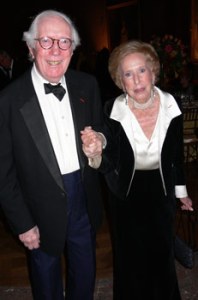 The art world considers him to be their loss. But he is a loss to music, too. I always considered it a sort of interdisciplinary imprimatur on musical events — events of the most diverse natures — to see him and the radiant Rosamund Bernier in the audience. And, ratifying their importance for music, both Copland and Bernstein adorned their effulgent wedding at Philip Johnson’s Glass House.
The New York Times said of his writings:
“Mr. Russell was an appreciator who liked to share his enthusiasms; as a consequence some readers and fellow critics found him too genteel.”
“I do not see my role as primarily punitive,” he wrote in Reading Russell. “There are artists whose work I dread to see yet again, dance-dramas that in my view have set back the American psyche several hundred years, composers whose names drive me from the concert hall, authors whose books I shall never willingly reopen. But it has never seemed to me much of an ambition to go though life snarling and spewing.”
The Possibilities Are Without Limit
August 18, 2008
George Steel to Lead the Dallas Opera
August 12, 2008
 It is announced today that George Steel, executive director of Columbia University’s Miller Theatre, long a darling of the New York press, and aforementioned here and here, is going to Dallas. He’ll be the new general director of the Dallas Opera — a company eminent in the history of the lyric art.
Read the rest of this entry »
 RogerEvansOnline.com