Now and Then
March 14, 2010

The revolution that the Internet has brought, and is bringing, can both horrify and exhilarate — or, more likely, do both at once in different proportions in different people. As an important new article points out, the Internet is eminently about Now while also offering unprecedented facilities for harnessing the lessons of history.
This somehow reminds me of the burden/opportunity of being a musician today. Our ancestors, right up until quite recent times, were interested exclusively in the music of their time and place. The Now, in fact. These days, musicians need just as much of the past’s traditional Now — at least as incarnate in fundamental skills and the ability to produce well-formed music in the present — while at the same time being burdened/endowed with a very extensive and conscious past. The degree to which this is true is unprecedented. In “classical” music, at least, composers and performers are almost universally informed by the past far more than ever before.
It is a commonplace of automatic-pilot journalism that Schoenberg broke with the past. But it is also true that he did so furnished with a knowledge of traditional harmony and counterpoint that may have been all but unequaled in the musical culture in which he was rampant. Composers now have to be prepared to have their work compared with everything from the phasmagoric twelfth-century polyphony of Notre-Dame de Paris to the sometimes similarly acrid effusions of Radiohead. And a modern keyboard performer may need to be able to play Ligeti etudes one night and Baroque continuo from a figured bass the next — while using the very latest digital technology to convey to her students something of the background of virginal-playing in the Elizabethan court one semester and of the Parisian experiments of Messiaen the next. The same knowledge of harmony will be needed for a thorough treatment of all of these.
The more I think about it, the more I suspect that the well-prepared modern musician may be of all people the most readily-naturalized citizen of that global cyberworld that is now here, and is to come.
Mucho más allá
March 9, 2010

It’s not just El Sistema in Venezuela and Dudamel in Los Angeles — huge as those phenomena are. Latin America’s influence on international classical music seems to be a bigger story every day. Here are two videos about some of Miguel del Aguila’s fascinating chamber music. The first is a one-minute clip:
And the second goes a little deeper:


Somewhere Mendelssohn Smiles
March 8, 2010
A boy of six plays with remarkably mature phrasing:
And a severely handicapped man has a heartfelt fugue that must get out despite all barriers:
What limitations are holding us back from making music today?
Tips of the hat to Jeffrey Biegel and Stephen Best
Add to: Facebook | Digg | Del.icio.us | Stumbleupon | Reddit | Blinklist | Twitter | Technorati | Yahoo Buzz | Newsvine
Bodies Infused With Music
March 5, 2010

I’m just been listening to a marvelous BBC Radio documentary about Diagalev’s Ballets Russes. In it, one of the surviving dancers talks about how, in many of the narrative ballets, the task was just to walk across the stage. “Anybody can walk,” she says. But then she goes on to say that walking in time to the music was the least of it. That every part of the body must be invaded by the spirit of the music, that the arms, for example, must be “infused with the music.”
It strikes me that this has a lot to do with acting in opera. We hear much today about making opera dramatically viable, but almost all the talk is about bringing the values of the spoken theater to the opera stage. How is it that, in the past, opera singers were sometimes rivetingly dramatic without even the slightest resemblance to the quite distinct craft of actors in plays? I wonder if it didn’t have something to do with what the old Diagalev dancer was talking about. There is such a thing as having your whole self so possessed by the music that it will be a partner with the composer, with the orchestra, with one’s own voice, in conveying the drama — the specifically music drama that is the whole point of opera. Not, one suspects, some imitation of what goes on in the legitimate theater.
Add to: Facebook | Digg | Del.icio.us | Stumbleupon | Reddit | Blinklist | Twitter | Technorati | Yahoo Buzz | Newsvine
Happy Birthday, Father Antonio Vivaldi!
March 4, 2010

Great composers don’t always “get” other great composers. Berlioz, in his idolatry of Gluck, devalued both Lully and Handel in irrelevant comparisons to the great reformer. Stravinsky, despite a semi-comprehending admiration for Gesualdo and Pergolesi (whom his imagination tended to recast in his own image), seemed unable to imagine earlier styles of music on their own terms and famously dismissed Vivaldi by saying that “he didn’t compose 400 concertos; he composed one concerto 400 times.” Given the skewed view that once existed of the Italian Baroque and how its music had originally been played, it’s understandable that this music — which is above all “performer’s music” not “analyst’s music” — didn’t reveal its extravagant charms. The charms were not those of the Urtext generation. Goodness knows that the zillions of vinyl representations of Vivaldi’s music that Nonesuch issued in the 1960s, with performances in which provincial German orchestras sawed away rather mechanically, may not go far to explain the dizzying rise in popularity that the music of “The Red Priest” nevertheless enjoyed.
Stravinsky probably didn’t know about the many written accounts of performances of that repertory when it was new. These are replete with descriptions of passionate playing of a sort that we don’t see enough of these days, with audience reactions that often involved even the loss of emotional control. This was not the scenario at Vivaldi performances of, say, the Stuttgart Chamber Orchestra — or, for that matter, the Chamber Music Society of Lincoln Center — during the century just past.
Thus it was with a shock of recognition that I first heard the Sicilian violinist Fabio Biondi’s group Europa Galante a dozen years ago. It was more a recognition of an ideal that I had been taught in music-history seminars than of anything I had previously heard from orchestras. They have since recorded hours of Vivaldi (as well as of much other 17th- and 18th-century music proceeding from Italianate models), and I challenge anybody to miss the great individuality of content and character in these finely-limned virtuoso performances. The prolific Venetian certainly didn’t write 400 of these:
or these:
The succeeding movements of this concerto are on YouTube as well.
Europa Galante, happily, has not neglected to extend the passion to vocal music:
Add to: Facebook | Digg | Del.icio.us | Stumbleupon | Reddit | Blinklist | Twitter | Technorati | Yahoo Buzz | Newsvine

Follow along with the original manuscript of the Poet of the Piano as the peerless Krystian Zimmerman plays the Ballade No. 2.
Music, Discipline, and Love
February 28, 2010

A grateful ex-musician picks up on one of our themes in the New York Times.
Music: Do It Yourself
February 22, 2010
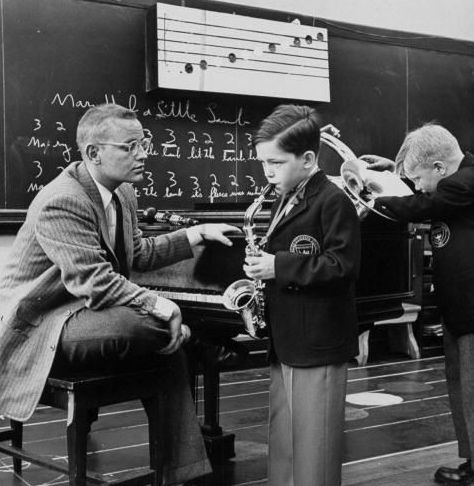
When I was a young child, some adult asked me whether or not I liked a certain piece of music. My reply: “I like it when I play it.” The questioner and the other adults in the room laughed at me, and some foolish person said how remarkably arrogant this child was to think that a certain piano piece was more pleasurable for him when he played it than when, say, Rubinstein played it.
But I was right. And I’ve never been less arrogant in my life; in fact, I’m quite sure I not only spoke honestly when I said it, but spoke in all humility. We are not arrogant about things that give us that much deep satisfaction.
In this age of iPods, with almost all recorded music easily accessed whenever we want it, wherever we are — all things I value myself — I worry that too few of us know the pleasure (and I won’t seek out here a more impressive word than pleasure, for that’s exactly what I mean) of knowing a work from the inside and making it sound with our own efforts. Even if the level of performance is inconsistent or the interpretation is incomplete, it’s still ours in a way that few other things ever can be.
And I know Rubinstein knew just what I meant.
__________________________________
Here’s a ten-year-old playing the Walt Disney Concert Hall organ. The playing is far from perfect, but I’ll bet he’s enjoying it even more than he enjoyed hearing Olivier Latry play the same instrument magnificently:
 RogerEvansOnline.com