Christus Victor
April 3, 2010
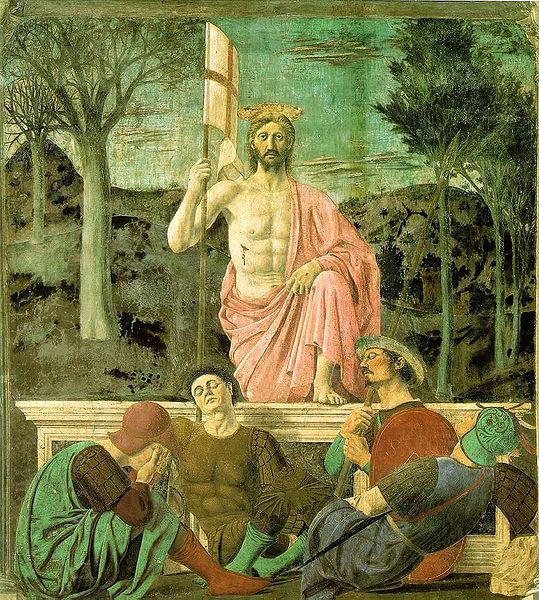
The Resurrection of Christ by Piero della Francesca (c.1420--1492)
My favorite over-the-top Edwardian Easter anthem (Stanford), on a super-dramatic medieval text (St Fulbert of Chartres).
Come, Ye Daughters, Share My Anguish
April 2, 2010

A Bach Saint Matthew Passion Webcast from The Netherlands, one of the innumerable local performances of the work this time of year — each different, with its own flavor.
Flourishing Art
March 31, 2010

Les Arts Florissants in Concert at the Leipzig Gewandhaus
The French troupe Les Arts Florissants have just left us. By us, I mean Brooklyn and anybody who could get there to hear and see their wonders. Why can’t they forsake Paris and just stay around here? What does Paris have that …? Never mind.
I’m one of those who have followed them for years. And to follow is to admire. I saw the now-historic production of Lully’s Atys that made them international stars, and if it didn’t change my whole life it certainly changed that not inconsiderable part of it that deals with the French Baroque and its tributaries. Lully, I had learned somewhere in an expensive education, was pretty thin stuff. Not as they delivered it, even as seen in this ancient sound-challenged video:
When I was in music school, a rumor went round that a guy from a few years before had run off to Paris and was intending to tell the French how to perform and appreciate music that they had themselves long neglected. There was lots of chuckling that Bill Christie was heading for a tumble. I, being too ignorant even to have an opinion, just heard all this and stored it away. I had heard a very fine harpsichord recital by him when he came back to collect a doctorate, but a recital does not a whole new operatic culture make.
But his Atys years later was revelatory, as have been many of the things I’ve seen and heard from his gang since. They did at least the second Dido and Aeneas that they’ve done in New York on this last visit, and this clip from the most famous bit should remove any doubt that modern production values and Baroque musical drama can coexist fruitfully:
We see Dido die and feel as centuries have felt at her fate, while hearing some of the most sublime music ever devised.
Why can’t more opera companies be so innovative — while also being not so much preservative as revivifying? I went to a rehearsal of their Fairy Queen last Friday. Mind you, this rehearsal was four days after the first performance of the run. Can you imagine the Met doing such a thing? Well, they simply opened the doors, charged people $20 to watch a 45-minute spot-check (i.e., the conductor giving “notes”) of how the production was going, with some commentary addressed to the audience. I, for one, did not feel in the least cheated by the brevity or the opportunism of the affair (photo below of the orchestra during the event). It was really quite wonderful, and one felt connected with an important enterprise. This is what I call intelligent marketing. Besides, at the “Baroque Cabaret” that they gave the weekend before, a BAM official had said that “When we do an opera series, we lose more money by intermission than we do in our whole theater season.” Glad to help, ma’am.

This is What Total Commitment Looks Like
March 26, 2010
And sounds like. The great Magda Olivero turned 100 this week.
A Composer Whose Time Has Come
March 23, 2010
 This from my friend Paul Desenne in Caracas.
Ten Books
March 21, 2010

In his own blog, Tyler Cowen has listed the ten books that have influenced him most and asked other bloggers to do the same. He is also aggregating other people’s lists. I choose to take the seat-of-the-pants approach and am writing the first ten that I think of rather than poring over this. Not the ones that I think I should say or the ones that necessarily would most influence me today.
Richard Adams: Watership Down
George Eliot: Middlemarch
James Alison: The Joy of Being Wrong
C.S. Lewis: That Hideous Strength
Anthony Trollope: Autobiography
Bruno Montsaingeon: Mademoiselle: Conversations with Nadia Boulanger
Robert Hughes: Barcelona
Oscar Wilde: The Importance of Being Earnest
James Boswell: The Life of Samuel Johnson, Ll.D.
Dorothy Parker: Complete Short Stories
UPDATE: Looking this over one day later, I’m fairly shocked by one fact: Dorothy Parker is the only American writer in the list.
ANOTHER UPDATE: I’ve been asked why the Bible is not on my list. Because I assume that practically everyone in our society has been influenced, if not most influenced, by that book or gathering of separate books. If you ask me my favorite drinks, should I list water? Or must breathing figure in my list of favorite activities? Even the person in our culture most adverse to its teachings is mightily “impacted,” as the cant goes, by that volume.
Opened, and Well Opened
March 19, 2010
 It’s a great pleasure to be able to say that the important spring season of the New York City Opera opened last night not only with a French operetta perfect of its kind, but with a general élan about the place that is greatly inspiriting for the many who have missed the company’s presence near the center of the city’s cultural life. The impression persists from the fall season — and is, if anything, augmented — that this company has a new lease on life.
The largely Gallic cast, and entirely Gallic flavor, of this very well-integrated mounting of L’Étoile by Emmanuel Chabrier (about whom a little more tomorrow) is very fine indeed, but to a New Yorker a special gratification must be a more residential element: the crack orchestra and a chorus that even approached the supererogatory Broadway level of choreographic gameness. For an evening of lighthearted, stylish entertainment, this show — which runs till April Fool’s Day — is a rare treat.
“Musicians’ Brains Are Different from Other Peoples'”
March 16, 2010

A Barcelona neuroscientist has turned her attention from Down Syndrome and cognitive disorders to the brains that musicians navigate their world with. If you’re a musician, the non-musicians around you who think your mind works differently from theirs are right. By the same token, you are on solid ground if you sometimes find others’ ways of thinking somehow organically different from your own. The following is translated on the fly from a new interview in El Periódico de Catalunya:
– Why does music exist?
“Darwin didn’t figure out why humans spend so much effort on an activity with no clear biological function, but in the brain there is an impulse that encourages us to listen to and produce music.”– My drive to produce reaches no further than tapping my foot.
“The brain of non-musicians reacts with the right hemisphere, the more emotional one, which registers the melodic contour. But the left, more analytical hemisphere is activated in musicians. They are preoccupied with the musical syntax, the language.”– Do they perceive it in a different way?
“You could say that musicians have a brain unlike non-musicians. There are also differences between composers and improvisors.”– What makes them different?
“Many conductors and composers have auditory imagery. You can ask them to play without sound and execute all the motions. It is as if they hear with the mind. Also tonal memory, which allows us to remember the sequences of tones.”– Music is in my head!
“There are separate regions of the brain that specialize in recognizing a tone or a melody. Some can always tell a C is a C, thanks to what is called ‘absolute pitch.’ People who have absolute pitch display an asymmetry in the planum temporale, an area of the brain that deals with language.”– And the hands of virtuosos?
“Music sets off distinct and complex skills in the brain. Violinists correct the position of their hands depending on what they hear. Audiomotor adjustment is exact.”– Genes are everything!
“Heredity is a factor. 5% of people are tone-deaf, and 15% don’t sing. Entire families! But don’t be fooled: while there’s something that’s innate, environment is crucial.”– At this altitude she tells me this [or can a reader provide a better translation?]!
“This is shown by studies of twins reared apart. We also know that listening to Mozart improves learning.”
Thanks to José Franch Ballester for pointing out the original article.
 RogerEvansOnline.com