A Window on Sills
May 26, 2010
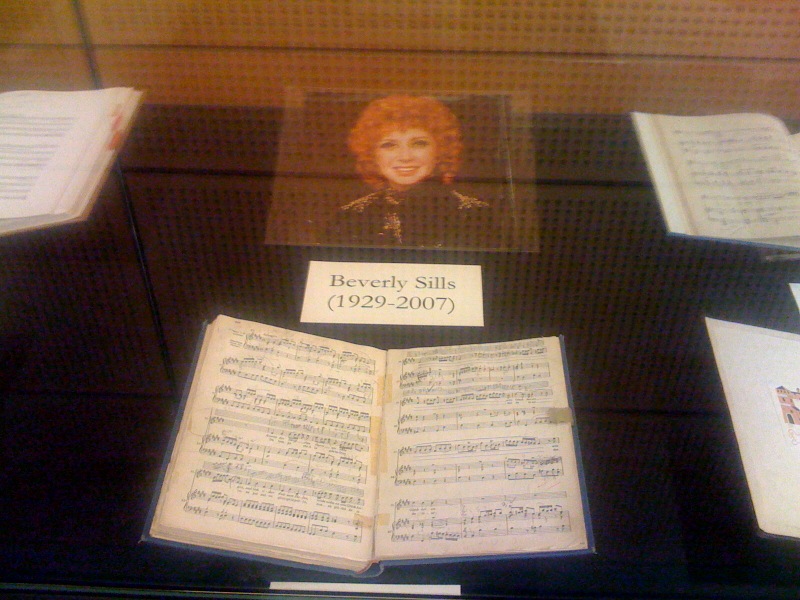
The wonderful Music Research Division of the New York Public Library at Lincoln Center (where I’m spending a great portion of my time lately) has a very good display in honor of Beverly Sills, whose birthday came yesterday. It consists of working piano scores for some of her roles. They are of course worn, much marked-up, and remarkably evocative.
Here is a view of her score for Handel’s Giulio Cesare, her performance in which first made her a household word. She has added a staff for her elaborate ornaments and included dynamic and articulation markings:

I was particularly interested in seeing her score for her celebrated appearances as Queen Elizabeth in Donizetti’s Roberto Devereux, a memorable portrayal that I’m happy to say I saw several times. In addition to the kinds of musical markings that we see in the Handel, she here includes notes for stage movements as well:
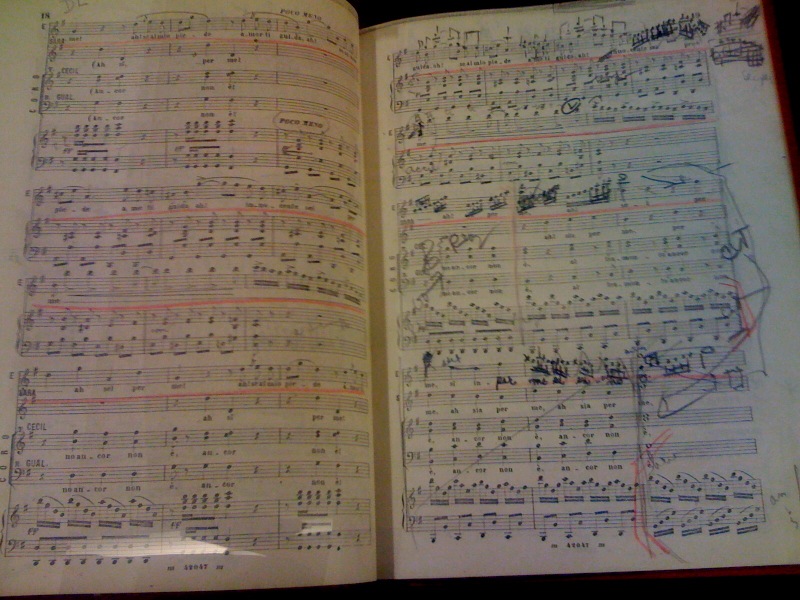
And here is her bookplate:

Mental-Health Break
May 18, 2010
I’m sorry I didn’t hear him when he was working on the much more extensive instrument at Westminster Abbey under my old friend James O’Donnell. But this is sublime, no?
Je suis content.
May 18, 2010
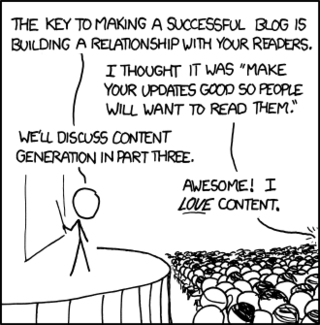
Hat-tip to XKCD.
Overheard in Passing
May 15, 2010

A young child says to his mother, “Mom, when I grow up I think I’d like to be a musician.”
She replies, “Well honey, you know you can’t do both.
Hat-tip to Justin Bischof
Now for Some Good News
May 14, 2010

After yesterday’s meme-warning, it seems important to illustrate that the Web is capable of extraordinary flights of poetry as well.
The Danger of Becoming an Online Meme-Magnet
May 13, 2010

A large public is daily at a further remove from the literary temper of a Martin Amis who could refuse to read 1984 because Orwell used the worn expression “ruggedly handsome features” on the first page. The editor of The Onion — of all people well-placed to suvey the Zeitgeist (if that word hasn’t itself become a cliché in English) — attacks the meme-menace with a will.
Dueling Organs
May 7, 2010
Another highly effective example of two Italian organs, and two players, facing off:
Johann Pachelbel: Partita on “Was Gott tut, das ist wohlgetan”
A Problem With Free Concerts?
May 5, 2010
Baba Shiv, a neuroeconomist at Stanford, supplied a group of people with Sobe Adrenaline Rush, an “energy” drink that was supposed to make them feel more alert and energetic. (The drink contained a potent brew of sugar and caffeine which, the bottle promised, would impart “superior functionality”). Some participants paid full price for the drinks, while others were offered a discount. The participants were then asked to solve a series of word puzzles. Shiv found that people who paid discounted prices consistently solved about thirty percent fewer puzzles than the people who paid full price for the drinks. The subjects were convinced that the stuff on sale was much less potent, even though all the drinks were identical.
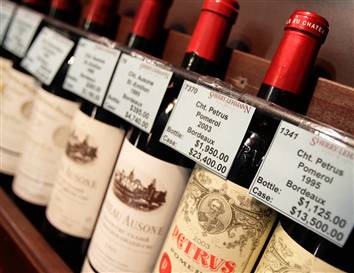
The same article — which doesn’t intend to say anything about music — goes on to a familiar kind of observation about wine-connoisseurship:
It’s pretty clear that we expect more expensive wines to taste better. (This expectation is visible in an fMRI machine.) But it’s also clear that, at least for amateurs, this expectation is mostly false: when you give people bottles of wine without any price information, there is no correlation between the cost of the wine and its subjective ratings. A $8 bottle is just as enjoyable as an $80 one.
One thing I wonder, though: is it all about what I personally am paying, or is it more about theoretical value? If I’m given a free ticket to a gala, do I nevertheless enjoy it more for knowing that other people are paying a thousand bucks? Did the people who got the energy-drink discount know that they were getting a special deal? This seems to me a crucial factor.
Another wrinkle: money may not be the only marker of exclusivity that operates in the enjoyment of music. The late Sir George Guest told me that, when he took over the choir of St. John’s College, Cambridge, even their developing excellence didn’t bring an audience for anything they did. Everybody went to KIng’s College down the street and ignored St. John’s. He then had a shrewd idea. He advertised their Advent Carol Service as involving “Admission by Ticket Only, to be Obtained Gratis at the Porter’s Lodge.” The college was not only besieged by the hordes wanting to get in, but the event provided a popular annual broadcast for the BBC. There were many other factors that made the choir deservedly world-famous, but Sir George was convinced that the initial leg-up for them came from that innocent ploy.
 RogerEvansOnline.com