Today we observe an anniversary that, among other things, celebrates a great piece of writing.
Thomas Jefferson, whose mother was born in London, and whose ties with England were strong, nevertheless wrote these later-excised words of both recrimination and longing with respect to the British people in his draft of the Declaration of Independence:
… and when occasions have been given them, by the regular course of their laws, of removing from their councils the disturbers of our harmony, they have by their free election re-established them in power. At this very time too they are permitting their chief magistrate to send over not only soldiers of our common blood, but Scotch and foreign mercenaries to invade and deluge us in blood. These facts have given the last stab to agonizing affection, and manly spirit bids us to renounce forever these unfeeling brethren. We must endeavor to forget our former love for them, and to hold them as we hold the rest of mankind, enemies in war, in peace friends. We might have been a free and great people together; but a communication of grandeur and of freedom it seems is below their dignity. Be it so, since they will have it; the road to glory and happiness is open to us too; we will climb it in a separate state, and acquiesce in the necessity which pronounces our everlasting Adieu!
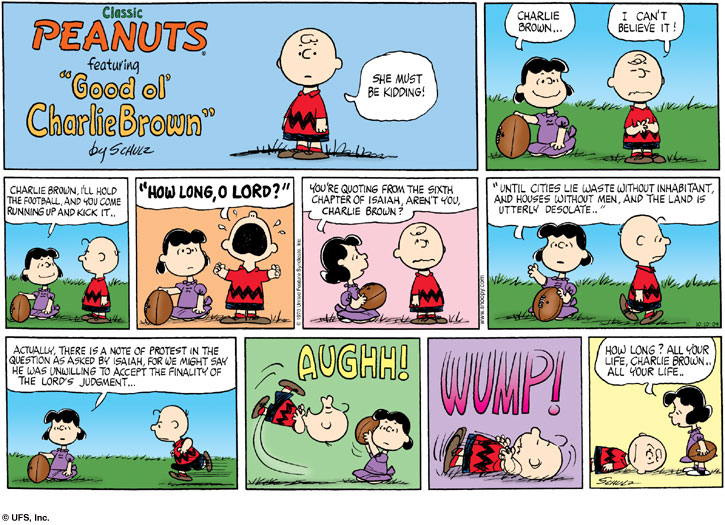
WUMP!
July 3, 2010
I want — I really want — to respect (even like) the current fiction that we’re told is of high literary quality. But those in the know just aren’t helping me at all. My heart leaps up when I hear of a writer who is turning out treasurable sentences. Then I feel like Charlie Brown in his encounters with Lucy and the football when I read the promises of a review like this, and then come down to earth with a thud when reading the sample of supposed greatness.
To me this reads like one of those entries into parody contests, such the annual Bulwer-Lytton Fiction Contest:
Hollows from the fingers of Aibagawa Orito are indented in her ripe gift, and he places his own fingers there, holds the fruit under his nostrils, inhales its gritty sweetness, and rolls its rotundity along his cracked lips. I regret my confession, he thinks, yet what choice did I have? He eclipses the sun with her persimmon: the planet glows orange like a jack-o’-lantern. There is a dusting around its woody black cap and stem. Lacking a knife or spoon, he takes a nip of waxy skin between his incisors and tears; juice oozes from the gash; he licks the sweet smears and sucks out a dribbling gobbet of threaded flesh and holds it gently, gently, against the roof of his mouth, where the pulp disintegrates into fermented jasmine, oily cinnamon, perfumed melon, melted damson . . . and in its heart he finds 10 or 15 flat stones, brown as Asian eyes and the same shape. The sun is gone now, cicadas fall silent, lilacs and turquoises dim and thin into grays and darker grays.
Here’s my high-fallutin’ critical aperçu on that one:
Yikes!
I will only add that I LOLed (to use a technical term) at “the planet glows orange like a jack-o’-lantern.” Heaven help us if this is what our masters consider even decent writing.
O Dowland, Here is Thy Sting
July 2, 2010
At first being somewhat put off by a review in the New York Times in which a classical-music reviewer gave primacy to the non-singing, non-playing performers, I soon had reason to be grateful that it steered me to Sting’s performances of songs by John Dowland. I think Sting’s performance of this song has almost everything the poem and the music require:
And here is a song in which a polyphonic version of the later verses comes from the one man singing a quartet with himself:
(And note, on the table, what looks like an authentic Renaissance part-book with the vocal parts printed to be read by people around a table.)
Remember Footnotes?
June 27, 2010

If it seems that there are more hit-and-run posts than usual this summer, and fewer longer expositions, it’s because there are. I’m deep in another medium — a book that needs to be finished by the end of August — and in many ways it’s refreshing to be back in the old mode, where revision and second-thoughts take place before publication. But you know what I really, really miss? Hyperlinks. Writing without the allusive immediacy that links give seems somehow artificial now. So thoroughly have I internalized the newer ways of communicating.
Words: to Inform or Mystify
June 25, 2010

How ironic — and touching — that a person with a disease that is gradually taking away his main skill can still advocate so effectively for the very ability he’s losing.
Ceiling of the Main Reading Room
June 23, 2010

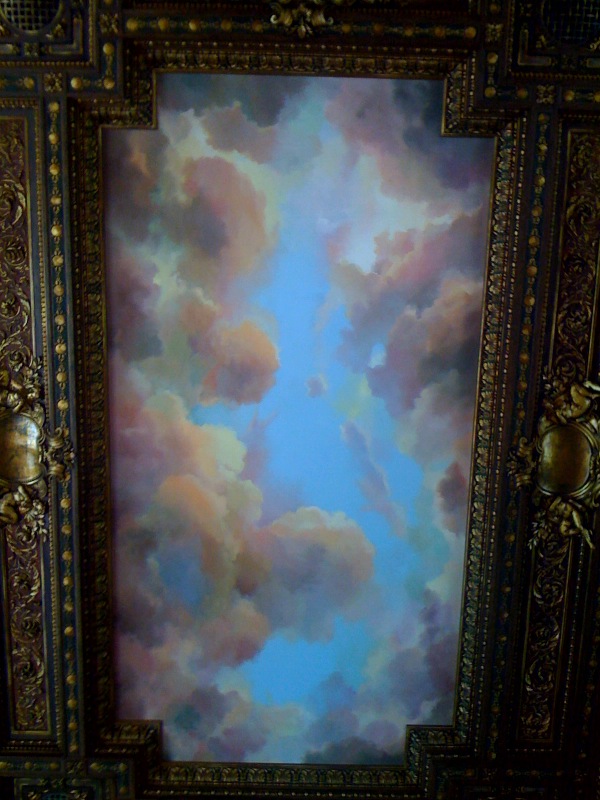
There are a lot worse places to be spending a big chunk of the summer than in the New York Public Library.
The feast day of the boy saint Aloysius Gonzaga is a great time to single out juvenile virtue:
(The title of this post is a quote from Margaret Juntwait of the Metropolitan Opera — yes, that Margaret Junwait — who led me to this video.)
 RogerEvansOnline.com