Haste vs Waste
August 14, 2011

Michael Agger sounds like a great guy. But in analyzing the question of how fast writers can/should/must write, he really needs to consider taking his time. Not only his own stuff but some of what he cites could use a little more thinking-through. For example, while he carefully gives a link to one of Christopher Hitchens’s daily feats of productivity, when he comes to Trollope (than whose creative process there is probably no more exhaustively detailed account in existence, thanks to his own writerly tell-all autobiography), he can do no better than quote the late William F. Buckley Jr. (whom he pictures writing in a cab, when the man gave us, in his own autobiographical writings, excruciating details about his requirements to have an available custom-built limousine).
But worse comes with an authority he cites: one who contrasts two creative styles, one supposedly belonging to Beethoven, who is characterized by going immediately to paper to “outline” a composition). This when the basic principle of Beethoven’s way of being is the extensive sketch books in which, for months or years, he would experiment with the basic thematic building-blocks of a future composition before beginning to confect it.
Why do I cite an article as though only to criticize it? Because the subject is of interest, and Mr. Aggers thinking is, too. He might tarry for the facts a bit longer next time, though.
But then there is that deadline.
“Composition”
August 13, 2011
It’s a word that can have many different applications, but they all marshal details in the service of a structure:
The other two videos from the same trip can be seen here.
Improvisation, cont.
July 28, 2011

If you’re as interested in the art of musical improvisation as I am, you may enjoy this link to something I just posted at Thornwillow.
Norway: Coming Together
July 28, 2011

Friends and loved ones gather at the Oslo cathedral to mourn 93 victims killed in twin terror attacks from a bombing in downtown Oslo and a mass shooting on Utoya island on July 24, 2011 in Oslo, Norway. By Paula Bronstein/Getty Images
The Musical Equivalent of Fusion Cuisine
July 26, 2011
Dave Brubeck gave a solo to his drummer; here it goes to a tabla:
(Tip of the hat to Gary Bloore)
Stonecutters Are Paid By the Word
July 20, 2011

I believe we can build a better world. Of course it’ll take a lot of rock, water, and dirt. Also not sure where to put it.
That little piece of wit, ladies and gentlemen, was conveyed by Twitter. There has been a lot said on the subject of decline of language lately, and much of what was said laid the responsibility on newer ways of communicating. Twitter has taken a beating in some quarters for its confining each communication to 144 characters, thus limiting discourse in a severe way; but an effusion like the one above shows that carefully chosen words can convey some degree of subtlety in even fewer characters.
Traditional correspondence has always had an honored place for economy of language. Even before the rise of telegraph and cables with their by-the-word charges, there were pressing reasons to think carefully about leanness of expression. (P.G. Wodehouse delightfully lampoons the idiotic telegrams of young men endowed with more dollars than sense.) Consider the note left on calling cards. The scribbled abbreviation P.P.C., for pour prendre congé, was once used in leaving one’s card before leaving town; and there were cognate abbreviations for calls of condolence (pour condoler), congratulation (pour feliciter), and thanks (pour remercier).
Invitations are still a locus classicus of carefully selected words — of course reflected in our retaining the handy abbreviation R.S.V.P. And the care with which we write our more ceremonious, obligatorily handwritten messages make them in some ways the higher-born relatives of the “tweet.”
In his BBC series English Delight, Stephen Fry has a characteristically brilliant 30-minute commentary on virtues of brevity that are as valid for rowdy new media as for the more venerable ones. It can be heard at this link for five more days.
So it’s not yet time to scrawl R.I.P. on good English yet.
*********
Please note: Some will have noticed, I hope, that I have long had a link, at the bottom of the page, to the wonderful company called Thornwillow. I am now also blogging for their site and will sometimes link to something there. This cross-post is the last time I will duplicate (or cross-post, as we say these days) between the sites, but this one will serve as a notification of my split blogging activities.
Don’t Curse Cursive
July 18, 2011
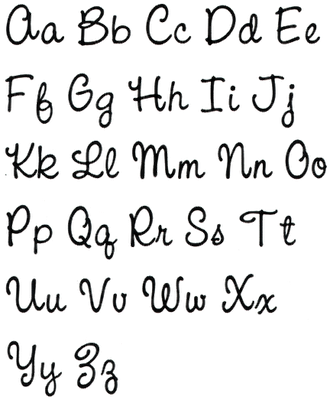
Are young brains being damaged because they are not being taught cursive script? There are implications that I hadn’t thought of before.
A Musical Life in Eventful Times
July 18, 2011

The composer with his wife and Victoria de los Angeles
In preparation for the centenary of his birth next year, there is a new trilingual site for the brilliant Catalan composer Xavier Montsalvatge. You’ll be seeing a lot more about the celebration in this space.
 RogerEvansOnline.com