A Little Carried Away?
December 13, 2011

“An opera is far more real than real life to me … I wish that life was an opera. I should like to live in one.” — Robert Louis Stevenson
At the very least I’d choose my role very carefully.
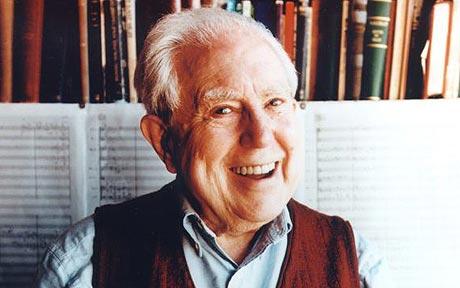
ELLIOTT CARTER TURNS 103 (STILL COMPOSING)
December 8, 2011
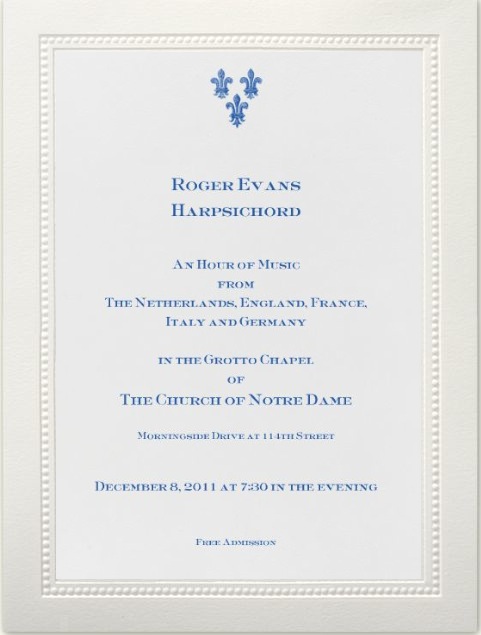
New York Recital, December 8
December 7, 2011

My harpsichord program for tomorrow night at 7:30 in the Grotto Chapel of the Church of Notre Dame, Morningside Drive at 114th Street in Manhattan:
William Byrd (1549–1623)
Galliard (FVB 164)
Fantasia (FVB 52)
Alman (FVB 163)
Jan Pieterszoon Sweelinck (1562–1621)
Toccata (Mixolydian)
Girolamo Frescobaldi (1583–1643)
Canzona seconda (from Il secondo libro)
Bernardo Pasquini (1637–1710)
Partite diverse di Folia
Louis-Claude Daquin (1694–1772)
Rondeau: Le Coucou
Louis Couperin (c. 1626–1661)
Chaconne in G Minor
François Couperin (1668–1733)
Le Troisième Acte
(from Les Fastes de la grande et ancienne Menestrandise)
Johann Pachelbel (1653–1706)
Ciacona in F Minor
Dietrich Buxtehude (c.1637–1707)
Canzona in G, BuxWV 170
J.S. Bach (1685–1750)
Toccata in D Minor, BWV 913
Domenico Scarlatti (1685–1757)
Sonata in D Minor (K. 517)
Silk Purse (formerly Sow’s Ear)
December 1, 2011
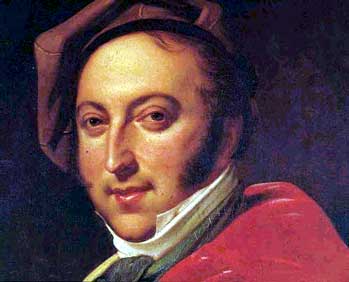
“I had an awful seconda donna for my opera, Ciro in Babilonia. Besides being hideously ugly, she had the most wretched voice. After trying it with the utmost care I discovered that she possessed one single good note. So I wrote an aria for her in which she had nothing but this note to sing. All the rest I put into the orchestra, and as it was liked and applauded, my singer of the one note was delighted with her triumph.” — Gioachino Rossini
(Hat-tip to an anonymous poster on Parterre.com.)
Making Music: A Basic Human Right — for Three-Year-Olds
November 30, 2011
An Australian guy makes the case:
The 2012 Grawemeyer Award in Context
November 29, 2011

As a young horn virtuoso in Finland, Esa-Pekka Salonen decided that his true path must be that of a composer. In an interview back in the 1990s, he told me that he quickly became dissatisfied with performances that his compositions were receiving; and, having laid down his horn permanently, he took up the baton as a way of making sure that his works were performed to his own satisfaction. The unbidden success that he found as a conductor led, without his intending it, to the stratospheric heights in that field that we all know about.
Now, on receiving the most prestigious composition laurel there is, he makes this interesting statement (via Twitter):
“The beautiful thing about our kind of music (unfortunately called classical) is continuity: never felt more grateful to my mentors & heroes.”
I think that gets it about right. Not that other kinds of music don’t have continuity; but is it not true that the “we” he is talking about feel a more conscious, almost measurable, connection with even our most remote documented forebears? Except in the most extreme, purposely disconnected individual musicians (whose chances of communication with a public are scant), we exist in light of a tradition. Even the most innovative developments have their effect against an inescapable backdrop — a backdrop that carries with it the joys, sorrows, aspirations, despair, consolations, misery, frolics, and dirges of countless generations.
And this should make us very happy.
A Recital
November 28, 2011
R.I.P. Montserrat Figueras
November 23, 2011
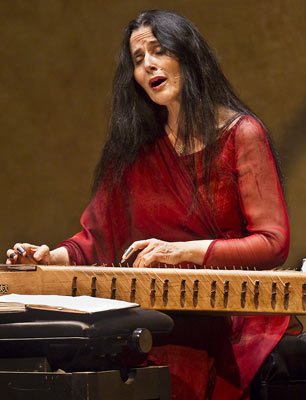
I’ll never forget the first time I heard her, with her husband Jordi Savall, in Barcelona. The news that she has died is shocking, but one consolation is that she must be one of the most-recorded singers of our time. Here is the first report of her death (in Catalan), and Alex Ross has posted this in her memory:
 RogerEvansOnline.com