Musician as Revolutionary
February 7, 2012

As the music world still absorbs the sobering fact of Gustav Leonhardt’s death, many have contributed to the widespread meditation on what he will continue to give us through his example. I have been late to come upon this extraordinarily graceful tribute to him that contains much good sense.
Thanks to Clavecin en France for leading me to that text.
Opera Shutdown in Barcelona
February 2, 2012
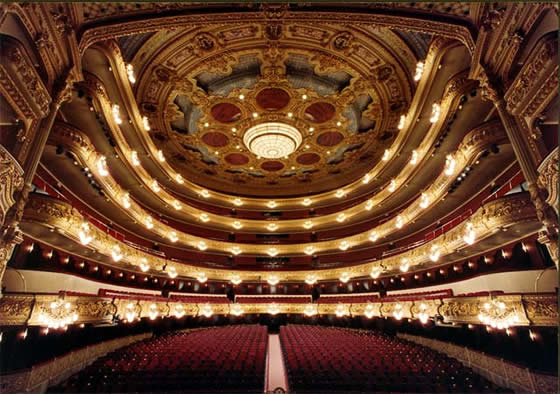
After having painted here a rosy scenario for the opera houses in Spain two years ago despite a precipitous economic downturn, it is dispiriting to see that the Gran Teatre del Liceu in Barcelona is being forced to shut down for two months. Distressing as this is in general, I’m relieved to see that three performances, in May, remain for Xavier Montsalvatge’s “magic opera” El gato con botas, in commemoration of the centenary of the composer’s birth and the tenth anniversary of his death.
The economy is, of course, hitting everybody and everything hard, but considering the difficult times during which the Liceu has managed to stay open in the last century, one hopes a solution can be found for this major company that plays in the second-largest opera house in Europe.
The Garden of Good and Evil
February 2, 2012
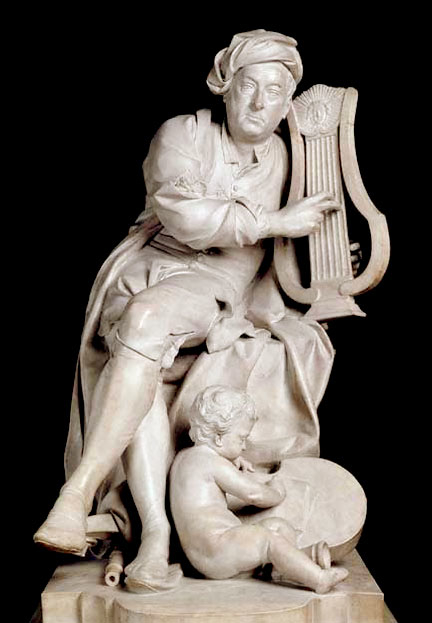
Handel, unbewigged and otherwise in accord with the (un)dress code of the 18th-century Vauxhall Gardens
One of the obituaries of Gustav Leonhardt last month cited his lack of enthusiasm for one of the Baroque greats, George Frideric Handel. In explanation for such dissent from the prevailing opinion among musicians, Leonhardt cited the fact that Handel was too much controlled by public taste. One wonders if the famously upright Dutchman had more in mind than musical style, for one of the composer’s haunts — one that was part and parcel with his reputation among and interaction with the public of his time — was the pleasure park at London’s Vauxhall, where gustatory and even sexual pleasures could be mixed with some of the best public music-making of the day. While such a scene ill accords with the image most of us have of the composer of Messiah, it is an undeniable feature of Handel’s career and one that has led to a fascinating book exploring the ins and outs, the bright lights and (literal) dark passages that made for the long fame of the Vauxhall Gardens. Readers active in, or simply interested in, large-scale production of entertainment or the practicalities of what is nowadays called “the hospitality industry” could still learn something from the vast scale and renowned efficiency of those Gardens (where a sudden order for four hundred roast chickens could suddenly arrive in the kitchens).
The best treasures in the account, however, await the reader interested in cultural history and the history of manners. The Yale University Press published it, and The Times Literary Supplement reviews it.
Worth a Thousand Words
January 31, 2012

Tip of the hat to Christopher Russell
Calling New Yorkers Interested in Liturgical Music
January 30, 2012

If you (or someone you know) has an interest in making music in the context of liturgy, here’s an opportunity: beginning February 1, I will be assuming the duties of Director of Music at the Church of Notre Dame, on Morningside Drive at West 114th Street (one block from the Columbia University campus, around the corner from St. John the Divine, and next door to St. Luke’s Hospital) and the Columbia University Catholic Ministry.
Both the church and the chapel have enviable music histories. The church has some of the most thrilling acoustics for singing that I’ve ever encountered, a distinguished 1924 organ by Casavant Frères, and a music library of over 1,400 items. The library and the musical tradition of the parish are especially rich in Renaissance polyphony, but the repertory will also be inclusive of earlier and later eras, as well. There is a polyphonic choir that sings on Sundays at 11:30 a.m., but there are also schola opportunities at 5:30 p.m. on Saturdays as well as at 8:30 a.m. and 5:30 p.m. on Sundays. That’s at the church itself. I’ll also be providing music for the 5 p.m. Sunday Mass in St. Paul’s Chapel of Columbia University. That has equally fabulous acoustics and one of New York’s most important organs.
The choir of Notre Dame is a chamber group that meets for rehearsal on Wednesday evenings. The choir at St. Paul’s Chapel rehearses at 4 p.m. on Sunday afternoons.
The clergy there are remarkable. We’re lucky to have three brilliant, and very different, priests who will give us support in creating beautiful music and who have already made amazing — and, frankly, unexpected — contributions to my own life. (I’ve been helping out with the music there for some time and have become very attached to the popular — and intense! — meditation sessions held on Monday evenings in the grotto chapel.)
There are also creative opportunities for instrumentalists. These includes organists, but other instruments will be used in imaginative ways, as well, so share with me any ideas or ambitions you may have. And, as I said, tell your friends who are looking for this kind of outlet as well. (One guy who has been helping out lately, and is a chant enthusiast and adept, is also a major lute-player. That’s going to sound great under the dome of Notre Dame!)
So feel free to be in touch: roger@aya.yale.edu or 202-577-5758!
Roger
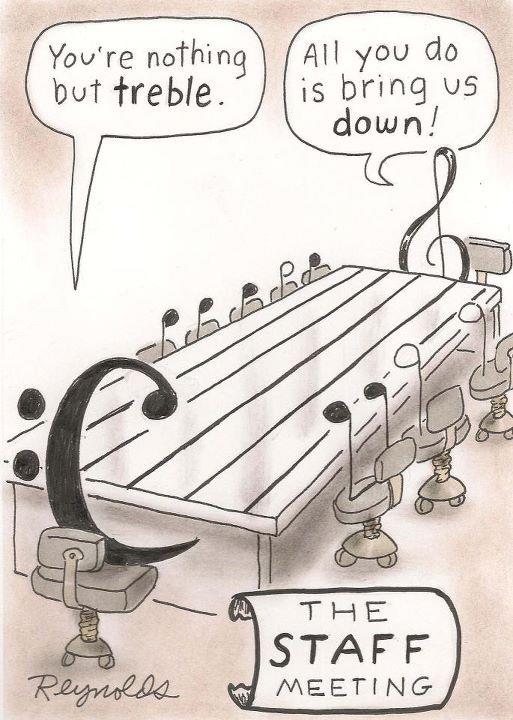
The Staff Meeting
January 26, 2012
A Report on the Funeral for Gustav Leonhardt
January 25, 2012
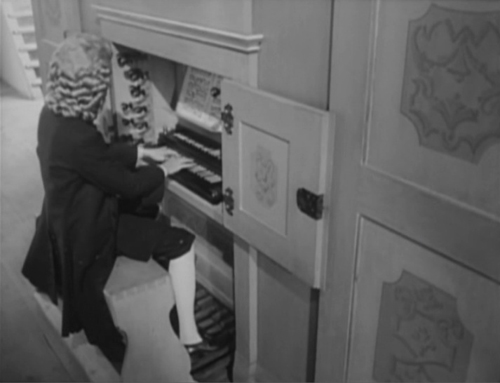
Leonhardt playing the organ in the film, THE CHRONICLE OF ANNA MAGDALENA BACH (available on Netflix)
Though I had hoped to hear or see the proceedings online, I heartily admire the fact that cameras and recording equipment were not allowed at the funeral. Too often one-of-a-kind occasions like this one are treated primarily as something to be preserved and publicized rather than lived in the moment. I should have known that Mr. Leonhardt would have arranged things as they were.
A reader who was at the obsequies has very kindly sent me a link to his own description of what must have been an unforgettable event. Bert Shudi has also posted these valuable reflections on the master’s career.
UPDATE: The blogger who had provided the account of the funeral has seen fit to remove it. I apologize for any inconvenience. Herewith, however, the link to a stupendous video of a live performance of Bach’s funeral cantata by Leonhardt, with other star performers that you may recognize, in Amsterdam’s Waalsekerk. The German text and English translation can be found here. This inspiring music, lovingly recreated at the hands of Gustav Leonhardt seems as fitting memorial as any musician could hope for.
Anniversaries, Birthdays, and Gratitude
January 20, 2012

William Rieder
With this post four years ago, RogerEvansOnline was born. Many thanks to all of you who have followed it all that time or any part thereof. But I want to do something far more important than to congratulate myself on the anniversary of the site or of my own birth.
The first week or so of posts during that January were typed at the beach house of my dear friend of long standing, William Rieder. At that point he had already been battling — no, warring with — cancer. There had been so many battles won and many more to come. Bill died a few weeks ago, just before Christmas, to the great grief of his many friends, and every anniversary of this blog, so long as it lasts, will be for me a day of thanksgiving for a man of many gifts and accomplishments, a legendary curator of the period rooms at the Metropolitan Museum, and an incomparable friend.
 RogerEvansOnline.com